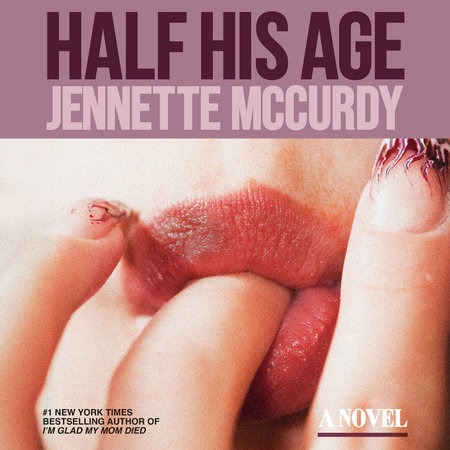
‘Half His Age’ is only half the page-turner it could have been
Jennette McCurdy’s debut novel underwhelms in idea and execution.
For fans of:
“My Year of Rest and Relaxation,” “A Certain Hunger”
1
By VERA WANG

Jennette McCurdy’s debut novel underwhelms in idea and execution.
“My Year of Rest and Relaxation,” “A Certain Hunger”
1
Content warning: This article contains references to rape and violence.
The simplest solution is almost always the best — Occam’s Razor. Except when it comes to abuse, it’s not.
Jennette McCurdy’s first novel, “Half His Age,” published Jan. 20, arrived with considerable anticipation following the bestselling release of her vulnerable 2022 memoir, “I’m Glad My Mom Died.”
This fictional story of 17-year-old Waldo and her alarmingly perverse relationship with her married schoolteacher tackles difficult subject matter, such as pedophilia and a troubled mother-daughter dynamic — issues clearly resonant with McCurdy’s own experiences with predatory adults.
While the book demonstrates flashes of genuine, lucid insight and shows McCurdy’s willingness to broach uncomfortable thematic territory, it ultimately struggles to find a stable footing — wavering between candid honesty, clear messaging and literary boldness.
For better or worse, the premise is straightforward: Waldo, a disaffected, snarky high-schooler frustrated by her emotionally neglectful mother and immature peers, develops an obsessive infatuation with Mr. Korgy, her middle-aged creative writing teacher.
A central problem, however, is one of voice, with the narration teetering uncomfortably between immature teenage edginess and adult retrospection.
While some frank observations land with humor — “I study Mr. Korgy’s thinning hair and nose pores” — others feel half-baked, relying too heavily on simple “I [verb]” constructions.
However, Waldo’s sensible analysis of Mr. Korgy’s emotional manipulation — her ability to instantly parse phrases such as “you’re usually so understanding” or dissect careful word choices of “break” versus “breakup” — doesn’t ring true for a 17-year-old in the midst of trauma.
Her even-keeled interjections about this bizarre situation don’t give the impression of being the conclusions of a teenager, no matter how introspective. It breaks the story’s immersion and creates a tonal dissonance that remains unresolved.
McCurdy seems to want both to show Waldo’s devastating immaturity and portray her as empowered and cognisant — an impossible dichotomy.
The result reads less like fully realised fiction and more like a cathartic exercise: a “what if I could go back in time, with the knowledge I have now?” scenario that prioritises authorial processing over narrative authenticity.
Most troubling is the book’s conclusion and overall messaging. After depicting a destructive relationship that should, realistically, leave deep and lasting emotional scars, Waldo literally drives off into the sunset, flirting with a gas station attendant en route, as if she hadn’t left behind both an abusive partner and an emotionally neglectful mother mere hours earlier.
If this story was meant as a cautionary tale, this sanitized ending undermines its purpose entirely. There should be no winners in a tale of predation and abuse, yet Waldo emerges seemingly unscathed, even triumphant: a dangerous message.
The book’s references to contemporary culture — colloquialisms, SHEIN, COVID-19, “YouTube rabbit holes” and doomscrolling — feel cheap and unsubstantiated, relying on the audience’s familiarity with these terms to fill in gaps in Waldo’s feelings.
With the main readership being aware of and invested in the book as McCurdy’s fans, and therefore entering with awareness of McCurdy’s upbringing in a different generation, these touchstones lack the weight of genuine experience.
The book also suffers from stylistic and copyediting oversights: “main’s” instead of “mains,” “ingratiate” instead of “integrate,” “Shein” instead of “SHEIN,” redundant dollar signs like “$114 dollars” and “$125 bucks,” and numerical formatting inconsistencies — all of which should not have appeared in a mainstream publication.
Considering the excitement generated by McCurdy’s social media marketing and publication attachment to Penguin Random House, such conspicuous errors feel unprofessional and disappointing.
Indeed, the book’s existence feels justified primarily by McCurdy’s celebrity and the cultural appetite for narratives about morally dubious female characters, rather than by the merits as literature.
For readers new to novels exploring feminine rage and transgression — à la “Victorian Psycho” and “The Days of Abandonment” — this might serve as an accessible entry point. But compared to more thought-provoking entries, “Half His Age” feels like it relied more on shock value and McCurdy’s personal story rather than fully losing itself to the uncomfortable depths demanded by this subject matter.
McCurdy clearly has the capacity for sharp, unflinching honesty. The problem here, however, is that she failed to fully commit to the darkness required to portray the messiness of teenage life and the hellish void that is a predatory relationship.
In the end, Waldo didn’t make it into the book as a fully fledged character, and the story is worse off for it, stumbling through an incredibly predictable beat sheet in a confusing stupor.
It’s a conversation starter, to be sure. Whether it needed to exist as a published novel, however, remains an open question.
If you are in need of support, here are some resources you can contact: USC Relationship and Sexual Violence Prevention and Services, located at Engemann Student Health Center, Suite 356. Individuals can call (213)-740-9355 and request to speak with an advocate or counselor. Services are confidential. Rape, Abuse & Incest National Network: A free, confidential hotline that is active 24/7. Individuals can call (800)-656-4673.