Mozart on the Metro isn’t meant to be background music
The subway system’s classical playlist has little to do with enjoyment.
By LAYAN ALASSEEL
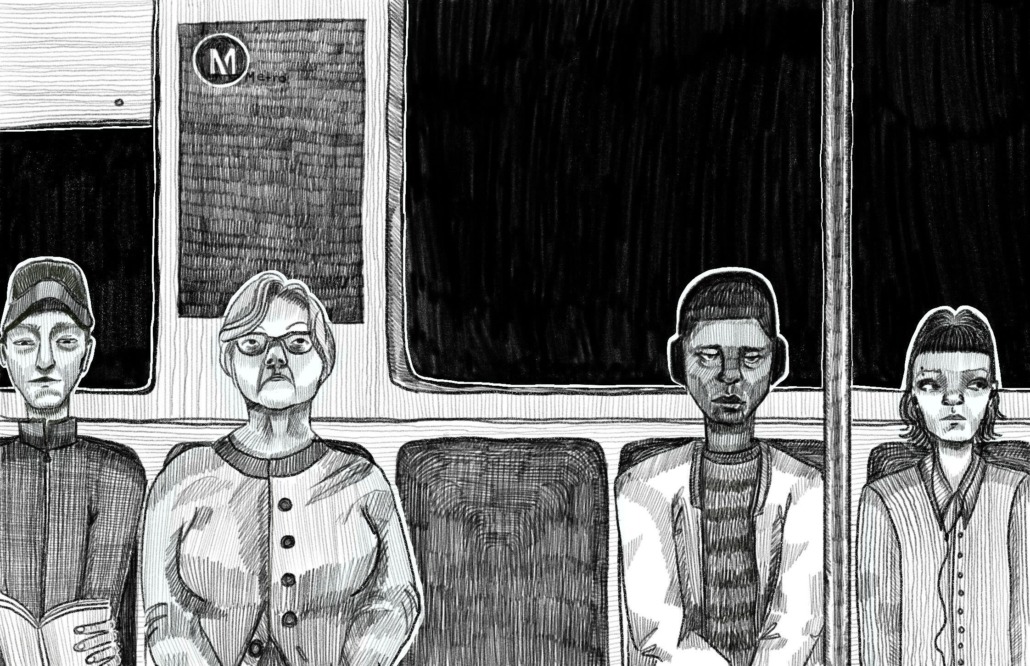

The subway system’s classical playlist has little to do with enjoyment.
As an avid user of public transportation, the Metro’s recorded safety messages are engraved into my memory. If you’ve ridden in Los Angeles, you’ve probably heard the familiar chorus: “We’re on this ride together, so please don’t play loud music, block the aisles or exits, or take up more than one seat.”
Unsurprisingly, many riders ignore these messages. What is surprising, however, is that the Metro does too.
L.A. has the second-highest homeless population in the United States. Not only that, but, according to Invisible People, a majority of unhoused people decline to go to homeless shelters due to safety risks, punitive rules and difficulty finding room to begin with. Instead, many seek refuge on the Metro or in its stations, finding the environment less dangerous and restrictive as explained by University of California Institute of Transportation Studies.
In an effort to decrease the presence of unhoused people, the Metro implemented a pilot program that included intensified lighting and blasting classical music at the Westlake/MacArthur Park station starting in 2023.
This was no “elevator music” experience — the music was not intended to be enjoyed. Instead, the Metro deployed the music as a deterrent, an acoustic signal designed to make their target audience uncomfortable enough to leave. Once a marker of elegance and relaxation, classical music is now being weaponized by the Metro to make certain bodies feel out of place.
By manipulating sound rather than enforcing policy directly, the Metro found a way to regulate behavior without directly appearing to do so. As a result, the program displaces the unhoused population from the Metro, forcing them to either endure or gather elsewhere, instead of addressing the systemic challenges they face.
In an email to the Los Angeles Times, Metro spokesperson Dave Sotero claimed that the music played at a volume of approximately 72 decibels — comparable to a noisy dishwasher — and therefore not loud enough to be harmful or distressing.
Yet, independent measurements taken with a handheld decibel meter by the Los Angeles Times reveal a starkly different number — sound levels averaged 83 decibels and sometimes peaked at 90 during musical crescendos, levels comparable to gas-powered lawnmowers and leaf blowers.
The use of music as a regulatory tool is not a new phenomenon. The invention and deployment of the “Mosquito” — a device that emits a high-frequency sound audible primarily to young people in order to deter loitering — is a perfect example. In 2005, British engineer Howard Stapleton invented the device in response to repeated property damage by teenagers near his home.
By 2006, shop owners and local councils in the United States began installing the Mosquito in public spaces and businesses to expose teenagers to the disturbing sound, thereby discouraging loitering.
Interestingly enough, the device was designed to be unnoticeable to anyone over the age of 25, as our hearing diminishes with age. Once again, the practice of weaponizing sound to target vulnerable groups is present.
What makes Metro’s strategy particularly effective is that it offers no meaningful choice. Commuters, by design, must endure the sound whether they like it or not. Yet the system quietly relies on the fact that most riders will tolerate discomfort because their exposure is brief.
A few minutes of auditory irritation is inconvenient, yes, but not enough to spark collective resistance. In this way, Metro separates populations: those who can leave quickly enough stay and endure the couple of minutes, while those who cannot are pressured out.
Online reactions from riders underscore this logic. When I was searching for validation about how distressing the sound was, I found shared sentiment in Reddit discussions. One user described Westlake station as “one of the most aurally unpleasant public places to be,” adding that without noise-cancelling headphones, they “wouldn’t take the Metro to work.”
Another commuter echoed this feeling in the thread, explaining the music routinely overpowered their headphones, but that they “just deal with it” because it was still preferable to sitting in traffic.
These responses reveal how the system produces a hierarchy of endurance. While commuters absorb the discomfort because they have access to alternative opinions and the privilege of time limits, unhoused individuals who seek shelter are subjected to prolonged exposure that becomes unbearable and carries the risk of hearing damage.
Many USC students come from outside of L.A. and rely on the Metro to navigate a city that is otherwise difficult to access without a car. For students like myself who come from suburban cities, these rides are their first exposure to the rhythms and rules of urban life: the crowded platforms, the announcements, the repeated signals about where and how they can be.
In stations like Westlake, this exposure includes the amplified classical music designed to shape behavior and demographics. Even if students are only passing through, the sound imposes a lesson in compliance; a reminder that public space is curated and unevenly accessible.
Those few minutes of classical music may seem harmless, but they disturbingly show whose presence is tolerated — and whose isn’t — on the city’s platforms.