SCA celebrates legendary filmmaker during ‘An Evening with James Ivory’
The event marked the finale of a three-day long retrospective of his work.
By THAMRA HUSSAIN
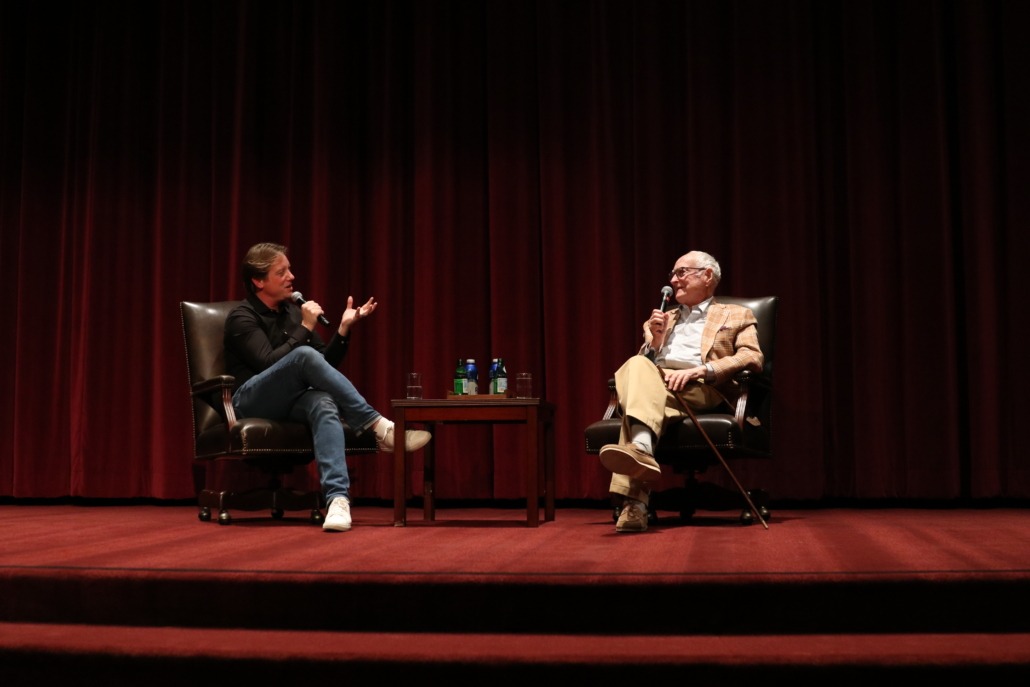

The event marked the finale of a three-day long retrospective of his work.
Renowned film director, screenwriter and producer James Ivory, a USC School of Cinematic Arts alum, visited Norris Cinema Theater Sunday to discuss his wide-ranging film career and filmmaking background to an audience of USC students, faculty, alumni and outside community members.
The “Evening with James Ivory” event marked the culmination of a three-day retrospective of Ivory’s work that included six screenings across a range of his films from Friday to Sunday. The evening began with a screening of Ivory’s film “Mr. and Mrs. Bridge” (1990), starring Joanne Woodward and Paul Newman. The 35mm print was provided courtesy of the Yale Film Archive.
“Mr. and Mrs. Bridge” follows a Midwestern married couple as they navigate changing social norms and familial relationships. Ivory said he specifically selected the film for the event because it is a favorite that doesn’t get seen very often. Ivory also called the film an “orphan” due to its current lack of a distributor, making it hard for viewers to screen or stream.
After the screening, Ivory participated in a Q&A moderated by Alessandro Ago, assistant dean of programming and special events at SCA.
Ivory, now 97 years old, spoke about being back at his alma mater, reflecting on his days as a student at USC. He graduated in 1957 with a degree in cinema.
“I don’t recognize anything at all, but I do certainly remember being here,” Ivory said. “The wonderful thing about going to SC as a student then was that you got to see a lot of movies that you would not otherwise have seen ever.”
It was at USC that he created his first film, “Venice: Theme and Variations” (1957), as his master’s thesis. The New York Times named the documentary film one of the 10 best non-theatrical films of the year in 1957. The film showcases Venice, which Ivory described as “the subject of landscape painters,” delving into the city’s artistic history and the artists who portrayed it.
Ivory also reminisced on the beginnings of film company Merchant Ivory Productions, which he created together with his life and business partner Ismail Merchant. Ivory discussed the moment they convinced screenwriter Ruth Prawer Jhabvala to join their team as their third collaborator — a partnership that lasted for over 40 years.
“She said, ‘Well, I’ve never written a screenplay. I don’t know if I could write a screenplay.’ And Ismail had said, ‘Well, I’ve never produced a film and Jim never directed one,’” Ivory said. “So she agreed, and that’s how Merchant Ivory was born.”
Known specifically for his works set and filmed in India and Europe, Ivory said he wanted to spotlight a lesser-seen part of his filmography — his American films — when he selected the films that were screened as a part of the retrospective.
“Nobody’s ever seen my American films,” Ivory said. “I wanted to have some films that some people had seen, that they knew were really the good ones, like ‘Remains of the Day’ (1993), but I also wanted to have some that people would not know anything about.”
Ivory won the Oscar for Best Adapted Screenplay for his adaptation of the novel “Call Me by Your Name” (2017) at the 90th Academy Awards. When asked about the film’s popularity among college students, Ivory joked, “that’s just because of Timothée Chalamet,” to the amusement of the audience.
Ivory noted the importance of fostering a culture of respect and trust on set, especially when working with accomplished actors like Chalamet.
“You have to trust them. Trust is everything,” Ivory said. “I believe the most important thing is that you leave people alone and let them show you what it is they want to do.”
Some of Ivory’s previous collaborators also attended the event. Bonnie Blake, who was the second assistant camera and filmloader for “Mr. and Mrs. Bridge,” remarked on “the camaraderie of the crew” when working on the film in Kansas City
“No matter what department we were in, it really felt like a group effort,” Blake said.
She shared a story of the crew creating the physical effects of the tornado scene in the film.
“All of us went out there, and we were all throwing things and pulling things, moving the furniture,” Blake said. “I mean, I was in the camera department, but I was out there helping. It was just great.”
Blake, who now works at USC in the School of Cinematic Arts, thanked Ivory for the experience, calling it formative early in her career. The project was one of the first projects Blake worked on in her 35-year career in cinematography.
“This movie meant so much to me, and you meant so much to me,” Blake said.
Gaurav Reddy, an attendee and senior at Chapman University majoring in creative producing and economics, said he learned about Ivory through interviews director Wes Anderson gave about “The Darjeeling Limited” (2007). The film’s soundtrack uses music from a variety of Merchant Ivory films, underscoring the company’s everlasting influence in the film industry.
“I like when he talks about listening more and letting the moment sort of surprise you and present something new,” Reddy said.
Organized as a tribute to James Ivory and a celebration of an alum’s work, the event illustrated his immense influence on the film industry and lasting impact. His distinct ability to bring a story to life on screen, his way of creating a beautiful atmosphere through a combination of score and cinematography, and his distinct catalogue of period pieces placed across the world continue to remain influential to new filmmakers and move audiences.