Black Price alumni reflect on their careers
The panel observed Black History Month and offered career advice to students.
By LIZZY LIAUTAUD
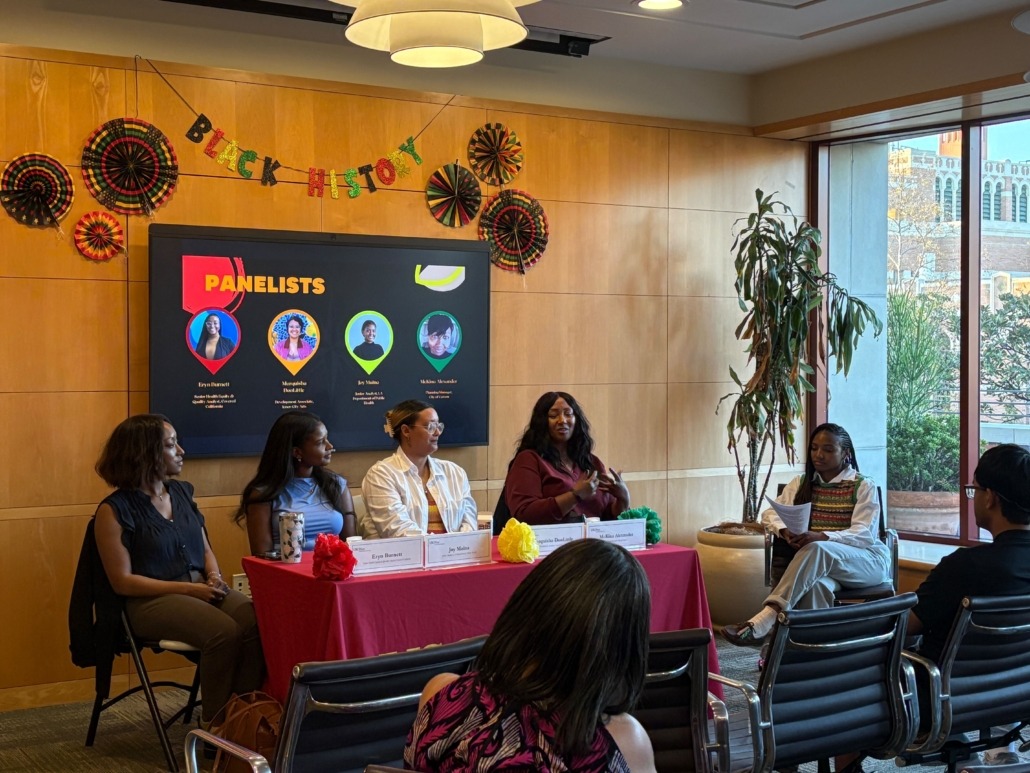

The panel observed Black History Month and offered career advice to students.
After studying fashion design for four years, Marquisha Doolittle had a dream. A literal one, she clarified, telling her she was on the wrong career path.
At first, she refused to believe it. Then, she had the same dream again. That’s when she decided she was going back to school.
“The art of the pivot,” said Joy Maina, a speaker at the event and a junior analyst at the Los Angeles Department of Public Health.
That phrase prompted Doolittle to share how a dream inspired her to make a life change. That’s what Maina called “the title of her life.”
The Price School of Public Policy’s Office of Student Affairs, in collaboration with the Associated Students of Planning and Development, honored Black History Month by inviting the four Price alumni to share their unique paths in public policy.
Pivoting became the central theme of the conversation between Doolittle, Maina, McKina Alexander, planning manager for the City of Carson, and Covering California Senior Health Equity & Quality Specialist Eryn Burnett as they discussed their career journeys as Black women working in public policy.
Aurion Wiley-Green, the panel’s moderator and a master’s student studying urban planning, said her conversation with the panelists resonated with her, and she hoped students in the audience had a similar experience.
“There [are] so many great gems that came from this event,” Wiley-Green said. “One of them that really stuck with me is ‘the art of the pivot.’ … It’s really okay to pivot. A closed door doesn’t always mean a closed opportunity.”
Wiley-Green opened the panel by asking the panelists how they came into their respective fields of work.
Burnett said she went into healthcare administration because she was rejected from a nursing program at her university, and decided to try something different.
“That was a key moment in my life, because one person might look at that moment and say, ‘Oh, you failed, you messed up, you didn’t try hard enough,’” Burnett said. “It actually ended up being a lesson in how to build a career that is in alignment with who I am.”
Alexander said when she chose to go into city planning she was the oldest person at her company in an entry-level tech position.
“Really try and understand what you’re passionate about, because you’re only given this one life to really walk out and be true to who you are,” Alexander said.
Wiley-Green also asked the panelists about how their cultural background influenced their careers.
Born in Minnesota to Kenyan parents and later moving to California in middle school, Maina said she spent much of her life reconciling her many identities. Maina said she learned early not to limit herself in her career or aspirations.
Maina began a career in maternal health where she gained an interest in housing after learning that some of the mothers she worked with lived in their cars. But she said she wanted to find a way to address broader issues of public health.
“Don’t box yourself in and don’t count yourself out,” Maina said. “If you ever feel like there’s a gap between where you are and where you want to be, if you’re determined enough to do it, you can close that gap.”
Wiley-Green then asked the panelists about the importance of bringing their lived-experiences into their jobs.
Burnett said that while working in maternal health, she saw Black women die during childbirth because no one listened to their concerns, saying representation in healthcare is critical for fair treatment.
“For us, it can be a matter of life and death,” Burnett said. “It’s very important that we have representation, because we need people advocating for each other in spaces where we might not have a voice.”
Alexander said students should take every chance they have to meet new people and experience new things. She said to “experience anything and everything,” including going to events like the panel.
“Whoever you are, be that person,” Alexander said. “As you continue to go along with this thing called life, and you’re meeting different people … just continue to help yourself grow … fill those gaps in as best as you can. This life is not perfect. It’s not a straight line.”