Zoe Alameda has her scrolling finger on the pulse
The alum explores tension between lived experience and online culture in her art.
By KIRA MANELSKI

The alum explores tension between lived experience and online culture in her art.
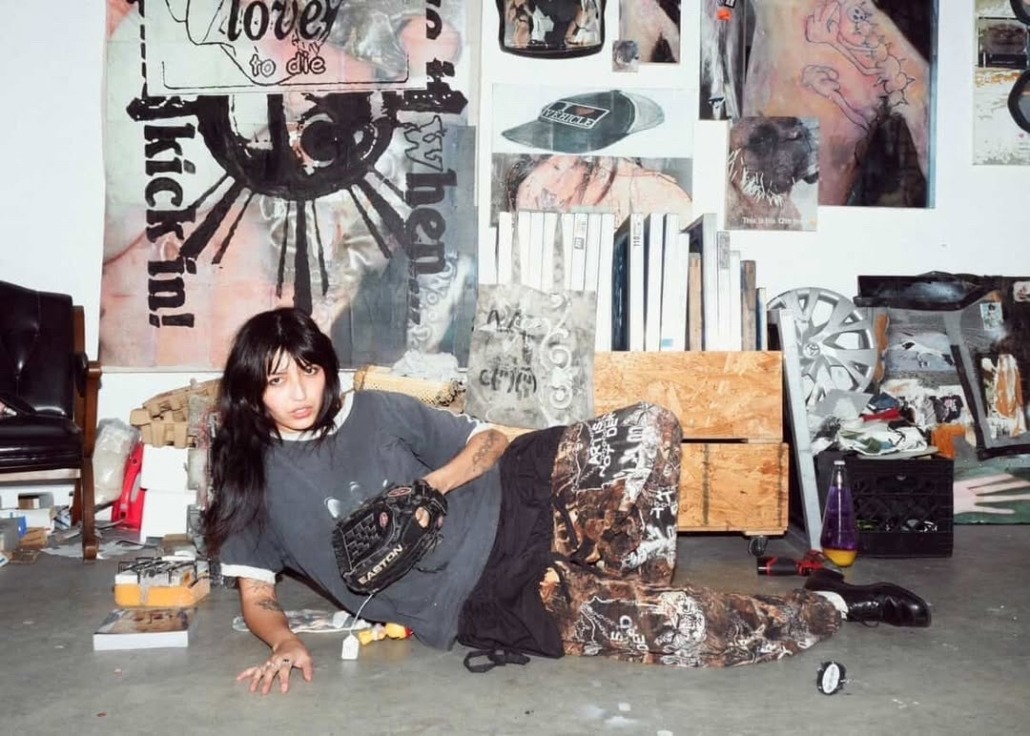
Artists and cultural commentators have been lambasting the “AI-slop,” “brainrot” and meme-based content that now pervades the main feeds of TikTok and Instagram. But for Zoe Alameda, who graduated from the Roski School of Art and Design in 2023, the cyber refuse that creatives usually discard is fuel for her own experimental, multi-media artwork.
Alameda’s most recent exhibition at Cheremoya Los Angeles, “It Takes Two Wrongs To Make It Right,” was inspired by intrapersonal conflict in the digital age. The display featured pieces like “Fold In Half So Easily,” acrylic and plaster prints on canvas revealing tentative hands cradling a melancholy, emptied car. Another piece, “I Know (hope) There Is,” shows a man’s face devolving into a piecemeal of nostalgic images which appear to be sourced from a sullen camera roll or arcane social media page.
From grasping Crayola markers as a toddler to experimenting with collage as a young adult, Alameda said she’s been an artist her whole life.
She said assemblage artists on Instagram, including Thomas Macie, and the works of Robert Rauschenberg, inspired her to begin sourcing digital content and responding to that online content through physically-realized visual art. Now, assemblage is her medium of choice, which she said allows for collaboration and interaction with digital culture and online responses to current events.
“I am a big hoarder of images,” Alameda said. “When it’s time to make a piece, I’ll just pick what feels right … If I’m collaging, I’m really just letting the process happen, and in that moment, I’m standing by and letting the work do its thing.”
Alex Carmen, a fellow artist and friend of Alameda, said Alameda’s strong instincts for which online artifacts will connect with her audience make her unique in the L.A. arts scene. That, coupled with her comprehensive understanding of material, has allowed her to shine. After their first meeting, the two young artists began collaborating on a fashion line and gained insight into each other’s artistic processes.
“Zoe is an artist,” Carmen said. “She is possessed to make work for a reason, and she references things she doesn’t fully understand. She pulls together imagery and phrases that she gets slight inklings of, sparks of understanding. It’s very intuitive and emotional. She is a product of the current moment.”
Alameda said the divide in many young people’s identity between their reality and their online persona inspires her work. Her pieces aim to negotiate these two identities and even merge them, brokering a kind of peace between online performance and interior sincerity, Almeda said.
“I feel so torn between two conflicting states of being, thinking a lot about my artificial self versus my authentic self,” Alameda said. “I wanted to make a lot of work that didn’t feel like just a painting, but it was also a sculptural object. A lot of things that are these in-betweens and this constant conversation. … And then realizing there is no true set answer, it’s everything at once.”
On the surface, her works may impress the viewer with a feeling of a distilled doomscroll, images circling the drain of their timeline and infecting the suspended figures’ consciousnesses. However, Alameda said that the heart of her work lies behind the memes and messages, in the vulnerable emotions young people obscure with the anaesthetic of social media and overly ironic cringe culture.
Selin Aydin, a friend of Alameda and also a Roski graduate, said the interplay between exterior, online irony and interior vulnerability is a defining element of Alameda’s work.
“There’s a lot of humor in her work that I don’t see as often,” Aydin said. “There’s that play of sincerity and insincerity, which I think is a really cool concept.”
Carmen said Alameda combines the imagery of decaying infrastructure and quality of life with the erratic and tender emotions of youth. By representing images seen in everyday life, like a McDonald’s wrapper or mass-produced memes, with emotions that individuals often repress, Alameda at once penetrates attention-grabbing online content as well as the authentic soul of the viewer, Carmen said.
“[Alameda] is very good at responding to what the conversation is,” Carmen said. “She takes in a lot of inspiration from the canon of art, but is very much in touch with the contemporary arts scene.”
Alameda’s bonds to the momentum of the current cultural moment have been fruitful. She’s preparing to show her artworks internationally for the first time, with upcoming exhibitions in London and Germany. She will also continue to keep her American audience on their toes: her work will be shown in Chicago, Atlanta and New York in the coming months.
“There’s never a moment when the work is fully done, because even when I think something is finished, I’m still not really knowing what it means,” Alameda said. “I love having conversations about my work. Oftentimes, I don’t really know what I’m making until after it’s done.”