Selfies train us to perform perfection
The selfie has conditioned Generation Z to run away from their authentic selves.
By RAVI SMITH
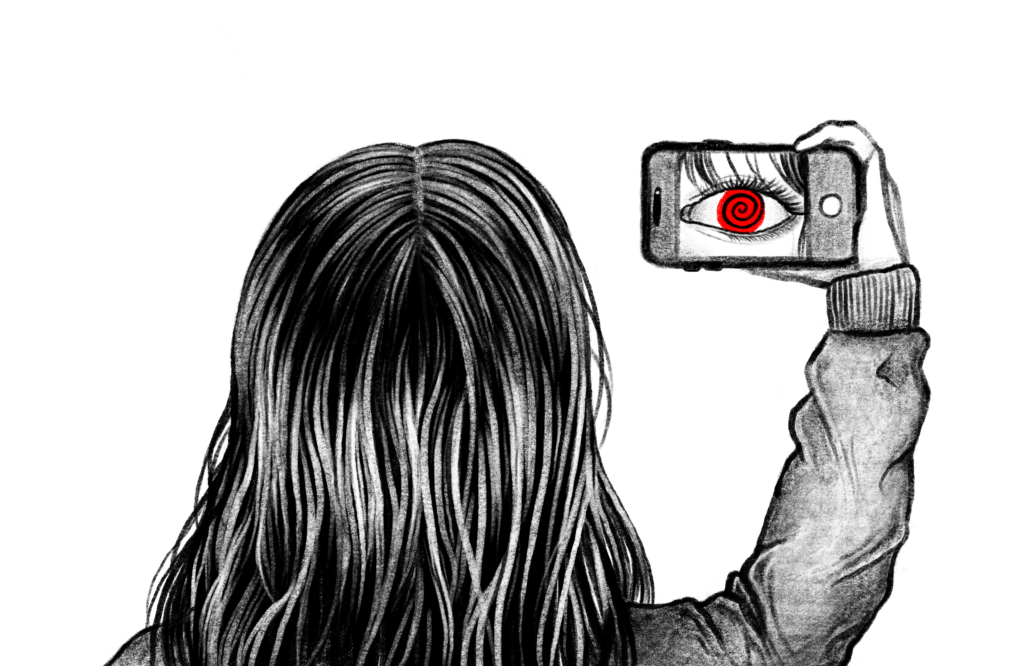

The selfie has conditioned Generation Z to run away from their authentic selves.
Nearly two weeks ago I was darting down South Hoover Street on my bike until the seat stem bolts snapped, the chain locked and before I crashed onto the pavement, I hung in the air like Wile E. Coyote scuttling off a cliff. I lay sprawled out on the concrete, my torn thumb spouting blood, those around me barricaded by their phones. And yet, more than the pain, I felt ashamed — for losing control, for revealing weakness.
This instance made me wonder why we as a society have been conditioned to shrivel up when we exhibit weakness, even when it is unavoidable.
Today, social media culture, mirrored by the selfie’s invention and reinforced in the bystanders who ignored me when I fell and the feeling of constant self-surveillance, has conditioned some of Generation Z to equate identity with appearance, reconstructing vulnerability into a shell that demands us to hide rather than grow authentically on one’s own volition. The selfie provides an untouched, undamaged shell we can shrink into.
Today’s generation is attracted, particularly, to the semblance of identity. It began with Narcissus and the spring, was crafted into the mirror, then developed into the photograph, and has now found itself in your pocket: the selfie, a deceiver of self-perception.
Self-perceived memories are made up of overlapping, fragmented moments but photos are the established materialization of a remembered time. Peter Gärdenfors, a professor of cognitive science at Lund University in Sweden, said in reference to the brain’s memory function that a photograph “tends to diminish the direct experience, because the emotions it evokes are different from one’s memory of the photographed situation and overlay it.”
This causes a subliminal rupture between who we are and who we appear to be. If selfies come to dominate how we remember ourselves, the mind loses itself in this mirage of who we think we are rather than who we’ve unconsciously become.
Recently, while scrolling through my selfies, I came across memories from Sept. 18, 2023, which I thought to be a good day because of how seemingly happy I appeared. But one photo triggered the memory I had forgotten: the end of my basketball season during senior year. Being one of the worst days of my life now leaves me confused.
Especially with social media’s impact, the self and the version we desire to present gradually merge. Much of our generation places its worth upon this virtual semblance, one we can hide behind and receive more attention than our physical, imperfect selves, like posting about your skiing trip to the Alps even if it’s mid-June. This leads to a confinement of a false persona driven by fruitless connection.
And by giving authority to this image, the ego adopts a fragile framework, slinging perfection to priority when presenting oneself. For example, only raising your hand in class when you’re sure you’re right or publicly correcting someone for saying mis-CHEE-vee-uhs instead of MIS-chuh-vis. These are insecure tendencies that indicate a restless and insecure self who yearns to impart authority upon others because they’ve yet to claim it for themselves.
The brain’s vehicle and translator — our eyes — are inherently greedy for images and its consumption inevitably bleeds into our precious psyches. So how can we pivot to remember the propeller of our humanity?
To rediscover ourselves, I say: Shut your eyes, breathe in silence and dive deep to breach the thick layers that have buried the child who’s lingered with you to this present moment. These memories have stayed this long to prompt you to play, to lose yourself in wonder and to reattach yourself to the pilot of your soul. Embrace feeling that hole in your heart and stop trying to fill it with poses that lie about your thoughts and feelings.
The direct contrast of this is the pressure to uphold a triumphant identity, pretending to know how to walk in corners of your life where you’re meant to begin crawling first.
The child’s malleable fearlessness is juxtaposed with a monologue in writer and filmmaker Andrei Tarkovsky’s film “Stalker” (1979): “When a tree is growing, it’s tender and pliant. But when it’s dry and hard, it dies. Hardness and strength are death’s companions. Pliancy and weakness are expressions of the freshness of being.” Why do we treat weakness as something to conceal rather than something that keeps us alive?
I find this pressure to be accentuated on USC’s campus, where social currency is status or potential and image precedes reality, trumping substance. It’s easy to get lost in the idea that we were already supposed to peak — professionally, socially — even when still finding our footing.
But, if you embrace a prideless pursuit of learning — accepting that this world is equally yours to learn and grow from — you won’t plummet into the quicksands clawing at your feet but spring from the trampoline at the bottom of the fall.
We must fall alone, embrace the vulnerability its process harbors to properly construct, brick by brick, an understanding of our identity, untouched and uncontrolled by external controllers like the selfie. Choosing stagnant routes to replicate identity with image and selfies — like lusting over our self-pixelated “beauty” — amplifies the desire to promote blinded strength.
By beginning to identify the moments or situations that ignite our 7, 9 or 11-year-old fears, do we understand that weakness is not failure and plasticity is integral to the cycle of nature. It brings the freedom your untouched soul began life with and slowly will your self-distortion encouraged by the selfie, dissolve into finding your precious self again, when you felt like you were floating because it was all so light.
So stop doomscrolling or rummaging through Snapchat filters and sit with yourself for 15 to 20 minutes in utter silence. I promise you’ll find things, new and old, about yourself. And if I’ve learned anything from this experience, next time, I’ll wear a helmet.