LA needs cafes for lingering
Productivity culture hollows out the comfort third spaces were established to provide.
By JULIA HO

Productivity culture hollows out the comfort third spaces were established to provide.
Many of my friends have deemed me one of the most “unemployed people they know.” Unfortunately, this isn’t a baseless accusation: My Find My location is routinely spotted on the outskirts of areas around campus — Koreatown or the Arts District in particular — in the middle of a weekday, during hours when I am, allegedly, studying or in class.
As much as I’d genuinely love to be work-free and frolicking for leisure, I’m almost always working. I’m the furthest from a highly disciplined student, but the alternative is letting my brain spiral in places that feel actively hostile to human thought — either the confines of my stuffy bedroom or the dungeon that is the Leavey Library bookstacks. So, I resort to going off campus.
Once I started college here, Los Angeles’ cafe culture quickly became a personal favorite pastime and an easy refuge. Since my freshman fall, I’ve probably explored a few dozen cafes across Koreatown, Downtown and the Arts District, nearly all with the same intention: finish the work I’ve been avoiding — rarely to linger or people watch, a few of my favorite hobbies.
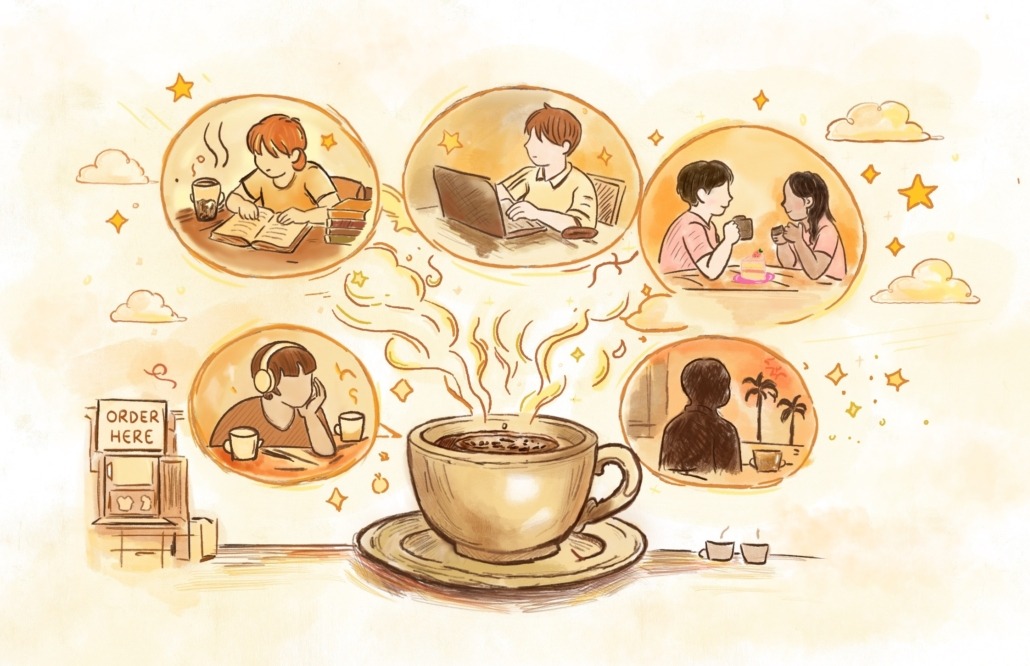
Spend enough time in these places and you’ll recognize the same scenes: Nearly every table hosts a laptop, an iPad, a notebook, headphones. Conversations, when they happen, are hushed and abbreviated, as if leisure itself might be disruptive.
Cafes used to be places for idling and maybe a cheeky little encounter with a stranger, but they’ve since been reorganized around output — a softer, caffeinated version of the office, where the only thing worse than being unproductive is being seen as such.
I’m not exempt from this aspect of productivity culture at all. Now that I’ve seen my fair share of cafes across L.A., I’ve begun feeling a bit uneasy within these aura-farming productivity hubs, even when frequenting my go-tos. Even as I grow discontent with it, I contribute to it — browsing Yelp for “study cafes,” choosing seating based on outlet proximity, ordering drinks that will last long enough to justify occupying the same table for hours.
Still, lately, I’ve been trying to resist the instinct to make every outing useful. I don’t mean that I’m never going to finish anything I start ever again, but more so picking and choosing my crash-out moments about not being “productive enough” more wisely — why spiral in public, hunched over my whirring MacBook Air in front of a bunch of performative Arts District dwellers, when I can keep that bad energy at home?
Yes, it’s February, but allow me a belated New Year’s resolution: to let cafes be cafes again. Places for drinks, yes, and pastries if we’re lucky, but also for good company, or solitude without justification and perhaps a questionable, smutty novel to pore through, or just sitting still without a deliverable in sight.
Last semester, I found myself itching to mobilize from my uncomfortable, back-support-less position at Maru Coffee in the Arts District. On a normal day, I would’ve probably stayed for at least three more hours, but that afternoon, the space felt especially performative — all polished concrete with its minimalist, off-white color palette — and I had to move. I immediately opened Yelp and typed, “study cafes near me,” scrolled past the usual suspects, and then stopped myself.
Two years ago, in an art general education course, I learned about the dérive — the practice of drifting through a city without destination, allowing space and chance to dictate movement. It is the only concept from that class I remember, and possibly the most useful.
So I walked outside and turned right.
Half a mile away, according to my phone, was a cafe with less than ten. Not even ten. A statistical red flag in any other context, but I still wandered in.
The walk was a bit treacherous — uneven sidewalks, the Arts District’s commitment to unfinished roads — but when I arrived, the cafe was nearly empty. The owner-barista greeted me warmly and recommended the banana bread, a family recipe — which I still think about — and a specialty matcha einspänner drink. I didn’t open my laptop — I sat, I ate and nothing bad happened.
L.A. is often described as a city of creativity, of people perpetually between things, lingering by default. Ironically, however, true third spaces — places for socialization and relaxation that are neither home nor work — are increasingly rare. These cafes, once informal gathering grounds, have been subsumed within the productivity economy; once you enter, you have the choice between a quick mobile-order grab-and-go or a long stay, but only if that stay is accompanied by labor.
Cafes don’t have to ban laptops, and productivity itself is definitely not the enemy. I just miss the possibility of lingering without explanation. L.A. doesn’t need more places to grind; it needs rooms where time can stretch a little, where a drink can condense on the table, untouched. Maybe it’ll begin with your own dérive — close your laptop, turn down an unfamiliar street and give yourself the simple permission to linger.