LA Phil says ‘hay’ to the Year of the Horse
The Lunar New Year show Tuesday featured four pieces from Chinese composers.
by DAVID RENDON
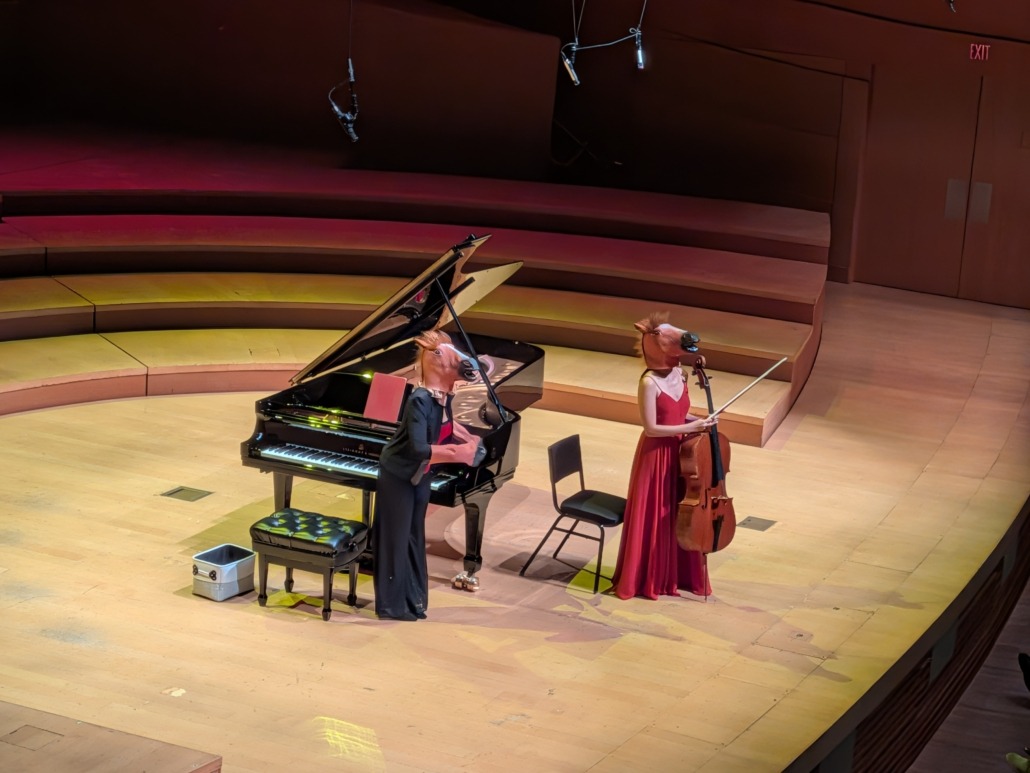

The Lunar New Year show Tuesday featured four pieces from Chinese composers.
If the packed audience at the Walt Disney Concert Hall closed their eyes, they would swear that with a mere cello and a piano, the Los Angeles Philharmonic brought a horse to life Tuesday night. The L.A. Phil invited guests to indulge in a night of chamber music to welcome the Lunar New Year on Feb. 17.
The L.A. Phil has hosted the event for a little over a decade. This year’s performance was short and sweet, featuring a series of four pieces that spanned about an hour and a half with a brief intermission.
The night began with Bing Wang, the acting concertmaster and an adjunct associate professor of violin at USC, introducing the audience to Lunar New Year and discussing her reasoning behind the night’s song choices. She also told the audience that her parents were in attendance that night, which received a large round of applause from the crowd.
Family was a theme of the night; Wang spoke of her fond memories growing up in China, celebrating Lunar New Year and the foods she would eat. She also said several of the pieces from that night were arranged by people she grew up with. Family was also reflected in the audience, with many grandchildren attending with their grandparents.
And then the horses were off to the races. The first performance was “Horse Racing,” a short four-minute piece by Haihuai Huang originally composed to be played on an erhu — a traditional Chinese two-stringed instrument — but was played on cello and a piano Tuesday night.
The piece was delightfully light and playful, something the performers were well aware of. When Dahae Kim and Joanne Pearce Martin walked on stage, Martin sat down at the piano, Kim brought out her cello, and both donned horse masks. They quickly took the masks off once they got their laughs from the audience; with a tapping of the keys and elegant movement of a bow, a horse galloped before the audience.
The piece was a standout of the night; it was energetic, exciting and drew the crowd in. Though it was short, the audience could feel the weight behind every footfall of the horse. Despite the piece not being intended for the cello, one would be hard-pressed to find anyone who noticed. Much less when, at the end of the performance, the instrument perfectly mimicked a horse whinnying.
The next piece was an arrangement by Dai Wei, “Three Pieces for String Quartet.” The 12-minute piece, made up of three miniatures, was playful, hushed and agitated. Wei’s ethos is to combine different traditions of music, namely Eastern and Western. Wang said Wei tried to represent the newer, younger generations of musicians in the showcase.
The pieces were a showcase of the versatility of strings. The performers perfectly played their pieces, utilizing techniques like hurried bow movements to instill a sense of whimsy; light plucking of the cello to create a sense of unease and need for secrecy; or loud, frantic wails from the violin to show true fury.
But overall, the piece didn’t stand out as much as many of the other sections. It was enjoyable, but not noteworthy, a middling performance from an exceptional ensemble.
The “ChinaSong” section was arguably the main focus of the night. This roughly 25-minute segment shone a light on more traditional music. The pieces were selected from the “ChinaSong” project originally recorded by the Shanghai Quartet and arranged by Yi-Wen Jiang, a member of the group.
It was here that the audience became most entranced by the music. The crowd leaned in as the string quartet began playing, and they were instantly transported as the instruments truly sang across the walls of the Walt Disney Concert Hall.
A highlight of the evening was certainly the penultimate miniature, “Reflection of the Moon in the Er-Quan Spring.” It had a gentle, soft tone, making listeners feel melancholic. The strings were soulful, and at certain moments, it felt as if they were almost weeping.
After the intermission, the show took an odd turn as the L.A. Phil decided to end the Lunar New Year show by playing Mozart’s “String Quartet No. 21 in D Major, K. 575.” It felt like a strange deviation from the entirely Chinese composer-based lineup that the night had featured so far.
Nonetheless, it’s hard to ever complain about hearing the L.A. Philharmonic perform Mozart. The 24-minute closer was a light and playful addition to the night.
The L.A. Phil’s welcoming ceremony ushered in the Year of the Fire Horse in a delightful, playful way, reminding audiences to have a little bit of fun.