The Daily Trojan endorses Rahman and Kim
Among ambitious tickets, Syrabi Rahman and Diane Kim hold the most potential.
By SPRING 2026 DAILY TROJAN EDITORIAL BOARD

Among ambitious tickets, Syrabi Rahman and Diane Kim hold the most potential.
Trousdale brimming with yard signs urging Trojans to vote for candidates for their next Undergraduate Student Government president and vice president can mean only one thing: USC’s election season has arrived. As always, the platforms are filled with sweeping promises that often obscure the limited scope the role holds. Our endorsement reflects which ticket best demonstrated a realistic understanding of what the role can — and cannot — accomplish in a single year.
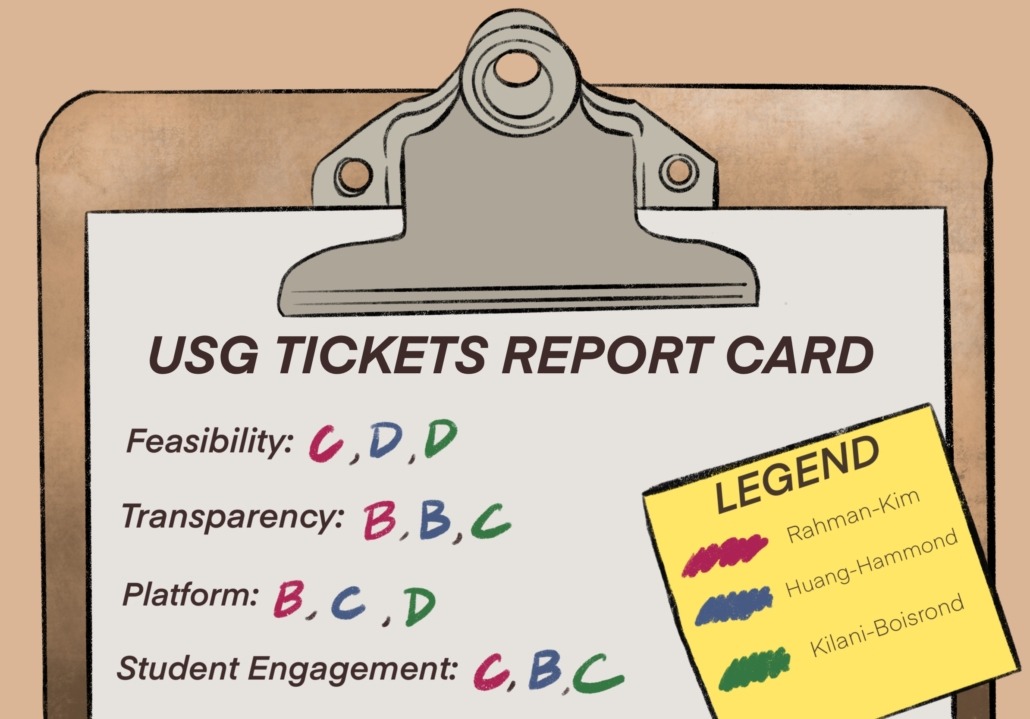
From Feb. 17 to Feb. 22, undergraduate students will vote between four tickets to determine the president and vice president of USG for the 2026–27 academic year. This year’s ballots include three formal tickets and one write-in campaign. As it does annually, the Daily Trojan Editorial Board interviewed each declared ticket to assess each platform’s feasibility, transparency, clarity and student engagement.
After careful consideration, the Editorial Board endorses Syrabi Nur Rahman and Diane Kim for USG president and vice president.
What USG presidency actually entails
The USG president is not a policymaker; the role is primarily administrative and representative. The president chairs the executive cabinet, meets regularly with the University’s administration, sits on key institutional committees — including within groups within the Board of Trustees and the Alumni Association — and serves as the primary liaison between students and the administration.
The vice president ensures that legislation and funding decisions move efficiently through the body, oversees senate operations, and manages internal governance.
Together, the president, vice president and their cabinet oversee an over $2.5 million annual budget. The majority of that funding is allocated to programming student assemblies and operational costs to sustain campus life. By contrast, the legislative project fund — the portion available for new initiatives proposed by legislative officers — totals approximately $19,000 and must be distributed across over 60 legislative officers.
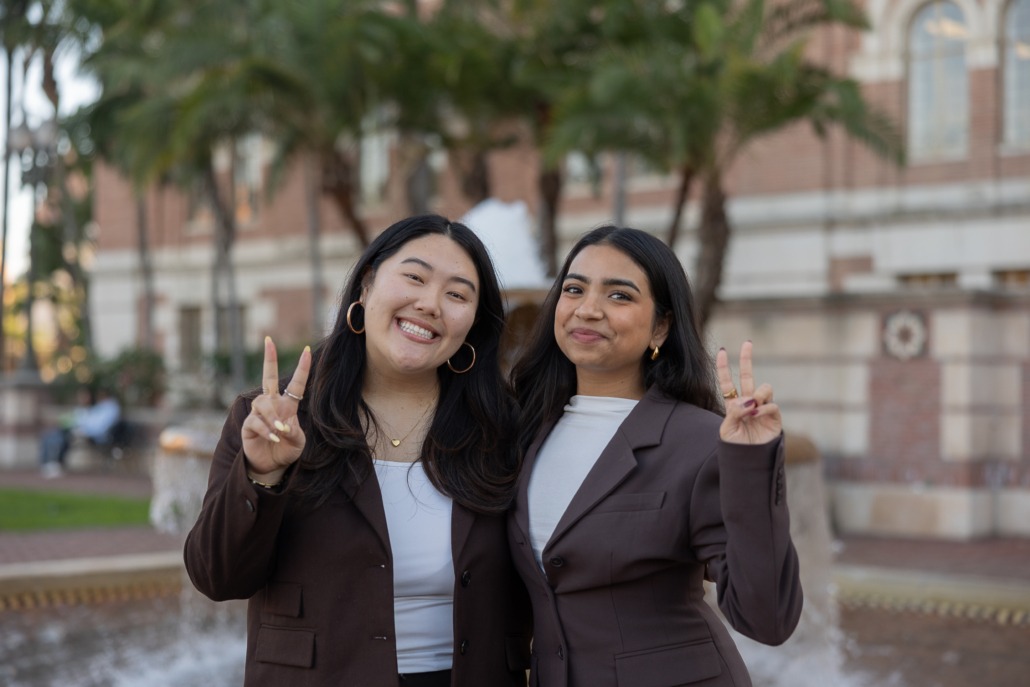
Rahman and Kim
Rahman and Kim’s platform, centered on the slogan “Ask, Listen, Act,” emphasizes affordability and access to opportunity. What distinguishes them from their opponents is their demonstrated understanding of institutional processes.
In interviews, Rahman-Kim consistently acknowledged structural constraints. Rather than presenting proposals as unilateral executive actions, they framed their plans as negotiations — incremental, relationship-based and administrative in nature.
On questions of affordability, including transportation access and professional development subscriptions, the pair outlined preliminary conversations with administrators and recognized that any expansion would require phased implementation and budget justification.
The Board did note Rahman-Kim’s shortcomings. For a ticket emphasizing “Ask, Listen, Act,” it was concerning that much of their platform was drafted without direct outreach to a broad cross-section of student assemblies and RSOs. Relying primarily on their “closest peers, mentors and co-workers” narrows the scope of who is “asked” and “listened to.”
However, the ticket stated they engaged identity-based assemblies, including the First Generation Student Assembly and the Asian Pacific American Student Assembly, to craft their initiatives after their initial platform release.
When pressed on protections for undocumented and international students amid heightened immigration concerns, Rahman-Kim’s answers emphasized advocacy and communication rather than defined policy mechanisms.
The candidates acknowledged the limits of student government authority, understanding that immigration enforcement ultimately lies outside the jurisdiction of campus leadership. Simultaneously, they are ready to “listen with an empathetic ear and challenge the administration,” and frame advocacy as an obligation rooted in their own lived experiences.
Rahman and Kim expressed a willingness to collaborate beyond electoral outcomes, pledging to support shared initiatives and ongoing health initiatives they did not originate.
Kilani and Boisrond
According to their platform, Jad Kilani and Jeremiah Boisrond seek to bridge the gap between students and administrators, arguing that a “student-first” mentality requires demystifying USG processes and advocating for undocumented, international and marginalized communities. They aim to meet with USC Hospitality to address student dining concerns and expressed interest in directing additional funding to student basic needs services.
When asked about immigration enforcement concerns affecting undocumented and international students, Kilani and Boisrond emphasized representation, outreach and advocacy within administrative spaces. While their commitment to engagement was clear, their response centered on communication rather than specific contingency plans, leaving discrepancies about how advocacy would translate into structured protections if enforcement activity directly affected students.
Kilani and Boisrond’s history of incomplete and stalled projects raises concerns about their ability to execute an ambitious platform within a single term. A laundry affordability proposal introduced by Kilani was stalled prior to gaining traction in its initial form.
Several proposals, including LinkedIn Premium access, overlap with the other tickets while lacking detailed budget frameworks or phased timelines. Given the scale of their agenda, the Board was left with questions about prioritization and execution within a single-term administration.
Huang and Hammond
Ben Huang and Wynn Hammond frame their candidacy around capability, access and results, arguing that USG should feel present in students’ daily lives rather than distant or procedural. In their interview with the Editorial Board, they emphasized high-impact pop-ups, engaging high-traffic spaces like Trousdale Parkway and increasing face-to-face engagement between senators and students.
Both Huang and Hammond are part of the ROTC program at USC and cite their experiences as having taught them “service, discipline, giving back to your community and putting others above yourself.” Alongside that, they have engaged in leadership roles among other communities, but none within USG.
While transparent about their lack of prior USG experience, their proposals lacked operational specificity. When asked about their stance on the safety of international and undocumented students, they simply stated that they would help students “know what their rights are,” but refrained from expanding further. Beyond broad promises to enhance the student experience, Huang and Hammond did not provide clear implementation details or budget pathways, leaving the Board with questions about feasibility.
Schmidt and Morley
While the Editorial Board did not have the opportunity to interview the write-in candidates Ava Schmidt and Preston Morley, we reviewed their platform promises. The ticket lacks USG experience and centers on broad proposals, including addressing housing insecurity in Los Angeles — an issue that falls largely outside the scope of student government authority. Though clearly passionate, their platform provides limited detail on implementation.
Call to Action
Democracy on a campus cannot be reduced to an Instagram graphic or a campaign slogan. It is a practice — one that requires consistency, transparency and the humility to work within limits while still pressing for change.
Creating space for student dialogue means more than appearing at assemblies during election season; it requires consistent attendance in the middle of the term when there are no ballots to win. Representation is measured not by promises made in February, but by accountability sustained throughout their tenure.
The Editorial Board endorses Rahman and Kim. Now, it is up to the student body to participate — not only at the ballot box, but in holding its leaders accountable long after the yard signs come down.
The Daily Trojan Editorial Board is a group of diverse editors and staffers from the print Opinion section. The views of the Editorial Board do not reflect the Daily Trojan staff as a whole.
Correction: A previous version of this article incorrectly stated that the Syrabi Nur Rahman and Diane Kim Undergraduate Student Government presidential ticket engaged with the Black Student Assembly to inform their campaign planning. The article was updated Feb. 17 at 11:41 p.m. to reflect that the Rahman-Kim ticket contacted but did not coordinate with BSA in time to advise the planning of their platform.