USG senate forum showcases platforms as elections begin
The forum offered students a close look at each campaign’s promises, such as free CanvaPro and chiropractors on campus.
By DANIEL ESQUEDA
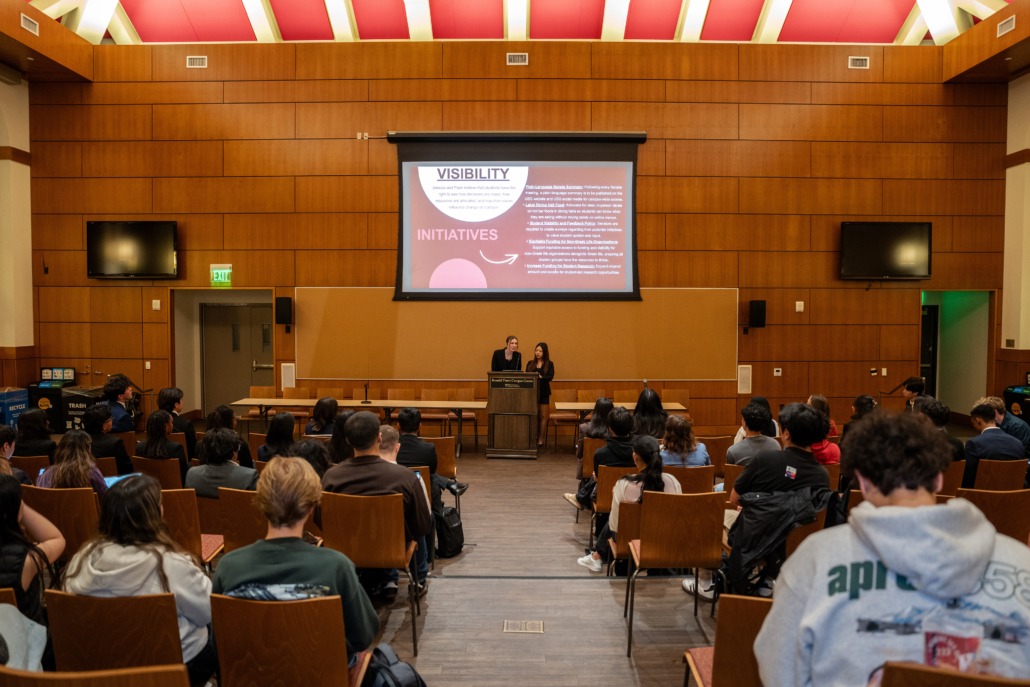

The forum offered students a close look at each campaign’s promises, such as free CanvaPro and chiropractors on campus.
Fifteen candidates vying for 12 seats on the Undergraduate Student Government senate shared varying campaign promises, like 24-hour dining halls, free LinkedIn Premium for students and reinstating Dornsife-specific advisors at the Feb. 10 senatorial forum.
Voting — which began on Feb. 17 — will remain open through Feb. 22.
Current senators Kevin Hoang, a junior majoring in economics and psychology, and Justin Shih, a junior majoring in artificial intelligence for business, are running together as a slate. Hoang said he intends to meet with the financial aid office monthly to make the process of filing out documents easier. According to Shih’s campaign platform, he plans to advocate for access to Canva Pro for all students, as well as a mobile student ID system.
Amy He, a senate aid on the wellness committee and a freshman majoring in sociology and physics, running for senate, said she intends to compile a syllabi bank to reduce the stress of course registration. She said she also wants to invite chiropractors to host workshops on posture and tension relief during finals week.
Daniel Tran, a sophomore majoring in business administration, said he wants to pursue a DoorDash option for unused dining dollars and wants to introduce a program where green tea and orange juice are available in dining halls during the “sick season.”
Senator Sudeepta Murthy, who served in the Fall semester, also pursued a DoorDash partnership in the fall, but the University informed her that they did not have the budget for the program. University dining halls operate under USC Hospitality, which operates independently of USG.
Murthy, a sophomore majoring in public policy and data analytics, and Jasmine Liu, a sophomore majoring in law, history and culture, are both current senators, but Liu did not attend the forum. According to Murthy’s campaign platform, they want to reinstate Dornsife department-specific advisors and advocate for a campus-wide LinkedIn Premium subscription.
USG does not hold any control over reinstating academic advisors.
Ginella Barajas, a potential newcomer to USG and a junior majoring in psychology, said she is running not just for students, but for staff and faculty, as well as those who have never been on campus before. Barajas said she hopes to bring local businesses onto campus and embrace different cultures to “make people more comfortable.” In 2016, USG and USC Hospitality partnered to introduce Wednesday’s weekly farmers’ market, which hosts a variety of local businesses.
Senate aides Piper Kujawa, a freshman majoring in political science, and Jessica Xue, a freshman majoring in public policy, said they want to label all dining hall foods with nutrition labels for those who have religious and dietary restrictions or allergies, increase funding to recognized student organizations and provide Lyft rides for students with disabilities. Kujawa and Xue did not specify where the increase in funding would come from.
The USC dining hall website labels each meal with any potential allergens they contain, as well as if they are vegan, vegetarian, halal, contain pork, or are not analyzed for allergens.
USC currently offers a Disability Access Ride Transportation program, which provides disabled students with rides within campus between 8 a.m. and 7 p.m., Monday through Friday. Disabled students have criticized the program for its limited operating hours and unreliability. While USG senators are not policymakers, they can advocate for new programs.
Madison Troup, a senate aide and a sophomore majoring in political science, said USG is “very disconnected” from the student body. As a senator, Troup said she intends to make EngageSC more usable and accessible for students and host programming events for first-generation students. Currently, the First Generation Student Assembly hosts events for first-generation students.
Manas Sood, a freshman majoring in finance and international relations, wrote in his platform that he hopes to make USC recreational facilities open 24/7 through a structured booking system to promote students’ “physical and mental well-being.” Sood said he also aims to expand academic and career resources for students who have majors and minors in different schools. Sood did not specify how he would expand academic and career resources or how he would fund increased recreational facility hours.
Mikai Chae, a freshman majoring in business administration, did not attend the forum, but had a friend present his platform. Chae’s platform centers on addressing everyday expenses for students, such as providing students with laundry credits, implementing free or reduced cost on books, and creating off-campus student discounts.
In 2024, the senate allocated $4,000 to a laundry stipend project, which gave 80 students $50 to subsidize laundry costs. Senator Jad Kilani wrote in a statement to the Daily Trojan that he is in talks with the Office of Student Basic Needs to provide prepaid cards for students to pay for laundry.
Senator Noa Foruzanfar, a freshman majoring in international relations and Kaylee Idrogo, a freshman majoring in neuroscience, said they want to change Brightspace to display grades throughout the semester. Brightspace is owned and operated independently from both USC and USG.
Forunzafar and Idrogo also advocated for a free laundry stipend and providing menstrual products campus-wide. Currently, the period pantry Trojan Food Pantry provides free menstrual products, and was allocated an additional $2,000 in funding at USG’s Feb. 18th meeting.
Noah Filliben, a freshman majoring in urban planning, and Thanmai Yandrapati, a freshman majoring in health promotion and disease prevention, said they want to reinstate the Academic Achievement Award. AAA allowed undergraduate students pursuing a minor or double major to take up to 21 units per semester at no additional cost, provided they met certain requirements. Without AAA, students with a minor or double major must pay to exceed 18 units in a semester. As of Spring 2026, the rate per unit is $2,467.
USG itself cannot reinstate AAA. However, when the University removed AAA in Spring 2024, it was briefly reinstated following USG’s petition, which garnered thousands of signatures. It has since become only an option for students who came to USC before Fall 2025.
Samuel Badilla, a sophomore majoring in environmental studies and philosophy, said he also intends to advocate to reinstate the AAA. USG cannot independently reinstall AAA; senators may only advocate for USC to do so
Also among Badilla’s campaign promises is to improve sustainability and food security for students, which Badilla said he would do by empowering the Association of Energy Engineers, a chapter at USC that encourages students to pursue careers in aspects of energy and sustainability.
Badilla said he also plans to advocate for a solar project, expand EBT spending on campus, 24-hour dining halls and extend gym hours, although he did not say how he would work to implement or fund those promises. What foods are covered by government assistance is determined by the United States government.
Filliben said they also want to work on creating 24-hour dining halls and include more water stations across campus. However, Filliben did not specify how they would implement 24-hour dining halls or water stations. USC’s hydration stations are overseen by Facilities, Planning and Management, which operates independently from USG.
Raquel Bell, a sophomore majoring in American studies and ethnicity, wrote in her campaign platform that she wants to offer increased printing credits and expand USC libraries’ offerings of textbooks and e-books. Bell did not specify how she would fund these initiatives.
Sonali Gupta, a sophomore majoring in political science, said she plans to work with the financial aid office on financial transparency, as well as clarity on the financial aid application process for students. Gupta also said she wants to promote work-study opportunities and internships, as well as support transfer students with course registration.
Current senator Zehran Muqtadir, a sophomore majoring in public policy, said his work during his term as senator is not over. He said he is advocating for a unit rollover program that would allow full-time students — who pay a flat tuition rate covering up to eighteen units per semester — to carry over up to two unused units to the following semester if they enroll in fewer than eighteen units.
Senate candidate Leilani Akwue did not attend the forum. Akwue is a junior majoring in political science and English. According to Akwue’s platform, she plans to increase student voice and USG transparency by issuing monthly senator updates, as well as publishing a guide explaining what USG controls and what it cannot change.
Disclaimer: Noah Filliben formerly served as a deputy copy editor at the Daily Trojan in Spring 2026. He was removed from the paper when his campaign for Undergraduate Student Government senator was announced and was not involved in any coverage of the USG elections.