‘Amadeus’ is a mostly magical experience
The latest Pasadena Playhouse production has exemplary performances and slight disappointments.
For fans of:
“The Invention of Love,” “Copenhagen,” “Oleanna”
4
By FABIÁN GUTIÉRREZ

The latest Pasadena Playhouse production has exemplary performances and slight disappointments.
“The Invention of Love,” “Copenhagen,” “Oleanna”
4
Acclaimed director Darko Tresnjak gives weight to the word “genius” — so much so that his production of “Amadeus,” at the official State Theatre of California, is inextricably linked to how destructive the search for that moniker, and its fame, can become.
“Amadeus” is the story of its namesake, Wolfgang Amadeus Mozart, but told from the point of view of Italian composer and imagined rival Antonio Salieri. Peter Shaffer’s play has, for decades, marked the dichotomy between born genius and that which works and sweats to match it.
At the heart of this tale of jealousy is Salieri’s scheme to bring Mozart down. The heart of envy is manifest in Pasadena until March 15 via stage veteran and Tony Award-winner Jefferson Mays. Jumping forward and back in time and age, and constantly addressing the audience, Mays himself composes an addictive symphony of syncopated sin.
Salieri says it best himself throughout the show: He seeks not forgiveness nor goodness, only fame. He’s upfront about his tricks to the audience, shrouding the truth to the other characters, but he does not shy away from what may be perceived as his evil.
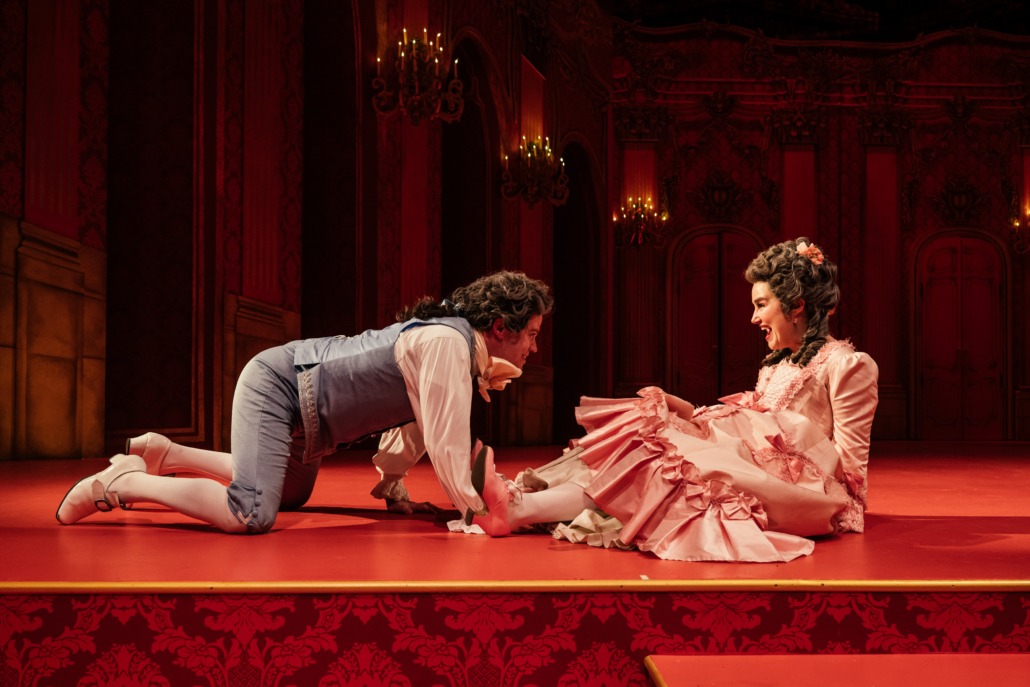
Alexander Dodge’s scenic design is appealing and ornate, but not to the fullest extent. The high-and-mighty Vienna court loses a touch of its glamour in a house the size of the Pasadena Playhouse — where, for example, a massive chandelier flown in multiple times throughout the play is just close enough to the audience for them to see how plain it truly is. It’s hard to buy that Salieri is ruining lives to have fool’s gold.
A similar pinch in the dream of this production comes any time one pays attention to entrances and exits through the two upstage doors. To play with perspective, a shrinking hallway leads to openings that are markedly smaller than all the actors; notably, Matthew Patrick Davis’ Joseph II surely has no good feelings in his joints after ducking and bending over so many times.
But the audience is thrust back into the magic of the music when the actors play with elevation on stage. Whether a judgemental stare down from a balcony, or the rageful scurry from the lip or downstage piano to behind the proscenium proper, many times the actions become intimate and inclusive of the audience. One is privy to these moments, to Salieri’s mind, on every level.
Where the world feels the most immersive is, funnily, when it is most separate from the setting of the play in itself. Salieri’s addresses to the audience — wondrously concocted by Mays, who struck real gold with his alchemy — are made all the more poignant with sound, music, lighting and projections. Most striking are the latter, courtesy of Aaron Rhyne, almost like melted wax stamps on scenic scrolls of magic.
While a combination of design aspects elevated some scenes from the normal setting, other acting performances muddled it. John Lavelle’s Orsini-Rosenberg hands out quips worthy of a chuckle in their moment, but are disparate from the comic grain of the rest of the show. He was certainly not unfunny, just not in the 18th-century-satire way that Shaffer’s script seems to strive for.
Contrast this with the Venticelli brought forth by Hilary Ward and Jennifer Chang, and one finds a more apt tone of relief. The same can be said for Michelle Allie Drever’s stellar Katherina Cavalieri, a satirical soprano.
This more fitting cabal is spearheaded by a sprung-up, energetic and magnetic Mozart from Sam Clemmett. As the maestro unabashedly impresses on first, third and millionth impression on the Viennese court, so too is the audience endeared to him and won over to the side of the titular character.
Special props must go to Lauren Worsham’s Constanze, the one who needed to be won over the most by a Mozart who neglected her. The Tony nominee admirably grappled with the character’s complexity, fighting through betrayal and resentment to display a heartbreaking, unwavering loyalty. Worsham helps bring life to the overall portrayal of Mozart and his historical context, a portrayal that rings more timely than expected.
Multiple times, Salieri speaks about how we are remembered. He recontextualizes, for example, the servants of the crown as the ones who endure in the form of their transgenerational work. Salieri’s gluttony for fame and recognition is thus an opposite to Mozart’s failures in life and misfortune. But knowing how Mozart is remembered now, and that Salieri, by his own words, is solely remembered for his envy, sticks with the audience.
Mays hammers this in through his rage, pain, avarice and incessance. He makes the audience — the “common Germans,” as Joseph refers to them in the play — question why people do what they do. It sparks the thoughts of who they work for, why they work and how they will be remembered long after they are gone. In the same way, for what it does well, “Amadeus” will persevere in the collective memory of recent work to grace the Pasadena Playhouse.
“Amadeus” will be at Pasadena Playhouse until March. 15.