Trump’s claim to the Nobel Peace Prize is profoundly ironic
The president’s insistence that he is a peacemaker is misaligned with his policy.
By DOUGLAS SHIRLEY

The president’s insistence that he is a peacemaker is misaligned with his policy.
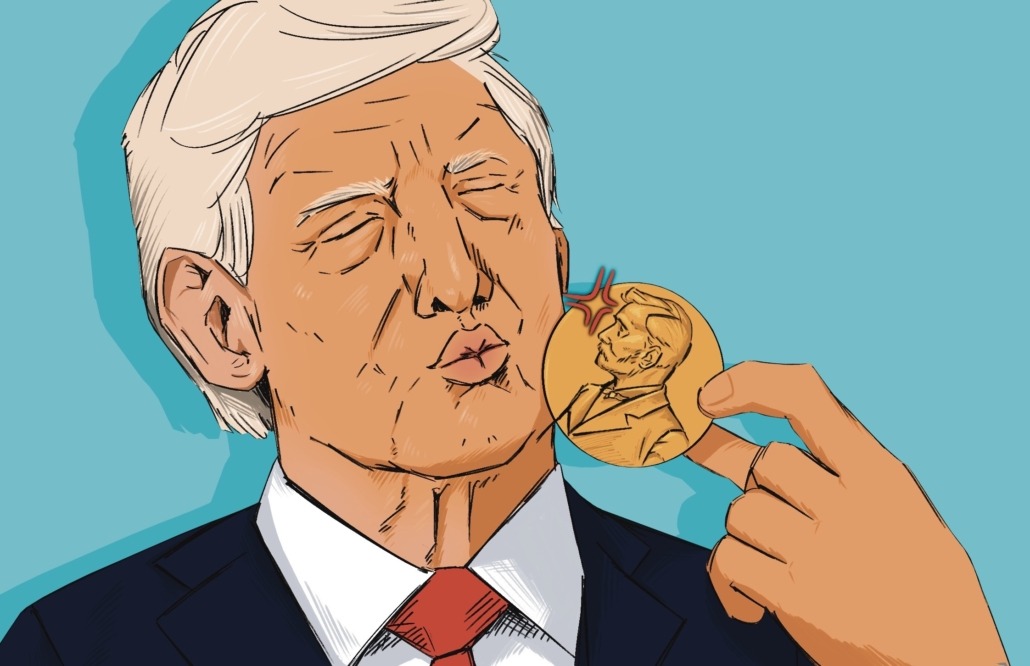
When Venezuelan opposition leader María Corina Machado gave her Nobel Peace Prize to President Donald Trump on Jan. 15, she did more than satisfy the president’s desire to finally possess one of the world’s most prestigious awards — she reinforced a brazen hypocrisy at odds with the political reality of the United States.
The handover, which took place during a White House meeting, occurred after a U.S. military raid in Venezuela that ousted former President Nicolás Maduro. When asked why, she pointed to what she described as Trump’s “unique commitment” to restoring democracy there.
Although Trump champions his own international peacemaking efforts, claiming to have solved more than eight wars abroad, his administration continues to pursue hardline domestic measures that are anything but peaceful, while promoting hostile rhetoric that equates civil dissent with insurrection.
It is these two images that constitute a contradiction: Trump in his inauguration speech wished to present himself as a “peacemaker and unifier,” yet his administration’s immigration policies at home suggest an increasing reliance on coercive, divisive and often violent tactics.
Indeed, those of us in Los Angeles are no strangers to their effects.
Just over eight months ago, in June 2025, L.A. became the center of a national backlash against those policies. Protesters clashed with the city’s police department and U.S. Immigration and Customs Enforcement agents over several grueling weeks due to an influx of aggressive ICE raids.
In response, Trump deployed over 4,000 National Guard troops and 700 Marines — an unprecedented show of military force intended to quell protests. He was also quick to brand groups of protesters as “violent insurrectionist mobs,” creating a lens that provided ready justification for deployment of the military.
Although local officials admitted that violence and looting were isolated within small pockets of the city and the majority of demonstrations remained peaceful, Trump doubled down regardless.
The president and his administration showed no reluctance in implementing domestic policy through fear-based measures while propagating dishonest rhetoric to justify said policy. But such an approach hardly serves as testament to his insistence that he deserves to be a Nobel Peace Laureate.
L.A.’s situation bears a striking resemblance to how federal officials recently carried out an immigration crackdown in Minneapolis: unleashing a flood of ICE agents tasked with performing raids, while their superiors waited to denounce Americans who protested their efforts. Except now, several U.S. citizens, including Renée Nicole Good and Alex Pretti, have been fatally shot by federal agents during confrontations, against the backdrop of Trump claiming the world’s greatest peace honor.
The killings of Good and Pretti were a tipping point that tested the power of that strategy last month. Still, administration officials were quick to heap blame onto them while publicly defending the ICE agents responsible for their deaths.
In Pretti’s case, Department of Homeland Security Secretary Kristi Noem described his actions as domestic terrorism. Later, Trump described him as an “agitator and, perhaps, insurrectionist” on his social media platform Truth Social when new footage emerged showing him protesting against ICE days before his death. Yet this is the same president Machado sought to honor with her Nobel Peace Prize, a man who characterizes protests as acts of insurrection.
It is no secret that Trump has long vied for such an award since his first term, despite recently denying that he cared much at all for it. That denial hardly withstands scrutiny, though. Only three days after receiving Machado’s medal, he wrote to Norwegian Prime Minister Jonas Gahr Støre, expressing that his push to acquire Greenland in January was deeply rooted in his feeling snubbed by the Norwegian Nobel Committee.
Of course, Machado’s decision to transfer her prize to Trump reads primarily as a political gimmick — one that sought to both flatter him and ensure his endorsement of her leadership. Whether that decision was ultimately in vain, however, has yet to be determined.
But when listening to the president’s repeated claims that he is more than deserving of a Nobel Peace Prize, it is difficult not to grimace at the reality that the country he was elected to lead has often been subjected to immigration policies that contradict the very image of peace he invokes.
Even as we wrestle with the path forward, the events of recent weeks — including those of the past year — serve as a reminder of the power this administration wields in terrorizing its own people while weaponizing rhetoric to protect its ambitions and suppress dissent.
Still, civil dissent remains crucial to democracy. We, as citizens, have every right to voice our criticism of Trump’s government, especially when it seeks to stifle democratic participation.
Should the president wish to parade a Nobel Peace Prize he has no formal claim to, so be it. But let us first address the violent political agenda by which he operates, which has instilled fear in countless millions and left the country drifting toward autocracy.