Webinar examines ICE actions in Minnesota
The participants discussed immigration enforcement and paths to civic action.
By RUBY MATENKO


The participants discussed immigration enforcement and paths to civic action.
As an immigrant, Wintana Melekin said the recent mass protests and the killings linked to United States Immigration and Customs Enforcement actions have “completely paralyzed” her. Melekin, founder of the Groundwork Institute, a Minnesota civic organization, said that day after day, people in her family in Minnesota have been detained by ICE.
Melekin, along with three other panelists from academia and advocacy organizations, discussed the importance of civic action related to immigration issues and ICE enforcement during a webinar panel hosted by the USC Equity Research Institute on Thursday.
In January, Renée Nicole Good was killed by ICE agents in Minnesota. Later that month, another ICE officer killed 37-year-old Alex Pretti, a U.S. citizen who was protesting ICE in Minneapolis.
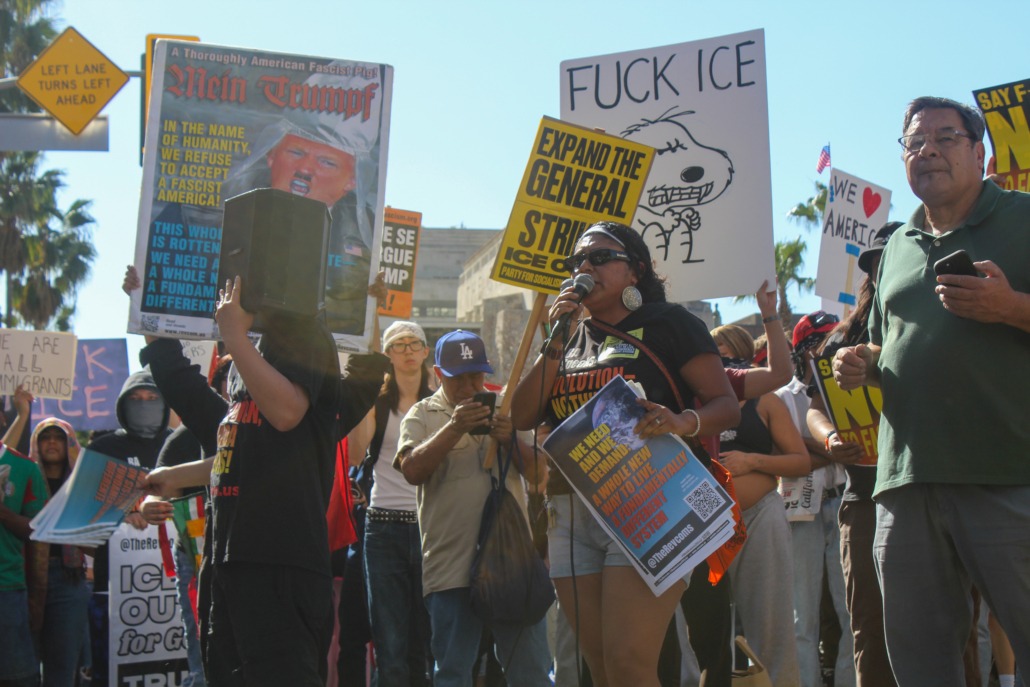
These killings sparked a national outcry, with thousands of Angelenos joining a national call for an economic shutdown and general strike against ICE and its continued mass deportation campaign on Jan. 30.
One of the hosts of the webinar, Jody Agius Vallejo, a professor of sociology as well as American studies and ethnicity, said the webinar’s intention was to examine what long-term collective action might look like.
As founder of the Groundwork Institute, Melekin spoke about civic mobilization in Minnesota. She said the state has a strong labor movement and high voter turnout, but also one of the highest rates of racial inequality in the country. NPR reported that the state of Minnesota as a whole has the second-largest income inequality gap between Black people and white people in the entire nation.
Irene Vega, an associate professor of sociology at UC Irvine, said that the webinar unraveled how current events reflect historical patterns in immigration enforcement.
“The way that I think about this is … as an escalation of long-standing historical institutional patterns within the coercive arm of the immigration bureaucracy: the Border Patrol and ICE,” Vega said.
Vega said that the recent incidents come from a “long-standing culture” of force shaped by what she described as a “warrior mentality” among some law-enforcement officers. Vega said this mentality means that police must view the public as violent and needing control.
“This bureaucratic structure … has long failed to regulate police behavior and has even encouraged problematic behavior,” Vega said. “Not just right now, through this under-training and mistraining that we’re talking about, but long-standing issues with transparency and accountability.”
Manuel Pastor, director of ERI and a professor of sociology as well as American studies and ethnicity, said that in the moment of national unrest, the key question is how to get from paralysis to action and find the courage to move forward.
Pastor said that there was a widespread civic pushback against ICE overreach, even involving ordinary people who didn’t hope to see neighbors taken away or “masked men” racially profiling communities and businesses.
Amaha Kassa, founder of African Communities Together, talked about the intersection between anti-Blackness and xenophobia in immigration debates. Kassa said it was important not to erase the racism that is tied to xenophobia.
“There’s something about the American racial caste system that tends to position Latinos and Asians as perpetual foreigners, perpetual immigrants, no matter how many generations they’ve been in the U.S.,” Kassa said. “It’s very important to the perpetuation of the American ideology on race, that Black people are from nowhere … that they do not have an origin story, an immigration story.”
Sandra De Anda, director of policy at the Orange County Rapid Response Network, said recent developments regarding immigrant rights mirror what she described as the “Cassandra complex,” a situation in which advocates’ warnings and concerns about the future are dismissed and ignored.
De Anda said rapid response networks monitor ICE activity, but have since seen different tactics.
Kassa said those who plan to protest ICE should learn not to avoid conflict, but to work through it constructively, provide people with aid, and identify common threats to democracy. Melekin said civic participation in Minnesota included lawyers and community members who stepped up to help fellow community members facing detention.
“People who have never even considered taking action in their life stepped up and led in ways I’ve never seen,” Melekin said. “We’re a clear coalition with each other in a way that we’ve never experienced. It superseded any political alliances, and superseded any race … anything.”