We direly need to relearn conversation
Dialogue does more for community cohesion than you might think.
By EFRAIN LANDIN
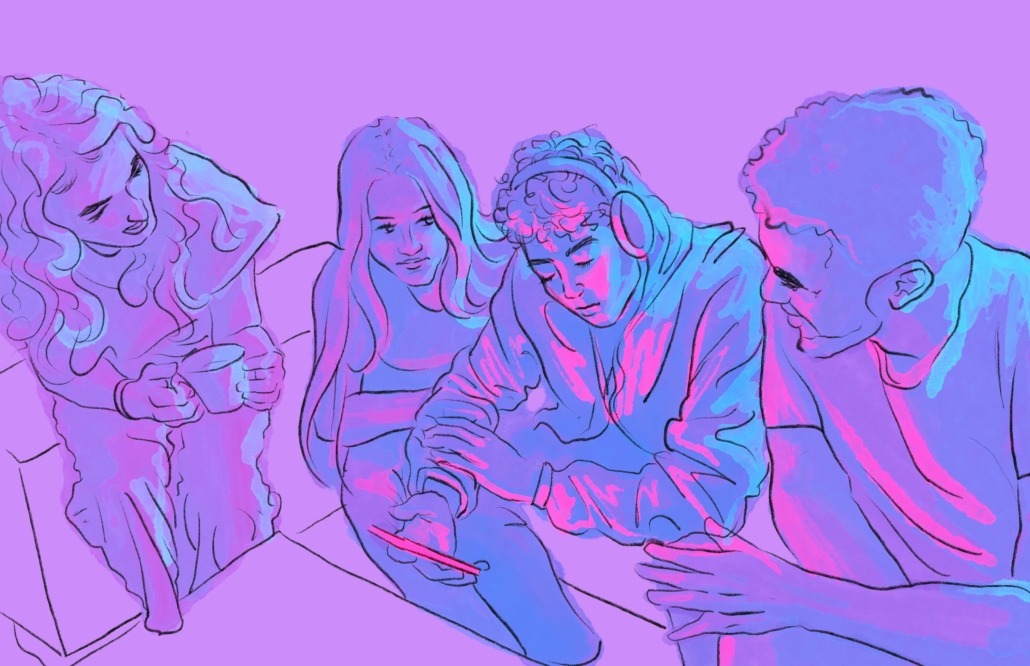

Dialogue does more for community cohesion than you might think.
Lately, it feels like younger people have lost something: the ability to find value in talking to those outside of their immediate social circle.
A comment underneath a clip of “The Jennifer Hudson Show” read, “never speak actually, that’s best,” on an episode about avoiding awkward conversations. When scrolling through more comments, many shared the same sentiment and dread of possibly having to talk to others.
When I began to notice that many others seemed to idealize a life of solitude, it raised a question: What’s the cost of abandoning the desire to talk?
Conversing is something that, as people, we know all about. It was one of the first skills we observed as children. The act of conversing is a fundamental part of our lives; it is how we make sense of the world and how we develop relationships with people who might not share the same convictions.
The understanding that we are all from somewhere and therefore that it does not matter whether the conversation is long or short, meaningful or inconsequential, enables us to see conversations as something other than simply fulfilling the innate need to socialize. In the exchange of words, there is the exchange of humanity and trust, which is imperative for public cohesion in a city where one cannot be everywhere all at once.
Los Angeles County spans over 4,000 square miles. It is almost impossible to belong to the same community without gruesome travel. In spite of this, I don’t believe that there is anyone living between Long Beach and the San Fernando Valley who has been exempt from the damages caused by our current administration in their attacks on Los Angeles. So then there must at least be an attempt to bring everyone together and try to make way for better living, and conversation may well be the way to do so.
However, it appears that initiating conversation is a burden in itself — especially as young adults. Because we’re still young, we still don’t have faith in ourselves, and so we talk a little fliply or not at all.
The conversation that I am talking about is not one that needs to last a certain number of minutes or be life-changing, nor does it have to provide solutions for all of the world’s problems. The point is that there should simply be one with intention; it can manifest itself as an act of care.
Although conversational rituals such as asking “How are you?” have become mundane, they still have meaning and should not be regarded as inconsequential. They play a large role in creating social ties, especially when meeting someone new, because they prove that, despite not knowing them, we care.
When we are on the other end of that conversation and allow ourselves to be open, we establish trust, which keeps people safe. Communities function like this on a much larger scale; employing themselves to be something we can lean on when times are tough, and our own knees are weak.
Conversation can also be a tool of empowerment. When we are living in the bizarre, conversation in our community allows us to see that we are not alone, and in some cruel way, that our battle is worth continuing to fight.
Silence has its consequences and a feeble community is one of them. When conversation is not utilized in tenuous times, it becomes infinitely harder to protect those who are most vulnerable. It is for this reason that conversation cannot be rendered obsolete: It mobilizes information in an era of censorship.
The efforts made by people who actively participate in protests, nationwide shutdowns and boycotts have been an incredible way of showcasing what is possible when conversation is seen as more than a universal human need.
I will not deny that fear has the power to weaken the mind, that for some of us, this moment in time is just another bad moment in our political existence in this country, and we have grown tired of it. So we stop talking to others about the damage to avoid confronting the discomfort that there might not be an end to this.
However, we must remember that by overlooking conversation as one of the greatest tools for empowerment, we forfeit the ability to make change; this is not a battle that can be defeated without collaboration.
To free ourselves from the idea that there is no more hope, to cure wounds that are hard to reach, to make way for a better future — there hangs the responsibility to converse, whether we have the time or courage to engage in it or not. It is a responsibility that warrants us to look out for one another when a voice no longer belongs to that of a stranger.