What happened to the internet?
Learning to navigate a new era of regression online.
By SAWYER SUGARMAN

Learning to navigate a new era of regression online.
Trad-wife, looksmaxxing, red pill, “girl dinner”: When did social media become a breeding ground for conservative extremism?
For most college students, our first steps into the online universe came during the infancy of social media. Vine was my first exposure to the internet, a place that at the time felt like a haven for creativity and optimism, an unprecedented space for cross-cultural connectivity.
During adolescence, the internet seemed to grow alongside me. During the pandemic, social media seemed like a beacon of unity amidst a world of uncertainty.
As a frequent social media user, I’ve sensed recent seismic pivots in my feed’s disposition, especially over the last two years, which spanned the campaign and subsequent election of now-President Donald Trump.
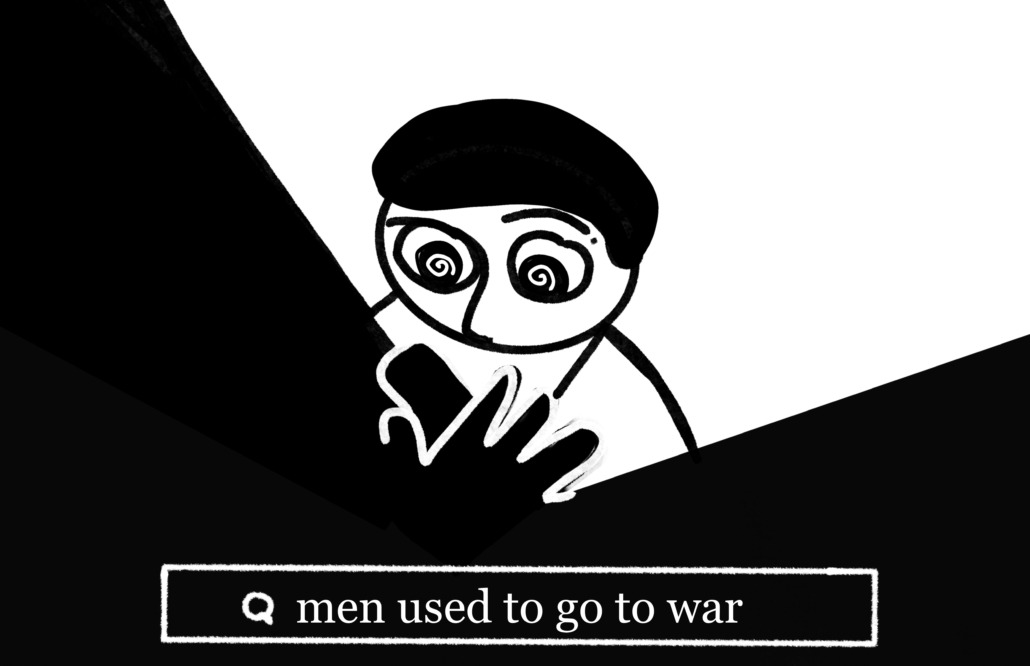
Feeling stumped about how to substantiate my impression, I opened TikTok, where I was accosted with the right-wing phenom of the month: Clavicular, the popular “looksmaxxer,” whose content epitomizes the confusing antiquity of our social media era.
The 20-year-old content creator uses his platform to share aesthetic and social advice for men, documenting his brash attitude towards women, most infamously by injecting fat-reducing peptides into his 17-year-old girlfriend’s face on a livestream.
Hundreds of videos in the same vein of dumbfounding regression populate For You pages, ranging from meditations on why men should shoulder financial responsibility to wide-scale fear-mongering against transgender people.
Less potent, but more popular iterations of conservative thought have emerged, like the “girl dinner” TikTok trend that trivializes women’s eating habits, a more subtle, but equally concerning fad that seeds misogyny to young people, a saddening departure from the internet I had come to know.
In fact, the poor treatment of women, queer people and racial minorities seems to have become one of social media’s hallmarks, reinforced by the ascension of a cast of right-wing agents, such as self-identified Nazi sympathizer Nick Fuentes and Andrew Tate.
After Kamala Harris’ 2024 election defeat, Fuentes sickeningly declared “your body, my choice” on his radio show, in reference to the nullified Roe v. Wade decision on women’s reproductive autonomy. The phrase spiked in volume of usage shortly thereafter, a testament to the chilling reach of radicalism on the new internet.
Social media has long been crucial in shaping Generation Z’s political identification. According to Pew Research, 53% of United States adults aged 18 to 29 use social media as a vehicle of political participation.
This coalition of far-right influencers is working to reel radical conservatism from social media’s outskirts and into the mainstream, and their online siege is no accident. These online spectacles don’t exist in a vacuum; their influence may already be impacting at the polls.
Young people, social media’s biggest demographic, showed just a four-point preference for Democratic nominee Kamala Harris in the 2024 election, compared to a 25-point preference for Democratic nominee Joe Biden four years prior.
Blame isn’t shared evenly, though. Generation Z men have pioneered their culturally conservative pivot, both online and off, anchored by a stronghold of progressive women. Men predominate the online conservative movement — Ben Shapiro, Fuentes, and the late Charlie Kirk, to name a few — stand at its center.
Unsurprisingly, this stratification has manifested itself in gendered voting behaviors. Around 56% of men aged 18 to 29 voted for Donald Trump in the 2024 cycle, a marked 15 percentage-point increase from the same group in 2020. On the other hand, young women favored Democratic nominee Kamala Harris at a 58% clip, a Democratic stronghold, but still down from 65% in 2020.
TikTok’s new ownership, a panel of investors stamped by Donald Trump, has also amplified concerns about an increased radical influence in the never-ending tug-of-war for the youth political consciousness. In a Truth Social post from January, Trump boasted that the app “was responsible for my doing so well with the Youth Vote in the 2024 Presidential Election.”
While it’s tempting to endlessly harp on social media’s bleak devolution, young people still wield the power of choice, having commandeered social media’s trajectory from its inception.
As we enter adulthood, we can still elect to use social media as a pedestal for meaningful advocacy, triumphs of inclusion and celebrations of love instead of endlessly fanning the flames of radical conservatism. The algorithms reward inflammation, but, without attention to sustain its wayward cause, absurdity has no place to go.