Daily Trojan Magazine
GOINGS ON
A tightrope in a typhoon: the events of the last two months, in retrospect
Balance — or lack thereof — can affect everything from the weekend to the world order.
By FRANCO GUTIERREZ

Balance — or lack thereof — can affect everything from the weekend to the world order.
I joined the rowing team for my last semester here at USC. Though creaking and rumbling, my calendar fit it in. I practice in the mornings before a shift at one of my two jobs; my classes for my major and the minor I tacked onto it last year; and — of course — coverage for the Daily Trojan, for which I am now a proud Magazine writer.
If it sounds like I am gloating, that is because I am. I am perversely proud of my 16-hour days because being busy is a virtue, and in three months, I will not be busy at all. Father Time will burglarize me, plucking from my side all the aforementioned thorns, and I feel inoculated against fulfillment.
I will — along with the rest of you seniors — be reerecting the house of cards from scratch, and I am desperately, existentially curious as to how one strikes a balance between disparate, incongruent entropies. I want to know how to stop and smell the roses amid a whirlpool of urgency, or how to contextualize the waltz of a perfectly choreographed calendar with the slapdash flurry of current events.
That whirlpool is inevitably irrelevant, but it is also my life as I know it, and I refuse to approach my life with anything less than effort. Just now, the question of how to live after a life ends has become rather material, as all over the world, social orders, status quos and the legitimacy of leaderships appear to have lost their balance, groaning and rending while those livelihoods that abide within them watch on warily.
Watching the wobble
Diego Andrades, assistant director at the Dornsife Center for the Political Future, has to balance the America he loves with the one he inhabits. He said Project 2025 was a theoretical beast in every relevant political circle, at first.
“Now we see the reality of what it looked like, and the worst parts that we had imagined a year ago … don’t even mirror what’s happening [on] the ground,” said Andrades. “It’s really interesting to see what’s happened, because I don’t think that a lot of people in their wildest dreams could have thought that the country would look like what it did after a year.”
Andrades said his agency was defunded by the Department of Government Efficiency and was laid off shortly after. While he believes Trump is “flirting” with authoritarianism, he said a blue wave in the 2026 midterm would see Trump’s followers scuttle the sinking ship.
On campus, the Recording Academy held an event on Jan. 30 for student artists at Grammy House as a part of their Grammy U program. The event included a masterclass, vendors and student performances toward the end of the evening.
At the Grammy Awards themselves, five USC alums took home six awards, including Ludwig Göransson’s fifth and sixth Grammys, for “Sinners” (2025). Alumni from the Thornton School of Music had a hand in several award-winning projects: Leon Thomas’ album “MUTT,” Kendrick Lamar’s album “GNX” and Billie Eilish’s song “Wildflower,” which took home Song of the Year.
Then came the Super Bowl.
The Grammy’s biggest award — Album of the Year — went to Puerto Rican musician Benito Antonio “Bad Bunny” Martínez Ocasio, who headlined the halftime show. He had previously said he would not perform in the U.S. for fear of Immigration and Customs Enforcement raids at his concerts. On stage, he protested the agency.
“ICE out!” Bad Bunny said. “We’re not savages, we’re not animals, we’re not aliens. We’re humans, and we’re Americans.”
Bad Bunny had to balance his opportunity for a platform on one of the most-viewed television events of the year with his existential concerns about ICE.
Saturated in Latino universality and culture, Bad Bunny’s halftime show celebrated love and pan-continental American identity by featuring Latin celebrities, anti-hate messaging and a real-life wedding officiated during the performance.
Also in the Super Bowl were four former Trojans, all playing for the Seattle Seahawks. Defensive end Leonard Williams, linebacker Uchenna Nwosu, defensive tackle Brandon Pili and quarterback Sam Darnold faced off against the New England Patriots at Levi’s Stadium in Santa Clara, where the Seahawks handed the most successful playoff team in the NFL a decisive 29-13 loss.
The Seahawks did not receive an invitation to the White House following their victory, while the USA Men’s Hockey team was invited personally by President Donald Trump following their Winter Olympic gold medal win. During the call, Trump disparaged the Women’s Hockey team — who had also won gold — to a roar of laughter. Shortly after, the Women’s team declined an invitation to the State of the Union.
Balancing the budget
While Projans on the gridiron for the NFL’s biggest night are an unequivocal point of pride for the USC football program, it is difficult for Jonathan Aronson, a professor of communication, to balance the threat of layoffs with the ever-more-flush athletics department.
Aronson said he was less likely to be laid off, but staff and adjuncts are vulnerable.
“Frankly, although the University says it’s a separate pot of money, the faculty are furious that you pay a football coach $11.5 million. Just furious. And that’s more demoralizing to the faculty than [President Donald Trump], in some ways,” Aronson said. “If [USC Football Head Coach Lincoln Riley] managed to win the national championship, a lot of that power would go off.”
Athletics are not the only controversial budget item in the face of layoffs. Even the University’s ChatGPT Edu subscription — projected to cost an estimated $3.1 million per year — fits this balancing act.
In response, Aronson said he fights back against artificial intelligence by going analog.
“The presumption is that with any paper, any essay, any resume, AI was used to either write it or enhance it,” Aronson said. “Therefore, what has happened in [my] classroom is [that] it’s gotten very retro. I now use in-class, closed-book written exams on paper. I had gotten away from that, but with AI, there’s no choice but to go back to it.”
A picture of fighting
Aronson tends to deal in drivers of change, rather than predictors of change, both in AI and international relations. He said he believes the next elections will swing in the Democrats’ favor.
Is the national tenor rebalancing away from the conservatism of yesteryear, with its felonious manosphere, Cruel Kids’ Table and not-so novel Nazi salutes? Andrades thinks so.
According to Andrades, the ICE shootings and U.S. invasion of Venezuela have generated untimely pressure on the Trump administration heading into a make-or-break midterm election year — the political equilibrium may shift.
“[Republicans are] so afraid of being primaried or challenged or losing their job that the calculus right now says … to support President Trump,” Andrades said. “But if 2026 shows a blue wave like 2006 … it will be this wake-up call that [Republicans] can no longer support Donald Trump, because it puts their jobs at risk [and] puts their party at risk for decades and decades.”
Andrades — who expressed that his views do not represent the Center for the Political Future — said he believes that the U.S. has destabilized the global order to an extent that world leaders are ruminating on a future without the United States. French President Emmanuel Macron’s speech at the World Economic Forum on Jan. 20 addressed Trump’s musings over the possibility of U.S.-controlled Greenland by championing a more Eurocentric approach.
“It’s useful not to forget what we learned from the Second World War: remain committed to cooperation,” Macron said. “[It is also] because of this principle that we have decided to join a mutual exercise in Greenland, without threatening anyone, but just supporting an ally and another European country, Denmark.”
Not everyone, however, is opposed to U.S. intervention in international affairs. The recent massacres of protesters in Iran have reignited calls for Reza Pahlavi — the son of the Shah deposed in the 1979 Iranian Revolution and a USC alum — to return to power.
On the USC campus, mourners gathered in a vigil on Jan. 23 for those killed in Iran. Among the attendees was Morteza Dehghani, a professor of computer science and psychology, who said he supported U.S. intervention in Iran.
“If you would have asked [me] as an individual citizen whether I would ever think that foreign intervention would be a good thing, I would have said ‘absolutely not,’” Dehghani said in a Jan. 23 interview with the Daily Trojan. “But today, the vast majority of people are hoping for the United States to do something, because we know the [European Union] will not do anything. And in reality, our hopes are with the U.S.”
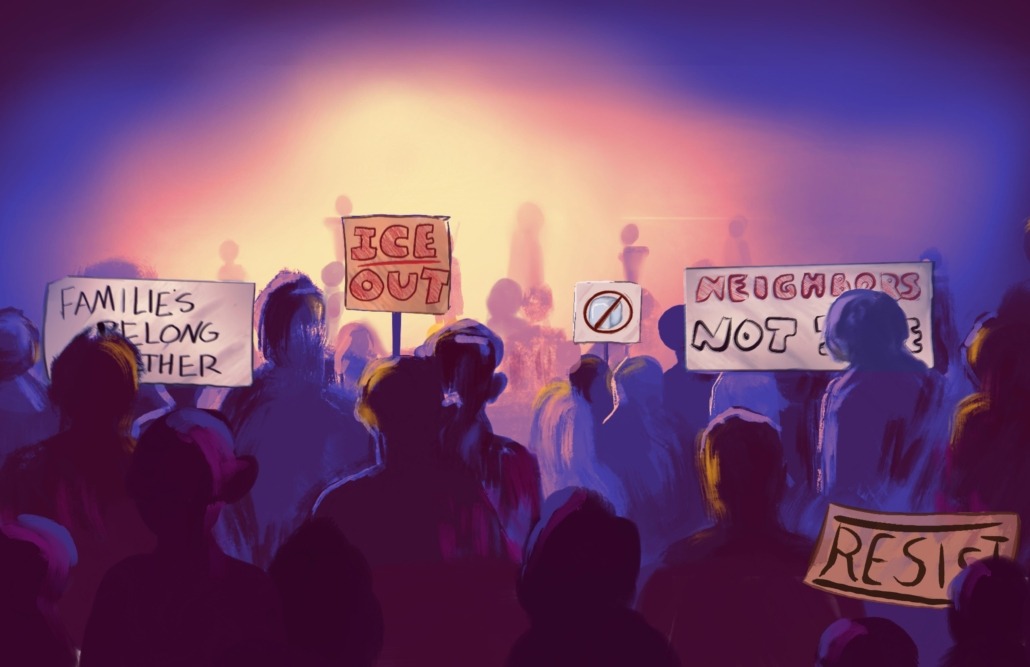
Protests for Iran, for Palestinians, for Venezuela, and against ICE, Israel and the Trump administration have streamed through the streets of major American cities, including Los Angeles. With less-lethal weapons deployed against protesters in L.A. during the February general strike protests, the question remains of how to slake the irritation of a nation without earning the violent ire of its policing arm.
The smaller scales
Closer to home for students, balancing a class schedule is something that is saturated with regretful retrospect as often as it is filled with rosy fondness, for both classes that were taken and ones that were not. In a recent Daily Trojan article, students chose their favorite “out-there” electives at USC, including Stage Combat, Seamanship & Navigation and Self Defense.
In all these questions of balance in all these hodgepodge cases, what thesis remains? It is an unfortunate answer, and one I suspect I knew coming into this: It depends.
Balance is not steady and slow; it is a juggling act flung upon a drowning person. It is friends you admire, and dreams you detest. It is being unhappily married to hope, and a tightrope walk in a typhoon. It is gulping down frustration and perspiring in the world’s longest game of whack-a-mole. It is different for every person, in every situation and at every time.
Be it an overstuffed itinerary or the constant lesser of two international evils, it seems balance is more of a staccato than a tenuto, and no one can keep in rhythm forever. I’m loath to say: The house of cards will crumble from time to time. But all my favorite memories are from seeing it come together again.
This story compiles events from Jan. 12 through Feb. 12.