When balance becomes performative, exhaustion stays off screen.
By BELLA CARTER
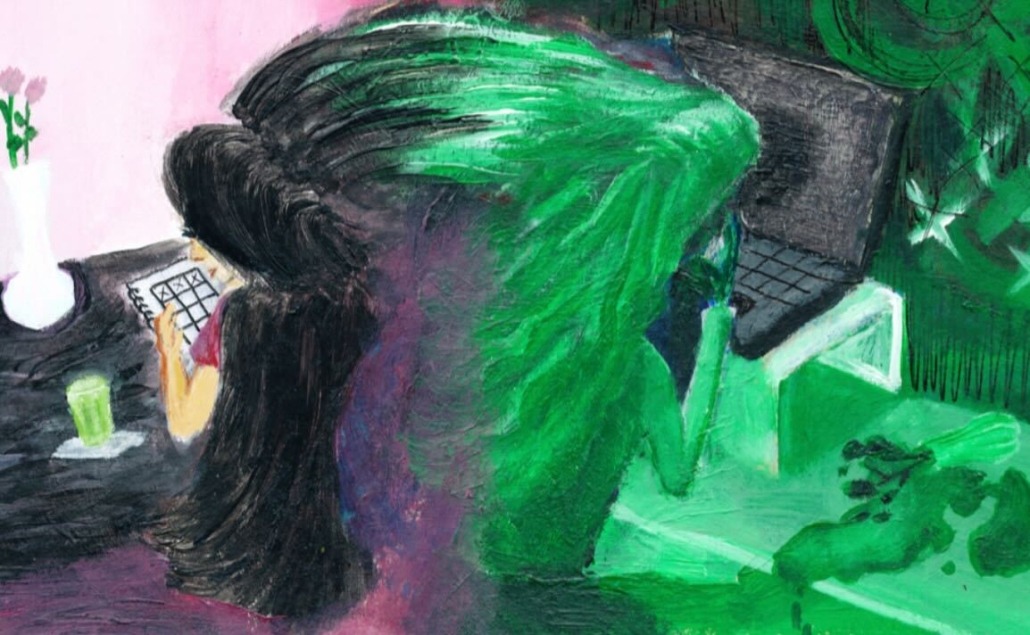

When balance becomes performative, exhaustion stays off screen.
Studying is now documented through aesthetic desk setups. Fitness is captured through gym mirror selfies. Socialization is validated through a precisely curated feed of friend group photodumps. Even self-care itself has been stylized with matcha, journaling and Pilates.
In between lectures or while in bed after a long night of studying, people may stumble across a student “day in my life” vlog on social media.
The message across most of this content is subtle but consistent: To be successful is to be balanced, and to be balanced is to look like one is doing everything and anything all at once.
In the era of social media, Generation Z comprises the majority of current college and university students and spends an average of 4.5 hours a day on social media apps, like TikTok and Instagram, according to a 2024 article in the American Association of Colleges and Universities’ magazine, Liberal Education. This rate of consumption can expose Gen Z users to a balanced lifestyle that has slowly shifted from an internal, personal goal into a visual aesthetic perfectly curated for consumption.
Productivity, ambition and happiness are no longer lived in private, but measured visually through carefully curated routines, putting productivity under a constant spotlight.
Bryce Brock, a senior majoring in legal studies, has felt this pressure on the high-visibility stage of being a student athlete for two and a half years at USC. The expectation of needing to perform well and appear as a particular version of oneself — even when that version is not what someone may truly want — is a performance, according to Brock.
From posting athletic media day pictures, internship announcements or graduate school preparation, Brock says this performance is done for someone to “give the air” that they’re doing what is right or what others want to see from them.
“It’s exceptionally dangerous,” Brock said. “It just builds into … this idea that, in order to be successful and in order to be efficient and functioning, you have to constantly be doing.”
This version of balance quietly sets a standard for what college life is supposed to look like, especially at a university like USC where high academic expectations and the strong social and professional intersection make appearing successful feel just as, if not more important than, actually being successful.
This pressure to look like one is doing it all can lead to burnout, according to Amiyah Wood, a freshman majoring in legal studies.
For many first-year students, who are adjusting to the academic rigor, social expectations and independence of college life, striking a balance is difficult.
“Your first year is not supposed to be perfect, but sometimes you just want to have that facade of trying to be better than you are,” Wood said.
The addition of social media can amplify feelings of isolation, since the pressure to appear put together can feel just as important as actually being put together in a space where strategic posting creates the appearance of connection and confidence.
Jolynn Hallum, a freshman majoring in legal studies, said she felt an unspoken pressure to demonstrate that she was thriving, even while searching for her sense of community and stability.
“At the beginning of my first semester, it was a little tough because I was having a hard time finding that group of people who I really mesh with and what organizations I wanted to be part of,” Hallum said. “It was kind of tough at first seeing a lot of people like, ‘Wow, everyone seems to have a big friend group, and everyone’s making connections. Why am I having such a hard time with that?’”
Isabelle So, a senior majoring in international relations, described how “everything’s behind the scenes.”
So has noticed a similar pattern with how balance is performed online with students posting beach trips and shopping hauls when, “in reality, they’re in their bedroom studying and they’re gonna ace that exam the next day.”
What seems to rarely appear in these “day in my life” vlogs are moments that disrupt the aestheticization of balance. It is uncommon to see creators film instances where they experience burnout, missed deadlines, mental health struggles or failures they encountered along the way.
For students in the Marshall School of Business, the pressure to constantly look successful can feel heightened in professional spaces, according to Sarah Semere, a junior majoring in business administration.
“Marshall has some really, really smart people … so it can be intimidating at times,” Semere said. “When it comes to networking, some people will put on a different persona and they’ll be completely different because they believe they’re putting their best foot forward.”
Semere acknowledged that academic struggle is common and expected, but said networking environments oftentimes demand a more curated version of oneself. She said this contrast can make these platforms feel intimidating, even with students recognizing that everyone around them is navigating their own challenges.
“I don’t really post on LinkedIn like that, but I wish I did,” said Semere. “But because the platform is so intimidating in general, it has discouraged me from posting really often.”
For Hallum and Semere, this shift toward authenticity means prioritizing what matters to them personally over what looks most enviable on someone else’s feed.
“I’m very transparent with the way I am,” said Hallum. “Who I am on social media is very reflective of who I am in real life. I don’t feel myself concealing a certain part of me or see myself being performative in any way, or trying to adhere to what I think a college student at USC should look or behave like.”
Semere has had her social media accounts deactivated for a few months as she’s embarked on achieving her goals, instead of using it to compare herself to others.
“Sometimes it can feel like you’re behind everyone else,” Semere said. “Don’t focus on what anyone else is doing. Focus on what you’re doing. Because if you’re focusing too much on other people, it makes you stray from your original goal.”
As she moved through college, So said that her perspective on balance has shifted from constant involvement to reflection on herself. During her freshman year, So said she focused on maximizing all extracurricular opportunities and meeting friends, but now as a senior, she said she recognizes that “balance is important.”
“During my freshman year, I was very wide-eyed, bushy-tailed, excited to experience everything … and just be involved,” So said. “Now that I’m a senior reflecting on it, I do think that your freshman and sophomore year really set you up for the rest of your career.”
Similarly, Brock realized that over time, pressure to perform slowly became a space to explore, fail and establish oneself.
“People have to give themselves more permission to be okay and to explore and to not have everything figured out,” he said. “Take the time to, while establishing your academic journey … apply that same effort to yourself. Everything will flourish and everything will bloom.”
Balance is not something that can be achieved all at once, nor is it something that can be fully captured in a 60-second social media video. It is uneven, personal and constantly shifting. The pressure to look balanced slowly gives way to an understanding that most students are still learning as they go.
For Emmanuel Garcia, a freshman majoring in legal studies, finding the time to do things he wants while balancing his responsibilities is still a learning curve.
“I’m still figuring it out,” Garcia said. “For me, the experience is all about, quite literally, a work-life balance.”
What social media often fails to show is that figuring things out is not a sign of falling behind, but rather a shared reality. Behind neatly curated routines are students who are navigating uncertainty and redefining success on their own terms. Balance becomes less about perfection and more about being honest with both oneself and others.
“Social media is a very scary place,” So said. “It’s an amazing place because it can empower people to do more in their lives and be productive and experienced … but at the same time, acknowledge that people only post when they succeed … so just give yourself grace. … If you work hard and do what you think is right, you will be rewarded.”