FRO Fest shines light on the future of Black film
The annual festival featured the best from the African American Cinema Society.
By KAILEN HICKS
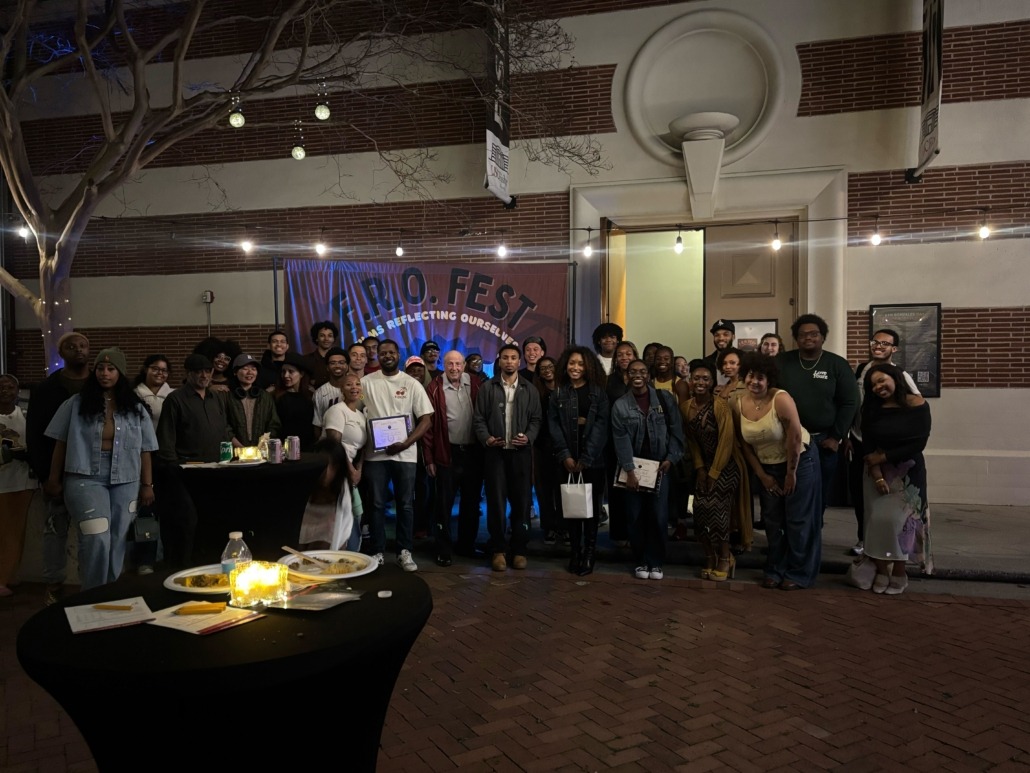

The annual festival featured the best from the African American Cinema Society.
For the first time, USC’s African American Cinema Society brought its annual Films Reflecting Ourselves Fest to the Fisher Museum of Art’s theater room Friday night, marking what organizers said was a milestone for the student group.
As Mikayah Lee, a senior majoring in cinematic arts, film and television production, and AACS co-president put it, the jump to the big leagues is bigger than FRO Fest — it’s indicative of a broader leap for the entire club.
“We went from having an e-board of, you know, eight to 10 people, to now 20 people,” Lee said. “We’ve produced more events than AACS has ever had.”
AACS hosted its seventh annual FRO Fest, a showcase of its members’ latest standout projects and a closing event for the organization’s Black History Month programming.
The five screenings at FRO Fest encapsulated a plethora of Black stories — a period film set during the height of the Black Panther Party’s activism, light-hearted comedic shorts that put audiences in the heat of fast-food chaos and tensely shot projects that touched on youth gun violence and grief.
The screenings began at 7 p.m. with a showing of Tatiola Sobomehin’s “I Was An Egg Once,” a compilation of personal archival footage that reveals the history of her family’s lineage.
“Seeing each member of my family have a diverse career, have diverse interests and diverse personalities, it helped me to understand that I was able to be my full self in any facet of what that meant to me,” said Sobomehin, a freshman majoring in media arts and practice, during a Q&A panel following the show. “It’s so important to portray the diversity of Black life, because really, we’re not a monolith like everyone says.”
Following Sobomoehin’s personal narrative, audiences were placed directly in the middle of a war zone with recent graduate Dominique Draper’s “The Day You Find Your Name.”
The film is about a young, pregnant female leader of the Black Panther Party, who audiences gradually piece together is Afeni Shakur, the mother of Tupac Shakur. A prominent leader of the movement in the early 1970s, she successfully fought for her innocence while facing 189 felony charges in connection with a New York bombing incident.
Draper received inspiration for the film through a chance trip to Oakland, where he said he stumbled upon a former Black Panther Party house, alongside murals of prominent women leaders in the movement. For Draper, research, respect and having Black women involved with the process were pivotal, he said.
“It’s [a] Black woman’s story, and I wanted it to be told from the lens of the Black woman,” Draper said. “I knew no male, no matter their creed, could tell the story.”
Following Draper’s film, audiences were taken into senior cinema and media studies student Zaria Calhum’s film, “The Interview. The film explores the journey of a young Black girl’s dilemma, and subsequent decision to wear her natural hair to a job interview, rather than straightened hair — a decision symbolic of her ability to combat Eurocentric corporate standards.
Afterward, the tone in the room shifted with Lauryn Bedford’s “Clucky’s,” a satirical comedy set in a chaotic fast-food restaurant.
Bedford said she tries to focus her work on films told during transitional periods that Black people go through, and this project was no different. The witty, quip-filled film, where co-workers and customers alike relentlessly torment Mia, the film’s “Employee of the Month” protagonist, is inspired by Bedford’s reflection of her time working at Jack in the Box to save up for graduate school at USC, she said.
“I thought that if I came there and was like, ‘I’m the best, I’m great and I have a degree and whatever,’ then things would be easy for me,” Bedford, a master’s student studying writing for screen and television, said. “They were not, and I was rightfully humbled by that. I had to realize that when you’re in these transitioning periods, there are people who don’t know you and don’t care to know you.”
The film festival concluded with a showing of Jay Pendarvis Jr.’s “See You Soon,” which follows a young Black man coping with the loss of his older brother to gun violence. The project was inspired by the second-year master’s in cinematic arts, film and television production student’s own high school experience, where the former track-runner lost three of his fellow athletes to a school shooting.
Bedford and Draper said the projects they showed on Friday are stepping stones to even loftier aspirations. Draper wants to take Afeni Shakur’s story and expand it to a feature film, and Bedford wants to take the quirky world of “Clucky’s” and turn it into a half-hour comedy sitcom.
When asked about her approach to evolving stories, Bedford said she focuses on the power of being deliberate with her voice.
“Be intentional with what you’re saying,” Bedford said. “People have told me that what you said has stuck with me for years, and I forgot how to even say it. It’s all about confidence with intentionality.”
Pendarvis said he aims to contribute to a world where Black stories are told more holistically, and aren’t regurgitations of common stereotypes historically seen in media, something that his father would complain about growing up when the two would watch together. Following Friday’s screenings, Pendarvis said he left feeling optimistic about a more expansive world in Black film.
“I always tell [my dad], ‘I’m in the film school now, and the stories we’re telling are so different,’” Pendarvis said. “When it comes time for our time to have these things on the big screen, I promise you’ll see much different stories about Black people.”