Climate consciousness takes front seat at Eco Media Festival
Filmmakers and artists from around the world came to USC to bring awareness to climate stories.
By DUNCAN E. GEISSLER
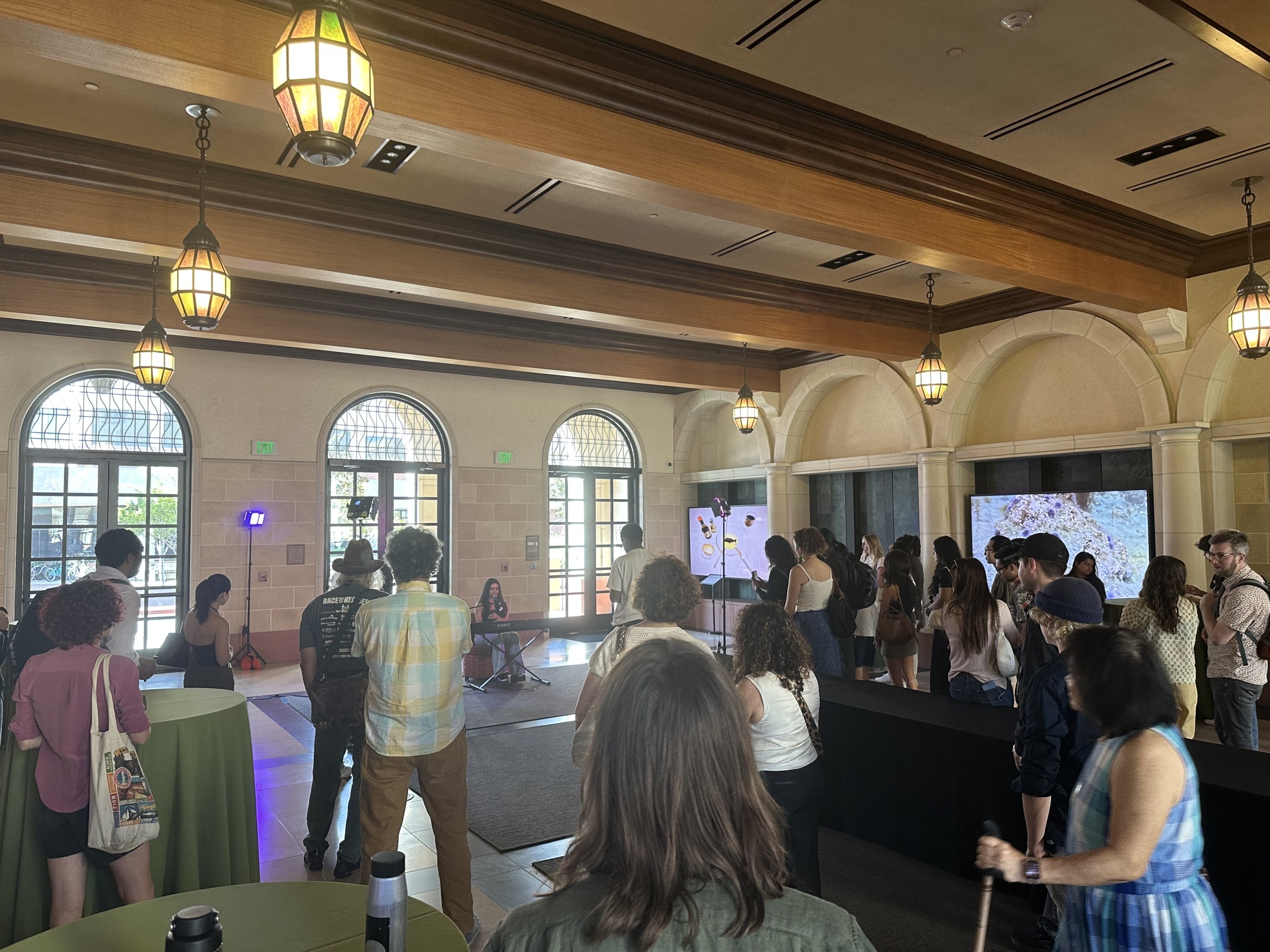

Filmmakers and artists from around the world came to USC to bring awareness to climate stories.
On Saturday, the Arts and Climate Collective, alongside the School of Cinematic Arts’ Division of Media Arts + Practice, hosted the fourth annual Eco Media Festival. The event, a multimedia arts festival dedicated to stories of climate awareness featuring pieces highlighting perspectives on climate consciousness from around the world, was organized by Arian Tomar, a senior majoring in cinematic arts, film and television production, and supported by faculty members Michael Bodie and Colin Maclay.
The event began with a panel discussion moderated by Natasha Nua, the founder of the festival, and spotlighted artists and activists Laurel Tamayo, Danny O’Malley and Maksim Snow. The panelists discussed their personal experiences and works in relation to climate activism, as well as their respective recent projects: the documentaries “Healing Lahaina” and “Canary” and the music project “loved lost loved.”
“The climate crisis is overwhelming,” Nua said. “So, I wanted to create a space where we can connect, inspire each other, learn and enjoy beautiful films.”
O’Malley proclaimed a similar desire in his work, also incorporating some ideas that echoed throughout the festival, specifically, individuals making big impacts in their communities.
“My goal is always to make something that resonates, because everyone’s on their own path,” O’Malley said. “It’s putting something out there that inspires people and shows them that, no matter where you start in life, you can make a big impact.”
Following the panel, attendees were ushered to a walkthrough of media art alongside a musical performance by Syante of her “moody, cinematic” anthem “Save Ourselves,” which deals with themes of climate urgency and human apathy to environmental collapse.
Avidha Raha, a master’s student studying journalism, discussed her piece, “Rising Above the Melt,” a documentary photo project recording the lives and hardships faced by young girls enrolled as Buddhist nuns high in the Himalayas. She said she wants to open up conversations about climate struggles in other parts of the world, such as the troubles with obtaining a reliable water source up in the mountains.
“People who contribute the least to climate change, they face it the most,” Raha said. “I want people to know what’s happening in the remotest corners of the world.”
The films screened were also from around the world, with Tomar mentioning that the nearly 100 film submissions the festival received came from over 27 countries.
“Starwhale,” a short animated film created by Rose Philander, a student at Pitzer College, discussed the connections humans have with the ocean through a post-apocalyptic sci-fi-inspired lens, with the lines between ocean and space being blended. This connection is taken literally by the characters in the film, who seek to initiate interspecies communication and mutual climate awareness with the titular whale-like creature.
“I was taking a course on the blue humanities about how different media over time reflect our view of the ocean and how we interact with the ocean,” Philander said. “I wanted to take those themes and make my own media that reflects what I thought our view of the ocean should be like.”
Another film featured at the festival, “Roper,” by Pitzer College students August Koskoff, Chloe Heath and Rachel Ma, was a documentary about the musician William Roper’s life in the aftermath of the Eaton Fire — which, as a result of poor environmental planning, decimated Altadena and killed a number of inhabitants of the communities there. Roper, whose Altadena house burned down in the fire, showcased how his life has changed and how his artistry playing the tuba has adapted since, all through the lens of climate awareness.
“We wanted to give him a voice and really share his story, because so many of the artists in Altadena lost their homes,” Heath said.
Koskoff said that one special moment he had when filming was when he filmed Roper playing the tuba at his home, and some of his neighbors heard him playing and stopped by to watch.
According to the filmmakers, this was one of the first times that the community, almost entirely destroyed by the Eaton Fire, came home to see what actually remained in the wake of the climate disaster.
“That was a really beautiful moment of community, where we got to see these neighbors interacting after they had just come back for the first time,” Heath said.
Koskoff said one film at the festival that he was a fan of was “Native,” directed by National University of Córdoba students Matias Racca and Lucía Cortez, specifically for its stop-motion style. The film showcased an anthropomorphized fox fighting against a mechanical tree cutter that seeks to destroy the fox’s home.
“It was a really creative way of portraying an issue through personifying a tool of deforestation,” Koskoff said.
The festival showcased the power of individual people doing their part to create change and make a difference on a collective level, according to Koskoff. Even though all of these artists and filmmakers come from around the world, they still all came together to stand up for climate awareness.
“In our world today, it’s sometimes hard to stay positive and optimistic, but being here at this festival reminds me that there are people that are out there doing as much as they can,” Heath said.
The festival certainly demonstrated this concept to its fullest, with narrative shorts, documentaries, animation and other forms of art all coming together to provide their own takes on how to grapple with the ongoing climate crisis and what they are doing to help.
“It’s really inspiring to know that people out there are continuing to do what they can for the environment and our communities,” Heath said.
Pieces from the festival will be featured as a digital showcase on the Arts and Climate Collective website starting March 4.
Correction: A previous version of this article misstated the inspiration for Avidha Raha’s documentary “Rising Above the Melt.” The article was updated March 6. at 9:25 p.m. to reflect that the project was not based on her experience teaching, and specified that the nuns in the documentary were Buddhist. The Daily Trojan regrets these errors.