Roski alum makes waves with community-centered artwork
Rahzizi Ishakarah’s recent football-field-sized mural is now a surf-centered landmark in Watts.
By THAMRA HUSSAIN
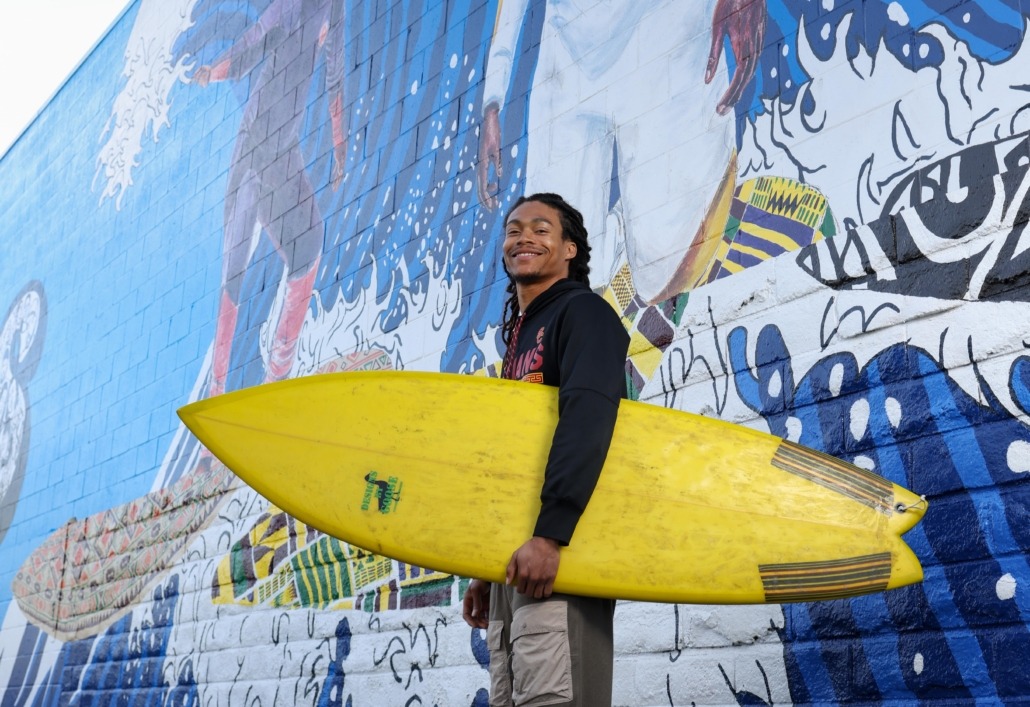

Rahzizi Ishakarah’s recent football-field-sized mural is now a surf-centered landmark in Watts.
On Feb. 8, the Watts Labor Community Action Committee unveiled a mural the size of a football field in Watts, adorned with images of brown and Black surfers and neighborhood icons. The artist behind the piece was USC alum Rahzizi Ishakarah, a multimedia artist and 2021 graduate from the Roski School of Art and Design.
Highlighting the roots of surfing in Black, Indigenous and other underrepresented communities and creating a landmark in Watts, a neighborhood in South Central. The piece is also a call to action, encouraging Black, Indigenous and people of color to explore the sport of surfing and reclaim areas once closed to them.
For Ishakarah, finally unveiling the mural that was once just an idea four years ago felt surreal. “I was kind of floating,” he said, reflecting on the day of the unveiling.
Tim Watkins, the CEO of WLCAC, L.A. City Councilmember Tim McOsker and Mayor Karen Bass’s office were all in attendance.
From a young age, Ishakarah was immersed in art, taking part in community art camps held by his dad in his hometown of Jackson, Mississippi, before attending art-focused middle and high schools, where he learned various mediums. Even now, Ishakarah is an artist of many mediums, including drawing, graphic design and photography.
Bryson Nihipali, Ishakarah’s friend and a fellow USC alum, said Ishakarah is a forward-looking and multifaceted artist. Both Ishakarah and Nihipali connected at USC over their shared backgrounds, both coming from underrepresented communities, Jackson and Hawaii, respectively.
“We’re always trying to maximize that privilege that we have being USC students and looking at ways to bring longevity to the work that we’re planning to do,” Nihipali said.
Throughout his time as a student, Ishakarah’s mastery of different artforms made him stand out to his professors and peers, according to his former professor Peter Robbins, who called him “a renaissance creative mind.”
“He really mastered that ability to cross-pollinate his work,” said Robbins, an adjunct professor at Roski, describing his development across mediums.
As Robbins puts it, as an artist, Ishakarah is “very representative of Roski,” and among the best Roski students who meld art and design.
Despite graduating during the height of the COVID-19 pandemic, which compounded the ever-present unpredictability that can come with being an artist, Ishakarah said he was determined to succeed, becoming proficient in multiple art forms to maximize his skill set for a future career.
Ishakarah started working at a nonprofit, Black Out the Ballot, after graduation and found himself creating a chalk mural for WLCAC for Juneteenth. “From there, it just felt like home,” Ishakarah said, and he has been working with them ever since.
Through WLCAC, he was able to create his latest mural, which was a difficult project, he said took four years of planning and over 150 volunteers who worked on the piece for three months.
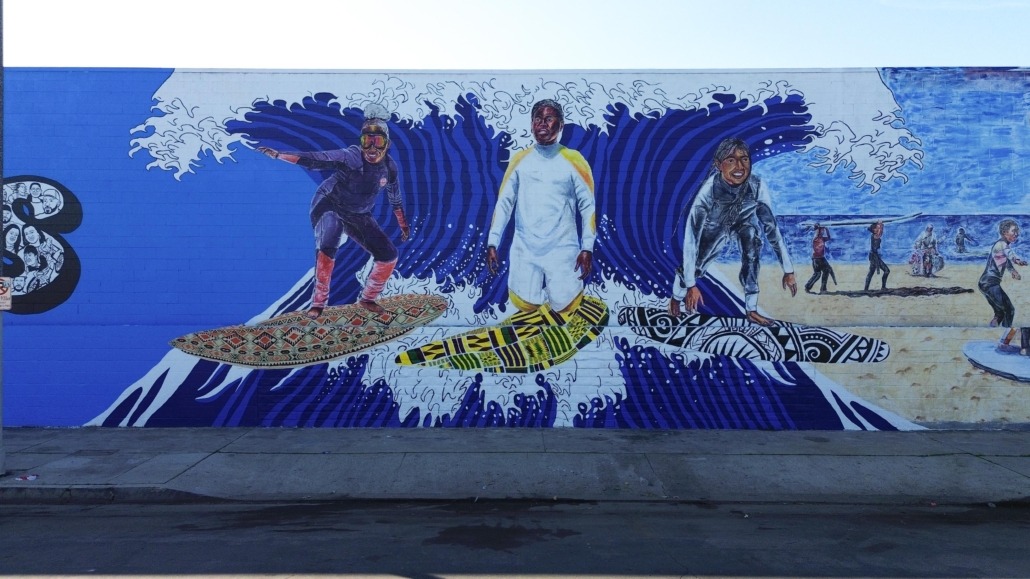
The piece is covered with intricate images of community figures in Watts and surfers of color. Ishakarah said the time spent working on it was worth it in the end. He said the four years gave him time to document the stories of the community he would soon amplify with his art.
“Everything happens for a reason,” Ishakarah said.
Representation of people of color in surfing is immensely important to Ishakarah, who shared that his journey to becoming a surfer was one of immense meaning and discovery.
“I didn’t know how to swim until I got to USC,” Ishakarah said. “I was always saying I can’t swim because I’m Black. And for me, I wanted to defy those stereotypes.” After learning to swim, he learned how to surf and soon came to understand that there was a strong history of surfing among people of color in Coastal Africa and South America
However, the stereotypical face of surfing often excludes people of color. This fact, coupled with historical barriers that have kept Black people out of the water, has led to much fewer Black faces in the world of the sport.
The mural, therefore, highlights the true history of surfing, while also celebrating Watts and the important people who came from the neighborhood, including JuJu Watkins and Florence Griffith Joyner.
Even the creation of the mural challenged preconceived notions people have of Watts. Ishakarah remembers being asked, “why are you doing a surf mural here?” as he worked in the neighborhood, and took this as a chance to educate others and challenge stereotypes.
That is to say, the mural doesn’t stop at simply illustrating surfing. Ishakarah said the mural is a call to action as well. In 2021, WLCAC partnered with Color the Water, a BIPOC-centered surf organization that taught Ishakarah how to surf. Now, they give free surf lessons to Watts kids in the summer, and the mural ends with a link that shares resources for free surf lessons, to help reclaim the history of surfing in communities of color.
Nihipali said the mural solidified a full-circle moment for Rahzizi, coming from Jackson, Mississippi, an inner-city area like Watts.
“His whole idea with being from Jackson is, like, a lot of these places are overlooked and seen as bad places to go,” Nihipali said. “He wants Watts to be like a place that you want to go in L.A., like a community where people feel welcomed and safe.”
Ishakarah’s love for his community, especially inner-city areas, is something he’s taking with him into his future work. He’s working on a documentary that showcases the cultural overlap of inner cities across America, like his hometown, Jackson, and his current base in Watts.
After the mural, Ishakarah also wants to get back to more personal projects. Celebrating a decade of creating art in Los Angeles, he hopes to hold a ten-year show to celebrate, and is working on a coffee table book of his charcoal drawings, many of which showcase USC alumni.
Despite how far he has come, Ishakarah always remembers to stay true to himself and his roots, and wants to make sure his art always exemplifies that. He advises fellow artists to do the same and use this as their compass: “follow the story that you believe in, that you want to tell.”