Students get their groove on at ‘The Dance Cure’
Campus Health’s ‘Great Read’ this year touts the mental and physical health benefits of dancing.
By QUINTEN SEGHERS
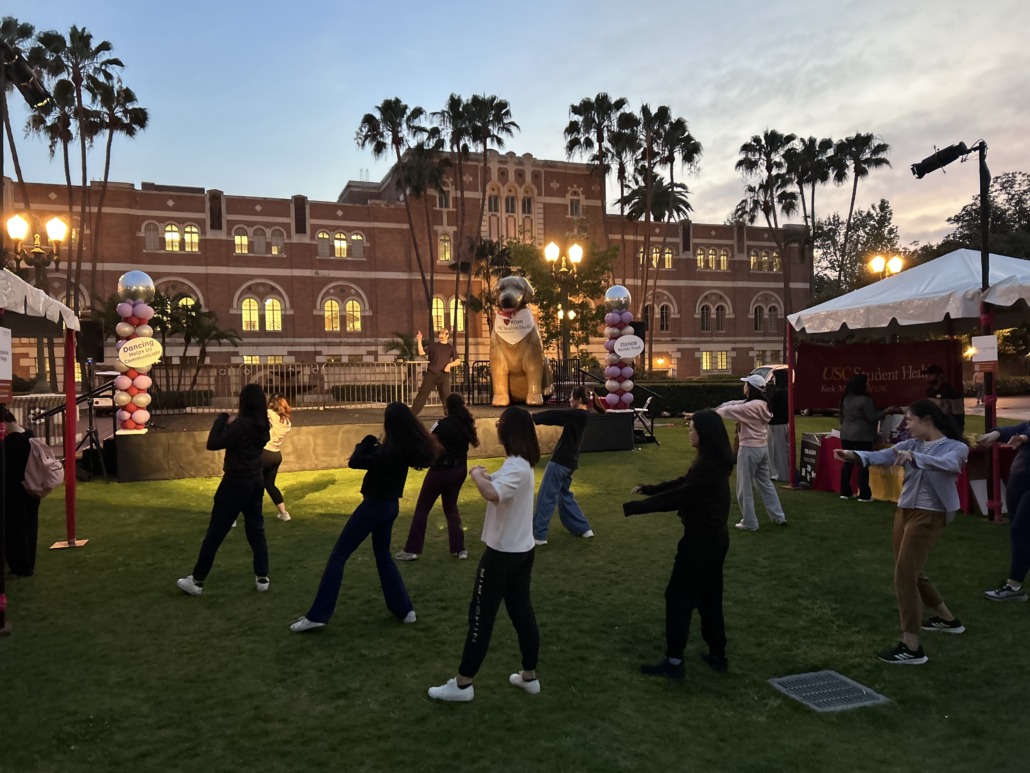

Campus Health’s ‘Great Read’ this year touts the mental and physical health benefits of dancing.
Students took polaroid photos, picked up free sexual wellness kits and danced their hearts out under the watchful eye of a giant inflatable golden retriever — Student Health’s mascot, Rumi — at McCarthy Quad on Wednesday evening.
The event, called “The Dance Cure,” is a part of Campus Health’s Great Read campaign, which is a campus wide book-club centered around health topics. Once a health-related book is chosen, events are held pertaining to its subject area. This year’s chosen book is “The Dance Cure” by self-proclaimed “dance psychologist” Peter Lovatt.
Lovatt’s book explores the science behind how dancing can improve one’s physical and mental well-being. He argues humans are born to dance and that doing so regularly can boost self-esteem and improve problem-solving skills.
“Dancing is special in terms of the way it impacts both our physical and psychological well-being, as well as building community,” Chief Campus Health Officer Dr. Sarah Van Orman said in a briefing with campus media Feb. 24. “[Dancing] can happen in your house by yourself, that’s totally great, but many times it can also happen in community and have extra benefits.”
The event alternated between instructor-led dance sessions of various musical genres, like pop, salsa and student group performances. Gigi Campusano, a member of Break Through Hip Hop and a freshman majoring in international relations and the global economy, said going to her dance practices boosts her mood and gives her an opportunity to bond with others.
Both Student Health and the Graduate Student Government tabled at the event, offering stickers, trinkets and information about the various resources they offer students.
Janielle Cuala, GSG president and a Ph.D student studying medical biophysics, alternated between manning the GSG booth and dancing. Cuala said she wants graduate students to know they “can still have fun” outside their academics and that GSG is there to hear their concerns.
“This is a really good space for grad students to take a break,” Cuala said. “I didn’t know just a dance break could be so powerful. My mood is up right now.”
Teresa Lara, associate director of outreach and community engagement for Campus Health, said before the event kicked off at 5 p.m, a “pregame” was held by students who took up Campus Health’s offer to lead their peers in a cultural dance. Sharon Salgado Martinez, a Ph.D student in history specializing in Chicano history, was one of those students and taught her peers the cumbia.
Martinez had learned cumbia, a dance she said developed in Colombia during the 17th century as a form of resistance to slavery, in Mexico City, but had never tried teaching it to others.
“It has lasted for centuries because of its meaning, but also [because] how it makes people get together and enjoy life in the moment,” Salgado Martinez said. “[It] gives you so much adrenaline, so much energy. I feel so alive right now.”
The event concluded with a raffle consisting of GSG merchandise, t-shirts and one grand prize — a Beats Pill portable speaker worth over $100. The event was intended to create a shared space for people who normally would not cross paths with one another to meet and to build community, Lara said.
“Dance is universal. It’s low-cost, high-gain,” Lara said. “I can’t tell you how many times I leave the house stumpy, and then [I] workout, come back, and I can’t even remember what I was mad about because it just shifts my perspective. And that’s what we wanted to offer, especially before midterms.”