Artists embrace imperfection at experimental music show
Several students and alumni showcased their electronic and visual expertise Friday.
By FIN LIU


Several students and alumni showcased their electronic and visual expertise Friday.
Pouring water from her sticker-decorated bottle onto potted plants that she’d set up in front of her mixboard, Yucca Maineri invited the audience to get up from their seats to touch the plants as part of her set during an experimental electronic music show Friday night.
Maineri, a USC alum whose stage name is Apolla, created an interactive, immersive experience that integrated plants and nature into her performance. Maineri graduated from USC in 2025 with a degree in neuroscience and a minor in music production and used to work in the Brain and Creativity Institute as part of the Dornsife Neuroimaging Center.
“I always loved the whole idea of certain frequencies and music helping us feel better, even healing certain parts of the brain and the body, and helping us with memory and learning,” Maineri said.
Hesitant at first during Maineri’s set, one audience member scooted closer to the pots and brushed their finger across the leaves. One by one, more people caressed the leaves, which produced different frequencies as audience members touched them.
Coaxial Arts, a collective that helps lesser-known artists showcase their work, hosted the performance and welcomed spectators with a glowing display of retro televisions that showcased their logo. Recent graduates and current students of Thornton School of Music joined forces to perform at the show.
The event was hosted by Chloe Villamayor, a first-year master’s student studying music composition known on stage as Gari, and featured performances from Apolla, Yumu, Warbler Ensemble and herself. Villamayor said one of her professors connected her with Coaxial Arts to bring the show to life, and met many of the artists featured through a music technology course at the University.
Maineri said when creating the piece she performed on Friday, she thought about the pain people are facing due to the recent United States Immigration and Customs Enforcement mass deportations.
“Nature has always shown us that the true way to live is to sprawl out and to immigrate,” Maineri said. “It’s such an integral part of nature, not even just human nature. And so [the music is] bridging those two: humans and nature.”
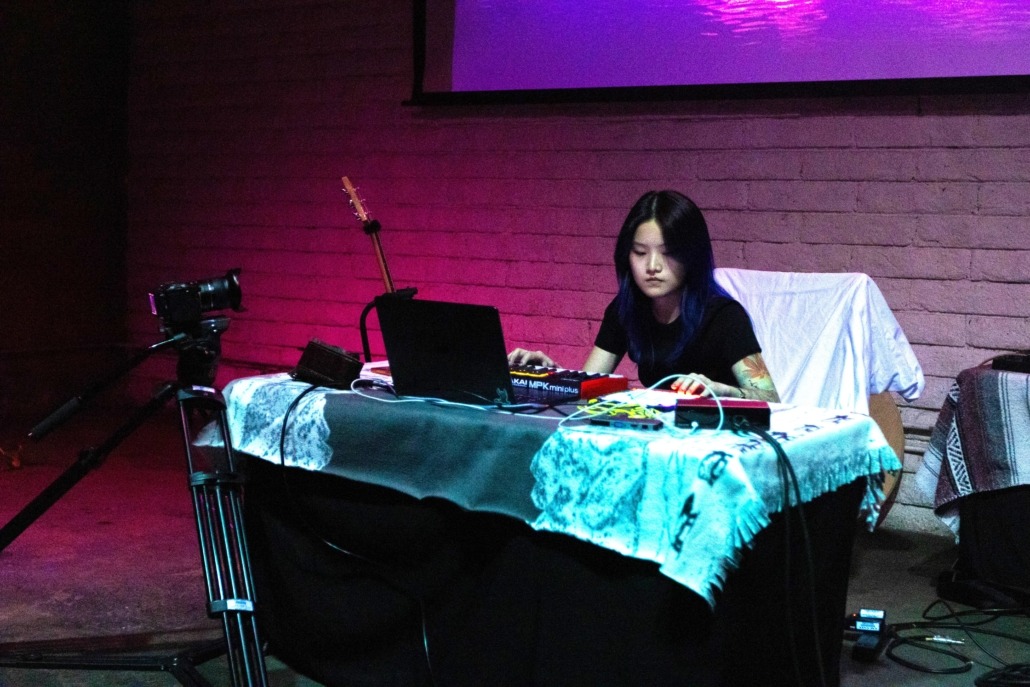
Roski School of Art and Design alum Yumu Huo’s performance was darker and edgier than the other performances Friday and combined experimental music and computer-generated visuals, which flashed to the beat of her music.
“I was trying to make music that makes people imagine stuff like entering a new world with different surroundings, just the intuitions that I have at the moment,” Huo said.
Huo said she visits studios of artists of different mediums, such as sculpture, paintings and ceramics, to get inspiration and find a middle-ground between visual and performing art.
Following Huo was Warbler Ensemble, a duo consisting of Evan Williams, a junior majoring in music composition, and Gibson Mahnke, a senior majoring in music composition. Williams and Mahnke strummed their guitars in a slow-paced piece that teased the audience before bringing Emi Savage, a junior majoring in media arts and practice, on stage, who created digital visuals that adapted live to the breadth of the music.
Savage initially signed on to create advertisements for the event, but later took on the role of VJ, or visual jockey, for Warbler Ensemble after the duo asked if she was interested.
“I only met the other members of Warbler Ensemble just this week,” Savage said. “I’ve been self-teaching TouchDesigner this summer, so it was really nice to finally have a chance to put it to use.”
Savage curated archival footage from Internet Archive, a non-profit digital library, and used TouchDesigner, a visual programming platform, to create a live-projected visual that reacted to the volume levels of the music. The visuals displayed a long expanse of road combined with a semi-transparent overlay of birds soaring through the sky.
Villamayor, the headliner of the event, closed out the show. She said her classical music background, combined with computer science classes, influenced her music, which blends melodious synths with her dulcet vocals.
Villamayor brought Huo back on stage to play guitar to accompany her vocals. Villamayor’s metallic accessories brought a futuristic vibe to her set. She began by looping her vocals, with the reverb creating an eerie echo. The visuals behind her flashed green and pink, lighting up the room while she sang.
After a brief intermission due to technical difficulties, Villamayor started singing once more. Then, her laptop seemingly crashed, and she paused the performance. During her second song, an abrupt screech interrupted the show. Due to the various hiccups, Villamayor thanked the audience for coming to the event and decided not to finish her set.
“This is the most prepared I’ve felt for a gig, and then, for whatever reason, everything just broke,” Villamayor said. “There are some things that are just out of your control, and I think I’m at peace, because I knew that going in, and, at the end of the day, it’s just music … Embrace failure and don’t let it get you down.”