Students pitch solutions for LA28 challenges
The event allowed student groups to engineer ideas for sustainability and efficiency.
By ZACHARY WALEN
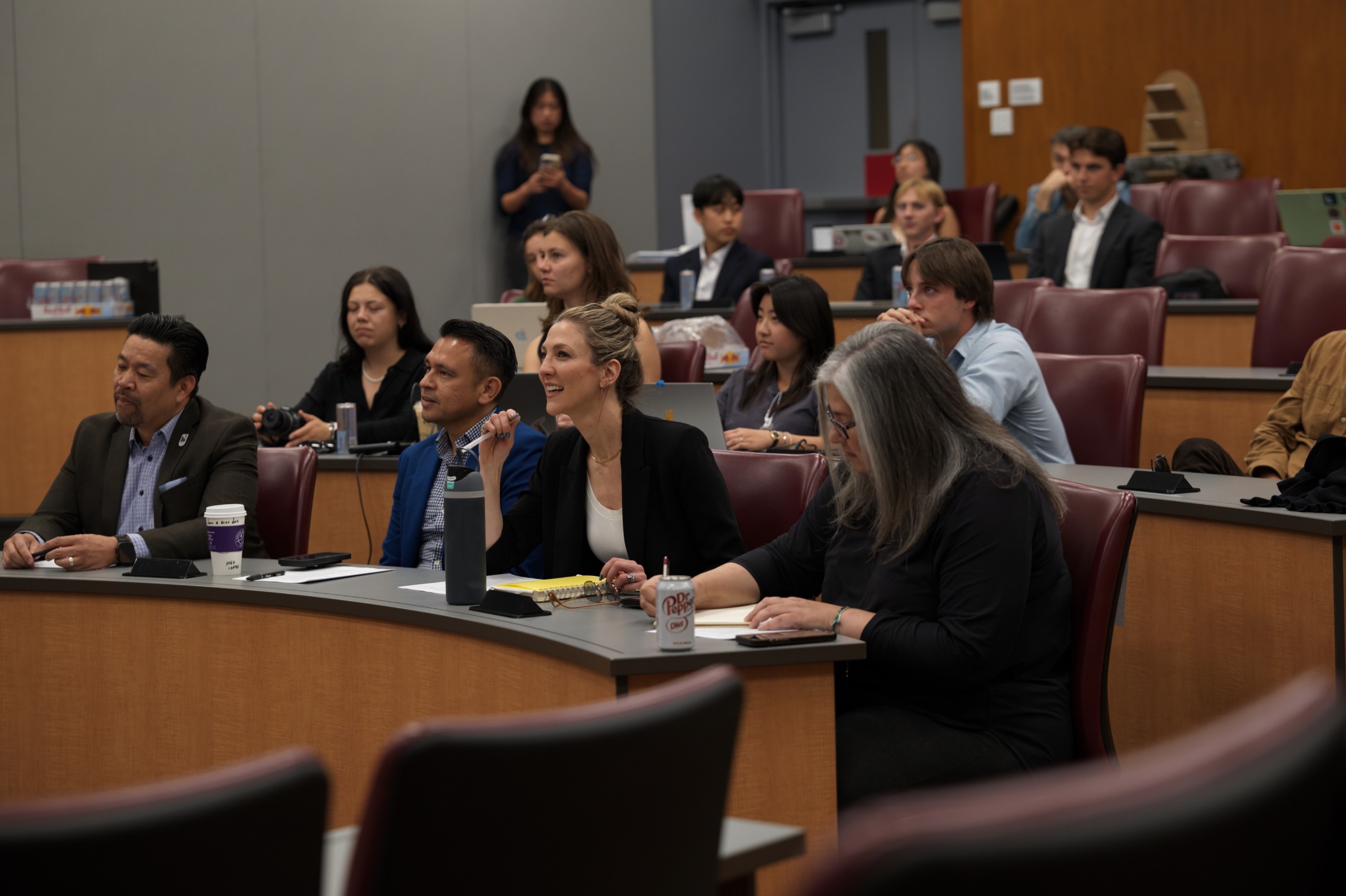

The event allowed student groups to engineer ideas for sustainability and efficiency.
Late nights, research and outreach paid off for Salma Setia, a junior majoring in health promotion and disease prevention studies, as well as her team Friday afternoon, when the judges of USC’s first The Games Week hackathon announced her team had won the $1,000 grand prize.
“I’m feeling like an Olympian,” Setia said.
The hackathon tasked student groups with developing solutions to tackle one of six “critical needs” Los Angeles has to address before LA28, including sustainability, resilient infrastructure and community impact. On Friday, the five finalist teams — made up of both USC students and a handful from other institutions —- pitched their ideas to a panel of judges to close out USC’s The Games Week programming.
Setia and her team’s pitch was called MatterFlow, a machine that quickly sorts through trash and separates recyclable aluminum objects — a process that the L.A. Memorial Coliseum said would take between four and five days after events like USC football games. She said the process would be too slow if multiple events were held in quick succession during the Olympics.
“Instead of just one USC football game, seven Super Bowls will be happening every single day with the whole world watching,” Setia said during her group’s presentation. “Everyone will have their eyes on the field, but we’re focused on what happens after everyone leaves it.”
In an interview with the Daily Trojan, Setia said she and her team came up with the idea for Matter Flow after visiting the Coliseum and seeing employees hand-sort the trash from thousands of spectators’ trash after a USC football game.
“When we were really thinking about what challenges would L.A. face, we saw that that was right across the street,” Setia said. “[By] talking to the actual people who are sorting and managing those operations, we saw this gap and opportunity to optimize this very manual, very slow process.”
Other groups focused on creating solutions designed to improve transportation in L.A. The third team to present, made up of one USC student and two from Santa Monica College, pitched retrofitting the Alameda Corridor — a train which runs from Long Beach to Ddowntown Los Angeles — with magnets.
Alnur Askar, a sophomore majoring in business at Santa Monica College, said the repellent forces between the magnets reduce friction between the train and the tracks, therefore reducing energy consumption.
Alameda Corridor runs from Downtown L.A. — home to six Olympic venues — to Long Beach — which has seven Olympic venues — and the Port of Los Angeles, which is also an Olympic venue. Currently, the Alameda Corridor primarily services freight trains; Seth Moberg, a team member and first-year majoring in public policy at Santa Monica College, said the group hoped to create a way for the corridor to serve passenger and freight trains during the Games.
“Our goal is to affect the transportation solutions for the LA28 committee, [and] to use [LA28] as a foundational demonstration for the technology as a whole,” Moberg said. “We would love to build upon this and work with the state eventually.”
When the team found out they were finalists, Askar said the team stayed up until 6 a.m. building a prototype of their product.
“We almost [went on] an all-nighter to make this,” Askar said. “We’re really happy about the design of the prototype because it shows the functionality of our product.”
Alongside the judges’ decisions, audience members were also able to vote on their favorite pitch; their vote went to the proposed company Bus In’, which won second place.
Jack Miller, a freshman majoring in mechanical engineering, pitched Bus In’, alongside two other USC students, as a shuttle company that adjusted routes based on customers’ needs. Spectators would input their location and destination, and Bus In’ would determine the best route to get them to their sporting events. Miller said each ride would cost passengers $15 to $20.
Deacon Larson, a junior majoring in business, said transportation during LA28 would be “chaotic,” predicting Uber and Lyft prices surging and describing the Metro as confusing and unpredictable. Larson said Bus In’ would be more reliable and efficient than other transportation options, providing ease of mind for Olympic spectators.
“For a once in a lifetime event, when you’ve already spent money on planes, hotels and tickets to the game, you don’t want to miss the whole thing because you waited too long for an Uber or you caught the wrong train,” Larson said.
In an interview with the Daily Trojan, Larsen said earning the audience vote was “the best feeling in the world,” and he was eager to continue developing the product.
“It’s a great competition. We got a great team, a great idea, [and] we’re super excited,” Larson said. “We’re gonna have a great time.”
Ishaani Pradeep, a member of the MatterFlow team and a senior majoring in biomedical engineering, said it felt great to hear the judges validate that their idea could make a positive difference in their community.
“[The win is] phenomenal, we’re ecstatic, and it just makes us more passionate about our project,” Pradeep said.