NO STRAIGHT ANSWERS
You are enough for yourself
In a world built around couples, finding comfort in your own company can feel like an act of independence.

By ANDREW CARDENAS
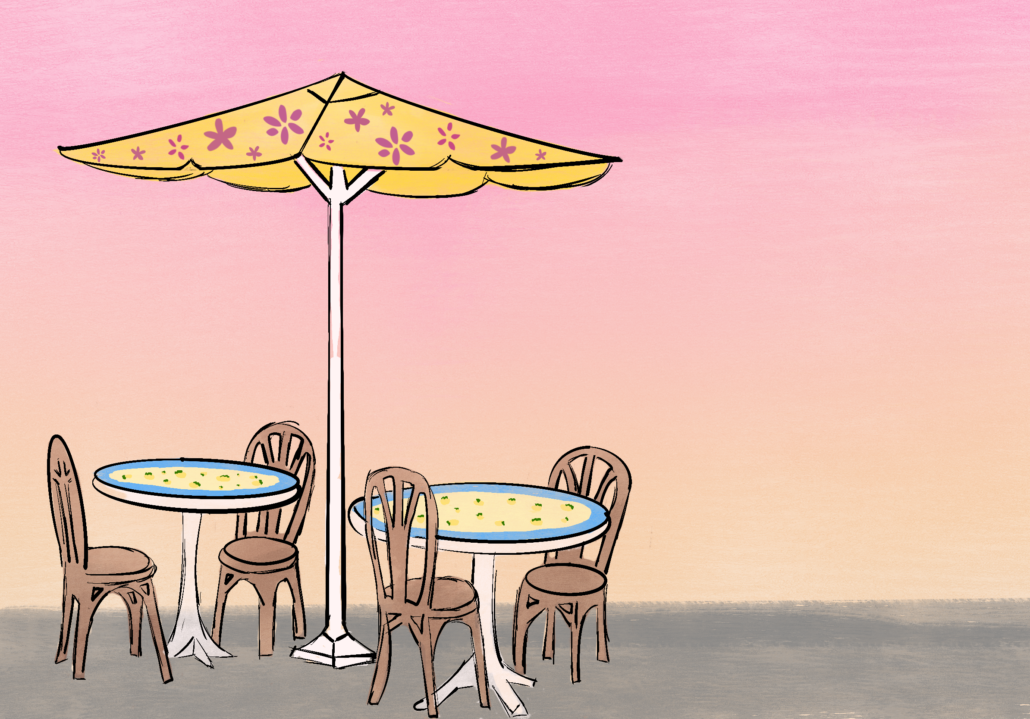

In a world built around couples, finding comfort in your own company can feel like an act of independence.
Early last Wednesday, I was sitting on a bench. It wasn’t particularly large, but it was clearly designed with a pair in mind — two people leaning into the same small pocket of space.
The problem was that there were three of us.
A couple sat pressed close together on one side, moving between laughter and whispers. I was on the other end of the bench with my laptop open, trying to occupy the leftover space without disturbing the symmetry.
But the truth was obvious — I was overcrowding the bench. So after a few minutes, I packed up my things and moved. Nothing dramatic — just a quiet relocation to the Leavey Library basement. But walking away from that bench left me with an uncomfortable realization: Most things in life are built for pairs.
Restaurant tables are arranged for two — two people talking across a table feels natural — or four, a pair of pairs. Movie theaters place seats shoulder-to-shoulder in tidy rows, pairs of park swings hang side by side and even sidewalks’ widths seem designed for two people to walk abreast in conversation.
Once you start noticing it, the pattern appears everywhere. Two is the social unit our culture treats as complete. For a long time, I made sure I always had someone beside me: If I was studying, I texted someone to join; if I was getting food, I invited a friend. Constantly searching for company felt productive, but it also meant I rarely had to sit with my own thoughts for very long. For years, that partner was usually my childhood friend.
We built the ordinary architecture of life together — late-night food runs to the taco stand outside USC Village Great Lawn, playing catch at McCarthy Quad and filling the quiet hours with easy company. But eventually, as it does for many friendships, the structure shifted as soon as they got a girlfriend.
Without that built-in duo, I had to decide what to do with my time alone. And that’s when the more uncomfortable realization surfaced: I wasn’t just used to doing things in pairs. I was afraid of doing them alone.
Being alone tends to carry a strange cultural stigma, especially in public spaces. Sitting alone at a long table — meant for six or seven people — can feel like a small act of social rebellion. Even something as simple as walking into a restaurant by yourself or watching a movie alone can make you feel briefly out of place, as if you’ve missed the person you were supposed to arrive with.
It’s in those moments that thinking about love becomes unavoidable. Love is difficult to think about in the abstract: It arrives with a mirror attached.
When people talk about love, they almost always mean it in pairs — the romantic kind, two people finding each other and forming a unit. The moment you start thinking about romance — what it means, what it feels like, what you want from it — you’re also forced to confront your own relation to it.
Are you inside that kind of love? Are you searching for it? Or are you standing somewhere just outside the frame, watching other people inhabit it? In that sense, romance is deeply existential.
French philosopher Jean-Paul Sartre wrote in “Being and Nothingness” that “existence precedes essence,” meaning humans are not born with predetermined nature or purpose. Unlike objects designed with a fixed function — a shoe is used to protect a foot, for example — our essence is not given to us in advance. Instead, Sartre insisted, we are “condemned to be free,” responsible for creating meaning through our own choices.
But in moments of loneliness, the temptation is strong to outsource that responsibility — to look for completion in someone else’s arms. The danger in that way of thinking is subtle but real. To believe another person completes you implies that alone, you are incomplete.
In Sartre’s terms, that belief is a form of bad faith — the quiet illusion that meaning lives somewhere outside us: in the right relationship, the right validation and the right someone. It’s easier to shape ourselves around what’s desirable than to sit with the discomfort of being entirely responsible for who we will become.
Still, understanding this doesn’t erase longing. Freedom does not cancel the desire to share your life with someone. Even if love cannot give life its meaning, it can still make carrying that meaning easier.
Romantic love is not meaningless — but it shouldn’t be mistaken for meaning itself. If Sartre was right, then purpose is not discovered in some elusive other person. It is created through everyday choices we make. Sometimes those choices involve love. Sometimes they involve sitting alone at a table meant for two and realizing you are still worthy of occupying space.
Standing up from that overcrowded bench made me realize how rarely I actually allow myself to do that. Adulthood eventually requires something we rarely practice when our lives are structured around pairs: learning how to inhabit your own life.
The bench I left earlier is probably full again by now. Life will always offer places designed to accommodate pairs.
But learning how to occupy your own life — not as half of a pair, but as a whole person — might be the most difficult transition adulthood demands.
Andrew Cardenas is a junior writing about love in all its forms in his column, “No Straight Answers,” which runs every other Wednesday. He is also the DEIA director and Talkin’ Troy editor at the Daily Trojan.