Politicians, professors react to criticisms of USC on gubernatorial debate
President Kim cancelled the debate after national attention and criticism over which candidates were chosen.
By STELLA MUZIN
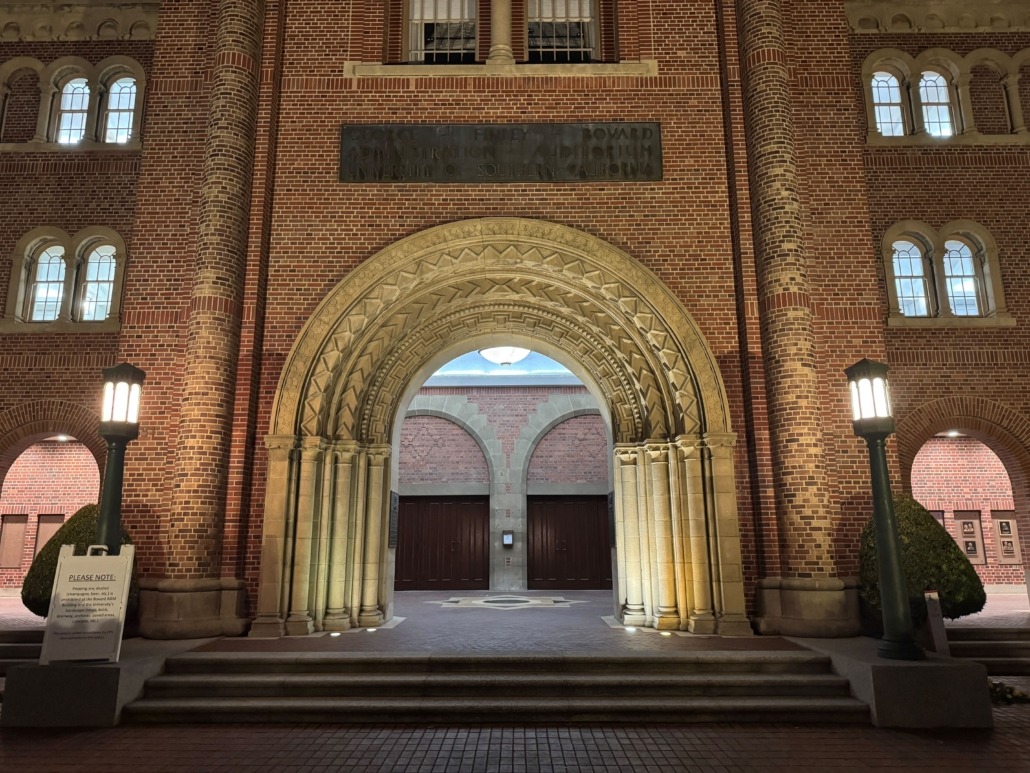

President Kim cancelled the debate after national attention and criticism over which candidates were chosen.
USC President Beong-Soo Kim cancelled Tuesday’s California gubernatorial debate less than 24 hours before it was set to take place on the University’s campus. The University was set to co-host the debate along with ABC7 in Bovard Auditorium.
This decision comes after Democratic gubernatorial candidate Xavier Becerra criticized USC in a public letter on March 14 for not including any Democratic candidates of color in the gubernatorial debate, under a formula developed by USC professor of political science and public policy Christian Grose.
In a statement to the Daily Trojan, USC wrote that it was unable to “reach an agreement [with ABC7] on expanding the number of candidates at tomorrow’s debate” and therefore cancelled the event.
USC’s Open Dialogue Project wrote in a statement on Instagram that it disagreed with the University’s decision to cancel the debate, writing that it “believe[s] disagreement is best navigated through more dialogue — not less — and look[s] forward to using this moment as an opportunity to engage in constructive conversation.”
Trojan Democrats put out a similar statement on its Instagram, stating that it condemned USC’s decision.
“We reject any suggestion that Professor Grose or the Center for the Political Future acted in bad faith or sought to unfairly shape the debate field to favor or disfavor any candidate,” the statement read. “At a moment when voter engagement is critical for our democracy, cancelling the debate entirely is both counterproductive and deeply disappointing.”
The four excluded candidates criticized Grose’s formula to choose which candidates would participate in the USC debate. As described by Grose, his calculations of which candidates would qualify for the debate weighed candidates based 65% on polling percentages and 35% on fundraising.
“The reason that the University should support Professor Grose in this situation is that there were very prominent, powerful people attacking his personal reputation,” said Morris Levy, associate professor and vice chair of the department of political science and international relations. “There is a place for comment on matters of direct concern to the University, and the reputation and esteem of faculty members would be paramount among those situations.”
More than 50 professors and scholars from USC and other universities released a statement Monday calling on USC to “publicly and unequivocally affirm Professor Grose’s integrity as a valued scholar.”
“Substantive disagreement over scholarship is the lifeblood of the university,” the statement read. “All of us expect and welcome critical engagement from inside and outside the academy. What Professor Grose has faced, however, is not substantive or methodological debate … These are harmful character assassinations, not substantive debate.”
In its statement cancelling the debate, USC wrote that it “vigorously defends the independence, objectivity, and integrity of USC Professor Christian Grose.”
Aria Hoch, a former student of Grose and a sophomore majoring in political science, said that the outrage against Grose has been difficult to see and deeply unfair.
“He was very understanding. He was very smart,” Hoch said of her interactions with Grose. “When you look at the algorithm itself, he was trying to improve traditional methods used to determine candidates for debate. Usually, they only do polling. So [Grose] adding in fundraising over time is backed not only by research … but also speaks to his thoroughness in trying to create a multi-dimensional approach to evaluating candidates. That’s a really tough job to do.”
In an interview with L.A. Material, President Kim confirmed that he made the decision to cancel the debate, stating that he wanted to expand which candidates were participating, but ABC was unwilling to do that.
“In advance of the decision, there were legislators and candidates who were critical of USC,” Kim said to L.A. Material. “I want to make it very clear that my decision was not in any way influenced by those demands or threats.”
The event co-hosts — USC’s Center for the Political Future, ABC7 and Univision — released a joint statement Friday, stating that they deny the claim that the debate criteria was in any way biased.
“The methodology was based on well-established metrics consistent with formulas widely used to set debate participation nationwide — a combination of polling and fundraising — and developed without regard to any particular candidate,” the statement said.
The co-hosts had reinforced their decision in the statement to not add additional candidates to the debate stage.
“If we were to change the composition of the debate participants at this stage, we would be doing the very thing these candidates are accusing us of doing by unfairly influencing the criteria to reach a pre-determined outcome,” the statement read.
According to Levy, the decision for the debate to be cancelled so close to the actual event was particularly surprising.
“I had no indication that it could be canceled; I had seen a full throated defense of the debate, and a sort of a forge ahead message from the Center for the Political Future, and also from ABC last Friday,” Levy, who was one of the letter’s signatories, said. “ I was also surprised because I know that President Kim has had a lot to say about his commitment to … core academic values, and I think we’ve also had indications that he’s serious about institutional autonomy.”
Another reason USC said it decided to cancel the debate was because it felt the controversy over which candidates would be included would “have created a significant distraction from the issues that matter to voters.”
CPF also said prior to the cancellation of the debate and in response to criticism that it would invite “all candidates” in for sit-down interviews that CPF would post on its website.
While Levy said he believes there is nothing that can be done to solve the situation at this point, he hopes the University learns from this experience.
“My hope is that in the future, USC demonstrates a commitment to integrity and communicates that to its community and to the world that it will stand on principles that it professes to believe in,” Levy said.