USC Surplus Store diverts move-out waste from landfills
The store finds new homes for items donated by USC students and departments.
By NIDHI BHOGI & ANNA RYAN
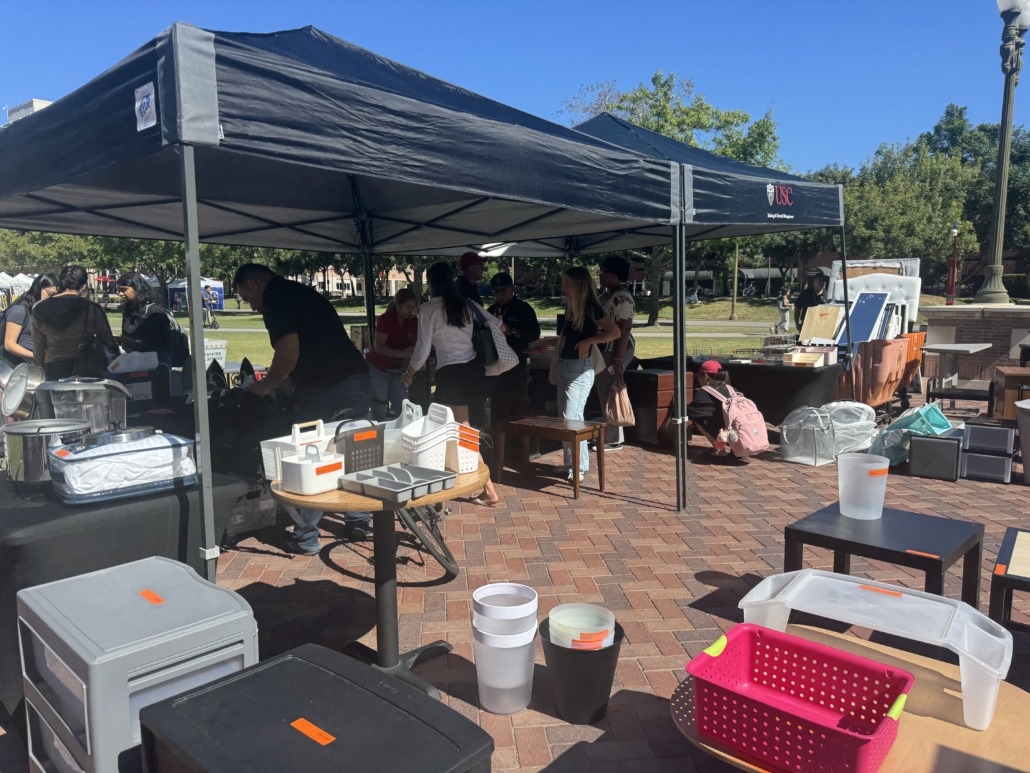

The store finds new homes for items donated by USC students and departments.
When Lucian Frisby moved out of his dorm sophomore year, he had to throw away items like laundry baskets, storage containers and shower caddies.
“I had to fly back home before I moved into off-campus housing. I had to leave behind a lot of things because I couldn’t physically take them back home,” said Frisby, a junior majoring in English.
Frisby said that being able to give away his things to someone who could use them would have made him feel a lot better. At this time, Frisby had never heard of the USC Surplus Store, a second-hand store aimed to mitigate waste generated from student move-out.
Beginning in October 2025, after a pandemic hiatus, the USC Surplus Store offered a new home to furniture and household objects donated from USC departments and students. To buy items, prospective customers register to shop with their USC email and then pick up purchased items from the warehouse.
At USC, about 7,000 students move out of University housing every year. On average, college students in the United States produce about 640 pounds of trash each year, according to Planet Aid, a sustainable development non-profit.
Calvin Holmes, the director of mailing and material management services, which manages the USC Surplus Store, said it offers refurbished items at “bargain” prices.
“My goal is to get us to a point where students and faculty alike are looking towards us first whenever it comes to buying items, so that way, we’re not generating new waste,” Holmes said. “The more that we’re able to repurpose these items, the greater impact we have on our sustainability efforts.”
The surplus store team evaluates the condition of every item that is donated on location, and brings them to the store’s warehouse, less than a mile from USC’s campus, Holmes said. So far, their process has seemed effective. According to Holmes, the store diverts 15% to 20% of items that would have been discarded upon move-out.
“If we look at the previous state, where there was no Surplus Store, a lot of students would gather older items from dorms and place them into a bin that goes directly to the landfill,” Holmes said.
The Surplus Store also donates some of the clothes it receives during move-out week to Office of Sustainability-hosted FreeSCycle Fridays. The monthly events from January to April allow anyone with a USC ID to pick through donations and go home with any item they choose for free.
“A lot of our presence relies on opportunities that the Office of Sustainability is able to provide,” Holmes said. “We’re finding creative ways to find customers and students so they can shop with us. We’ve grown from about 100 to well over 3,000 followers [on Instagram].”
Millanna Biller, a sophomore majoring in environmental studies, said she has noticed the University’s sustainability efforts through compost and recycling bins, and sees the Surplus Store as an opportunity to further waste-reduction efforts on campus.
“It gives whatever is being donated a little bit longer of a lifespan, which is important to get as much use out of one product as you can,” Biller said.
In addition to the Surplus Store, the University has taken further measures to promote sustainability during move-out. At the end of each year, USC Housing and the Department of Public Safety collaborate with Goodwill and the American Textile Recycling Service to repurpose second-hand items that students are unable to bring home with them, such as extra bedding and clothes.
“[Buying] secondhand would, one, save me a lot of money,” Frisby said. “Second, when I would get stuff from IKEA, I would have to rebuild it, so it [would save] me a lot of time as well.”
Holmes said the mental shift in students is key to improving sustainability efforts, especially considering the Surplus Store functions on donations and does not offer any incentive for people to part with their things.
“If you’re a student and you need to replace something, or you need to purchase something new, think about where you want it to go, and how you can try to prevent it from just going to waste,” Holmes said.