Faculty organizers prepare for April union vote
The election will culminate a roughly year-long effort to unionize non-tenure faculty.
By SEAN CAMPBELL
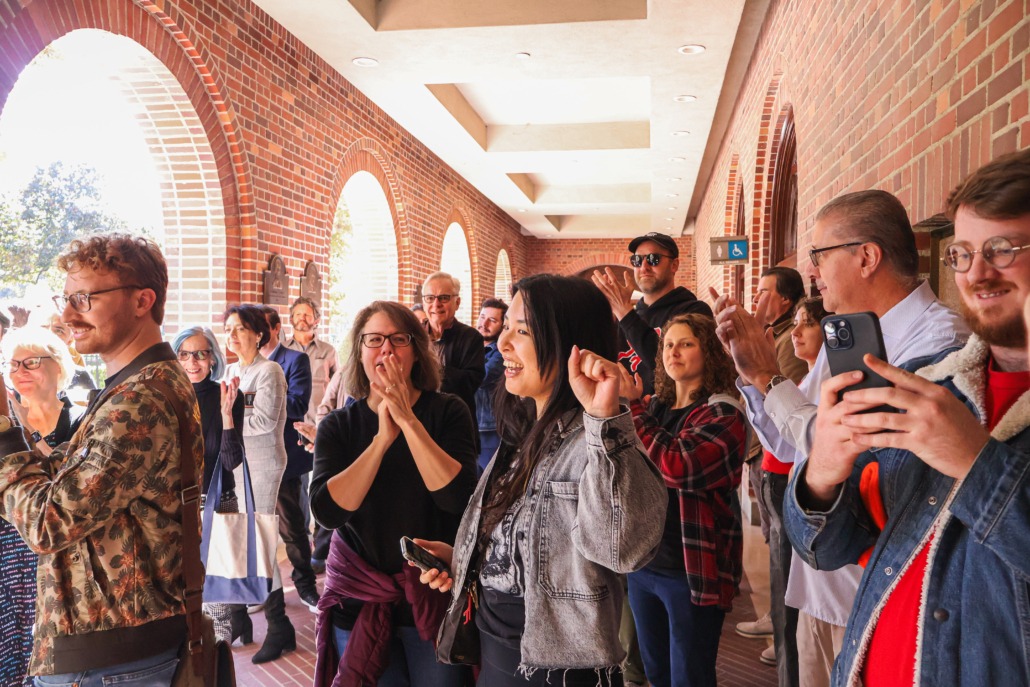

The election will culminate a roughly year-long effort to unionize non-tenure faculty.
A regional National Labor Relations Board ruled March 19 that USC’s non-tenure track faculty can move forward with a union election, rejecting the University’s challenges and ordering an election on two consecutive days during the weeks of April 13 or April 20.
Votes from the more than 2,500 research, training, practitioner and clinical-track faculty represented by the proposed union must be cast in person. If United Faculty-United Auto Workers wins its election and is officially formed, it could begin surveying faculty about their priorities, electing officers and establishing a bargaining team to begin working on its first contract, among other actions.
The election order came more than 15 months after UF-UAW initially filed its petition to unionize with the NLRB on Dec. 10, 2024, and over a year since the regional board heard its case, alongside USC’s case, in January 2025.
“We had no idea when it was going to come,” said Madhav, an associate professor of technology and applied computing practice. “But, certainly, we’re really excited that it did arrive. And it’s in our favor.”
Kate Levin, another UF-UAW organizer and an associate teaching professor of writing, said the cost of the University’s effort to delay the election through a challenge with the NLRB was “irresponsible and unethical.”
She said unionization would help the University by giving faculty more time to focus on teaching students, rather than worrying about job security, healthcare changes or other issues.
“When you’re in a union and engaged in negotiations, these are not recommendations. … You need to get to an outcome which is a contract,” Levin said. “You have two parties sitting down and hammering out an agreement, as adults should, frankly.”
USC had two major arguments against RTPC faculty unionizing. One argument was that RTPC faculty were serving in managerial or supervisory capacities through the Academic Senate and other shared governance bodies, meaning they could not unionize. USC’s other argument was that RTPC faculty, representing most of USC’s schools, have too broad an interest to unify under a single body.
UF-UAW would represent all RTPC faculty at most of the University’s schools, outside of the Keck School of Medicine and faculty employed by the Children’s Hospital Los Angeles. Adjunct and part-time faculty at the School of Cinematic Arts are also excluded due to unionizing separately without a University challenge in February 2024.
Madhav said it makes sense for faculty across schools to unionize together because it eliminates the potential USC argument that RTPC faculty in one school couldn’t receive certain benefits or securities without being unfair to faculty at other schools. He said the Adjunct Faculty Alliance – UAW, the SCA adjunct union, came across similar issues, which is why it agreed to a memorandum of understanding with the University in May 2025, delaying contract negotiations so it could organize with UF-UAW.
“We want to work with the University. To this point, they have not signaled a willingness to work with us,” Madhav said. “What we are hopeful for is that with our really big turnout, with a big victory in our election, that USC will finally decide, ‘Okay, maybe we should work with the faculty rather than try to fight them.’”
The University could appeal the results of the election, or it could accept the result.
When asked by the Daily Trojan if the University planned on appealing the decision, a USC spokesperson did not answer the question, but referred to a community-wide message on the RTPC unionization efforts signed by Provost Andrew Guzman and Senior Vice President for Health Affairs Steven Shapiro.
The letter stated that the election will “present a number of practical and legal issues.” It also stated the regional board’s decision was inconsistent with past rulings about faculty shared governance, citing a test established by the NLRB in 2014 to determine whether faculty at any given University have true power through shared governance.
While RTPC faculty are represented in the Academic Senate and other shared governance bodies, NLRB Region 31 Regional Director Danielle Pierce determined in the NLRB’s decision that the faculty do not “exercise actual control or effective recommendation” set out by the ruling regarding Pacific Lutheran University.
Madhav said the more than 1,000 layoffs of faculty and staff in Fall 2025 has made job security a primary concern among faculty. Without a union, Madhav said that RTPC faculty — many of whom work on temporary contracts ranging from a semester to multiple years — could have their contracts not renewed without need for cause, significantly impacting job security.
As somebody with muscular dystrophy, Madhav said a priority for him is employee health insurance, which has seen significant changes in recent years, including a roughly 5% on average price increase. To keep his current doctors, Madhav said he has had to pay significantly more in health insurance premiums, without his pay increasing significantly.
“My effective take-home pay is significantly lower now than it was six years ago,” Madhav said. “Every faculty has their own specific thing that’s most important to them. That’s why [unionizing] is so important.”