Amped up at Electro-Acoustic Showcase
Thornton students transformed Schoenfeld Symphonic Hall into a playground of sound and experimental techniques.
By KATHERINE KANG
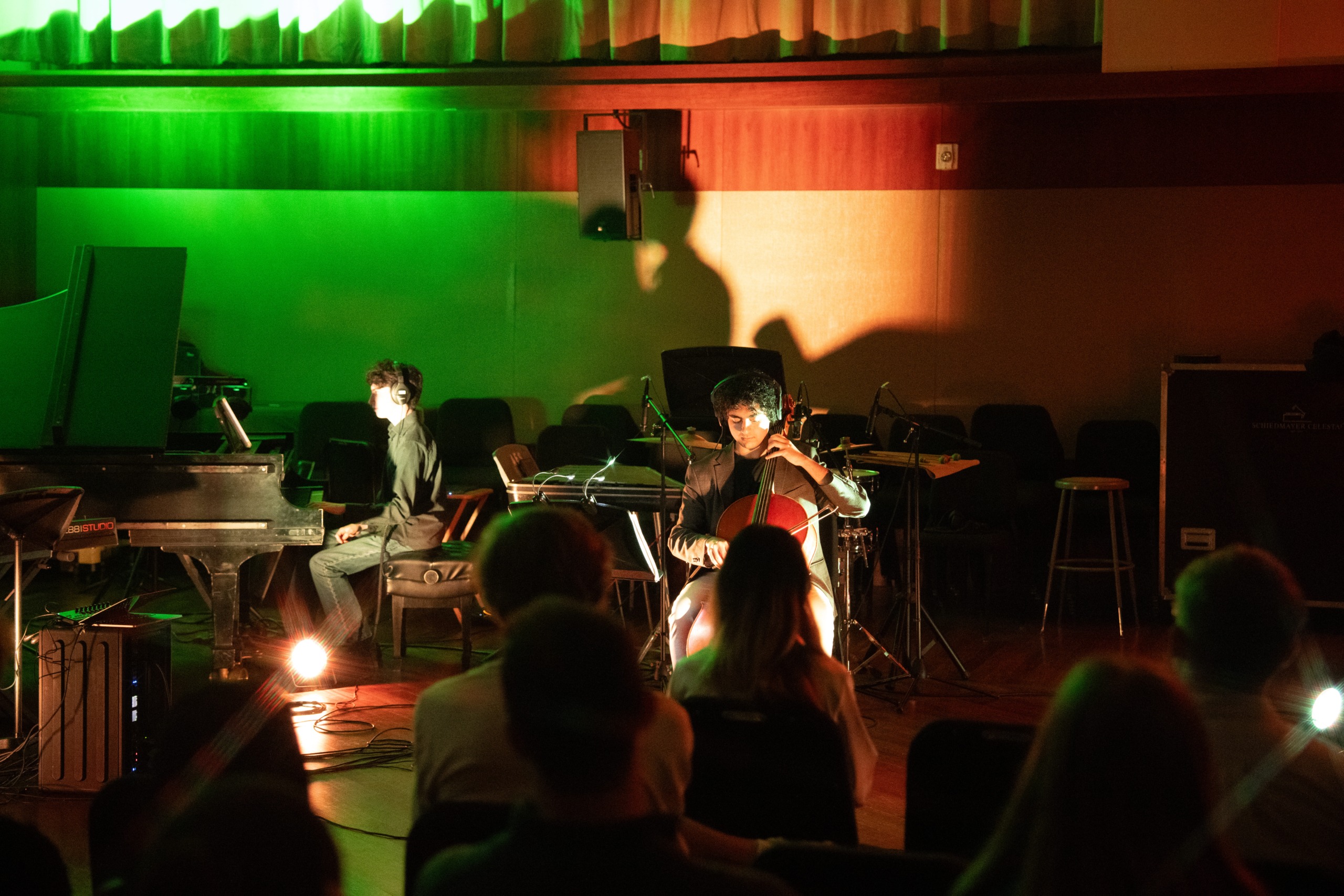

Thornton students transformed Schoenfeld Symphonic Hall into a playground of sound and experimental techniques.
“Hawaiian Cocktail,” the sad background music from “SpongeBob SquarePants,” played pitched and sped up and down as the instrumentalists wore SpongeBob-themed attire. The composer of the piece, “There3,” Chloe Villamayor, a first-year graduate student studying music composition, sported a taped-on, drawn tie. The idea originated from an assignment for her choral arrangement class.
“I’ve just been thinking about SpongeBob a lot recently, for whatever reason, this sad SpongeBob theme,” Villamayor said. “I had the original soundtrack and the vocal arrangement, and I altered the speeds using the theremin as a MIDI controller.”
Green and orange lights illuminated Schoenfeld Symphonic Hall as the Thornton Electro-Acoustic Showcase commenced on Sunday. Electro-Acoustic is a genre where acoustic sounds are manipulated and processed through electronic technology. The showcase is held to present students’ works and to build the technical skills of putting on a multi-setup show from start to finish. This includes miking and seating for performers, routing audio equipment correctly and designing acoustics and lighting.
“I’ve been wanting to do this for the past two years, because I think it’s such a great experience to learn by doing,” said Makenna Harding-Davis, a junior majoring in music composition.“Learning how to do the technical side of things, like setting up all the equipment, understanding why things aren’t working and fixing it.”
Composer and pianist Billy Waldman, a freshman majoring in music composition, was the first to take the stage alongside cellist Iman Torkian. Both put on headphones in preparation for Waldman’s piece, “Ouroboros.”
The cello opened with pizzicato phrases joined in unison by the piano, representing cyclical patterns of the world, according to Waldman’s program notes. The cello began bowing a similar rhythm, complemented by a pre-recorded beat layered with the live looping that the cello and piano created. The piece ended with the recorded syncopated cadence fading out.
Gibson Mahnke, a senior majoring in music composition, and Evan Williams, a junior majoring in music composition, composed the next piece, “nervous corners,” collaboratively as the “Warbler Ensemble.” With the stage empty, whispering tones filled the hall through four speakers set up around the audience.
Slow rumbling grew into seemingly distant explosion sounds. Improvised ambient melodies of an electric guitar juxtaposed with the war noises sampled from the British National Sound Archive of World War II, creating an intense push and pull of sound.
“The planes that are flying over in these recordings have a natural Doppler effect happening,” Williams said. “As they fly by, the pitch changes, so it really works in the space, and it sounds like things are moving around you.”
Mahnke and Williams had political intentions with their piece, wanting to create a juxtaposition between war and music.
“We’d started recording it after the war in Iran had been announced,” Williams said. “We were imagining a world where we’re playing the fairly gentle music that we tend to play at our live shows under the threat of war.”
The contrast of the political commentary, signified by the war sounds, and the lighter ambient elements became immediately clear to the audience.
“[nervous corners] seemed to comment well on what’s happening now,” said Nathaniel Parks, an attendee and first-year doctoral student studying composition. “The ability to sort of bury your head in the sand, looking forward while these immense acts of violence are happening behind, I thought was really cool and interesting.”
The stage remained empty for the following fixed media, or pre-recorded, piece, “coming/going” by Harding-Davis. Blips of ambiguous conversations quickly played and paused over a layer of ambient music and train sounds, manipulated and reversed.
The piece was adapted from a previous project that Harding-Davis worked on, where she was shown a video of a dancer who was dancing without any music, and then had to write music to their movement. She then expanded and arranged the piece for four speakers.
“My person was starting and stopping, and I just really liked that idea,” Harding-Davis said. “I ended up taking an audio file from a train station and then starting and stopping it to their movements.”
Three instrumentalists took the stage to perform the final piece before intermission, “to keep on going when it’s pointless” by Henryk Golden, a doctoral student studying music composition. Golden sat in front of them, with his back turned away from the audience, hunched over a computer.
The percussionist softly tapped on a cymbal, and the violinist followed. The percussionist navigated multiple instruments and mallets to vary the level of ringing or muting while the violinist used extended techniques to create percussive sounds. Golden sampled the percussion’s resonance through the keyboard, creating a feedback-like sound.
Chirping bird sounds came from the four speakers for Williams’ solo fixed media piece, “there was more but we forgot to write it down.” Subsequent ambient street sounds created a sense of movement. Unintelligible whispering drifted through the quadraphonic setup over sustained notes, prompting the audience to turn, wondering if someone was actually there.
“Everything was salvaged from videos and voice memos,” Williams said. “I’d asked a while ago a few friends to record themselves talking about things that they’d done in their day… and I collaged them all together into this piece about forgetting things.”
The lights shut off completely for the showcase finale, leaving only stand lights gently illuminating the cellist, vibraphonist and alto flutist. “Triptych 1” by Murk Haji-Sheikh, a doctoral student studying music composition, began with the flutist stepping between two pitches over recorded air-like sounds.
The cellist joined in, circulating through a few notes, followed by the vibraphone and a driving drum beat. Contemporary techniques, including sharp over-blowing and two-measure delays, created layered repetition.
“Outside of school, it’s hard to get this kind of setup happening, and so [the Electro-Acoustic Showcase] really lets people experiment,” said Ryan McWilliams, a lecturer and doctoral candidate in music composition. “[The audience gets] to hear some really creative, cool risks taken with the sound.”