Eulogy for the dead group chat
The ability to maintain relationships through group chats has been lost.
By ANVITHA KOMARRAJU
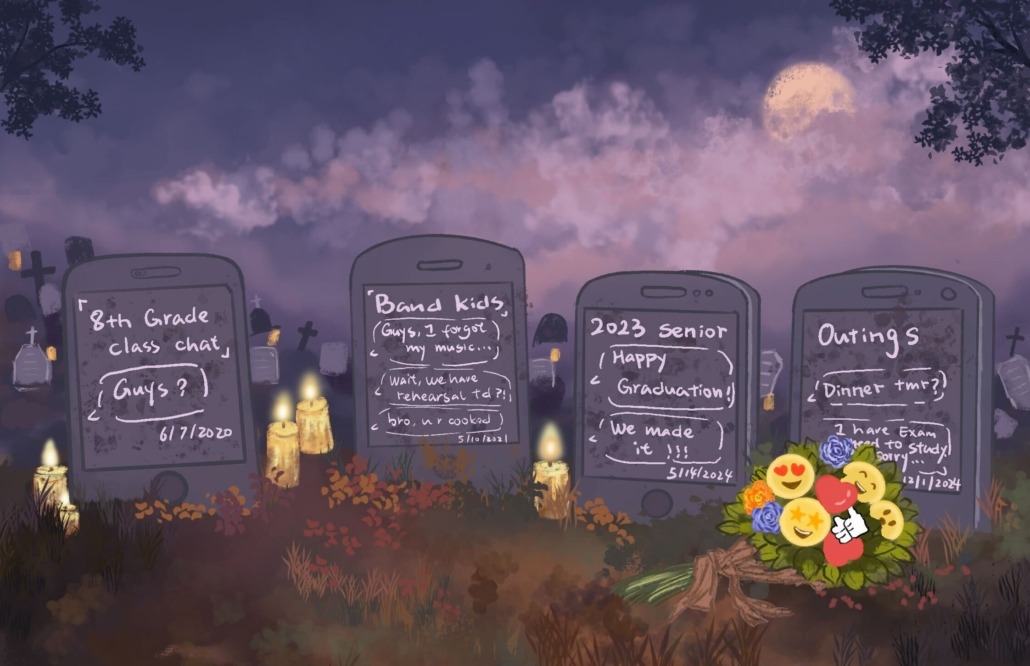

The ability to maintain relationships through group chats has been lost.
Think about that old group chat from high school filled with memories before graduating, or the random one from your dorm freshman year, blowing up with messages until 2 a.m. — maybe even the 30-person mega chat that seemed to be adding new people every day.
While the conversations in these chats range, they have one thing in common — they’re probably all dead. And if they’re not, kudos to you. Over time, I have become guilty of letting group chats go and letting people slip away, and I’m sure all of you are as well.
Group chats are digital archives. They are scrapbooks of different times in our lives, chronicling inside jokes and late-night freak-outs. However, the eventual silence that falls over them isn’t always natural, revealing a deeper problem: the fact that we value starting something over sticking with it. This isn’t just an issue with group chats, but a symptom of a larger issue with our generation.
We always seem to be starting something new, picking up a new hobby or exploring a new talent, but we lack the ability to sustain it. And nowhere is this habit more destructive than in our relationships.
The cultural habit of ghosting our interests has even altered our romantic lexicon. The development of the term situationship — that weird in-between part of a relationship when you aren’t officially together — is a testament to our flightiness: a relationship defined by its lack of definition.
At USC, this flightiness is embedded in our social lives. The other day, upon running into someone from class last semester, we chatted and ended the conversation promising to get Cafe Dulce together one day. However, like most conversations, the promise was forgotten and we wouldn’t talk again unless we awkwardly ran into each other.
As college students, we are forced to network and reach that coveted 500+ connections on LinkedIn, forced to create surface-level relationships for personal gain. In a world where we are constantly taught and expected to maximize utility, putting effort into reigniting a group chat feels unpurposeful and like a waste of time.
When we view relationships as transactional rather than bonds that require nurturing, the value of a genuine connection inevitably drops. Daniel Cox, director of the Survey Center on American Life, coined the phrase “friendship recession,” saying that we have lost the ability to connect with others. However, at USC, it feels more like a friendship inflation.
We aren’t suffering from a lack of connections. In fact, it’s the opposite. We have thousands of Instagram followers, hundreds of LinkedIn connections and dozens of casual acquaintances. We have such a surplus of surface-level friendships that each individual connection gets devalued. These inflated friendships are easy to acquire but near impossible for our flighty social bandwidth to sustain.
We are the most digitally connected generation in history, yet statistically, we are also the loneliest. A 2018 survey by healthcare company Cigna found Generation Z’s loneliness scores to be significantly higher than the Greatest Generation, averaging a 10-point jump on the UCLA Loneliness Scale.
Scores on the loneliness scale are measured on a 60-point range — from 20 to 80 — meaning a 10-point margin accounts for a deviation of almost 17% between both groups. Against the backdrop of a world saturated with differing political and social opinions, that gap shows a generation that, despite being connected, is emotionally stranded.
The true tragedy of the dead group chat isn’t the lack of messages, but that we’ve started to accept the silence. Every time we see a notification and decide to reply later, or when we put off meeting someone for coffee, we dig the grave a bit deeper.
So don’t let that friendship die. Send a dumb meme, or a goofy throwback photo. The eulogy for your group chat hasn’t been read yet.