As Los Angeles prepares for the 2028 Olympics, transportation challenges, the legacy of 1984 and the Games’ potential impact come into focus.
By LILAH KEATING
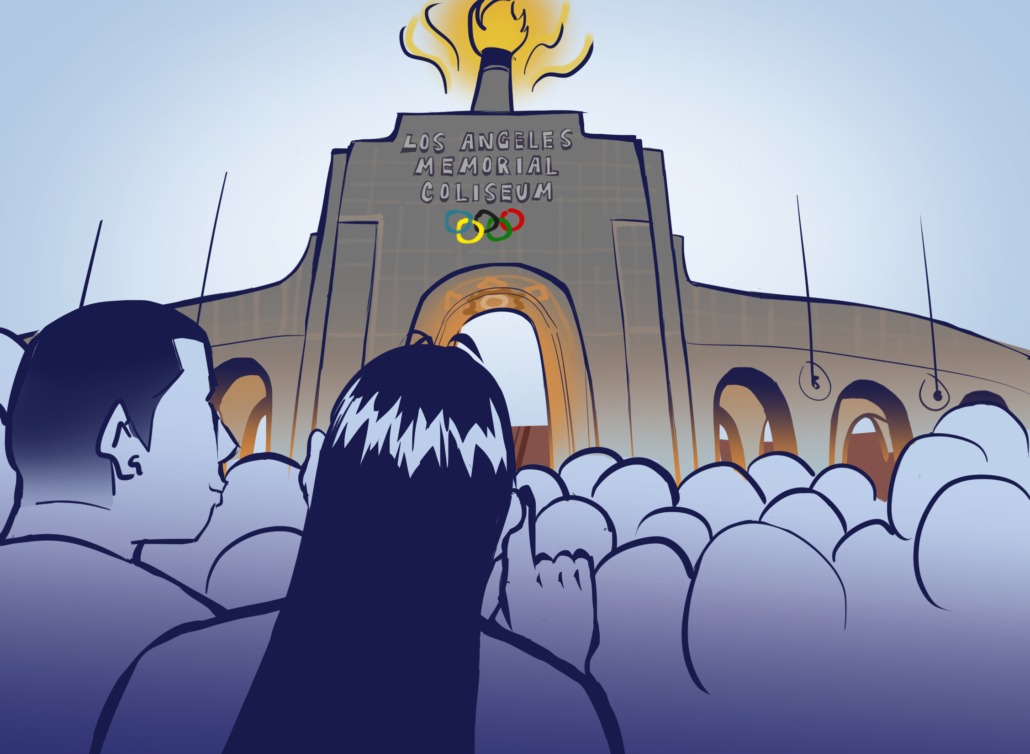

As Los Angeles prepares for the 2028 Olympics, transportation challenges, the legacy of 1984 and the Games’ potential impact come into focus.
In just 28 months, the eyes of the entire world will turn to Los Angeles.
The Olympic Games — one of the most-watched sporting events on the planet — are coming to the City of Angels. To the Los Angeles Memorial Coliseum. To the doorstep of USC’s campus.
For USC students, the Olympics will be impossible to ignore as the games will be woven into practically every aspect of campus life during the summer of 2028. The University will serve a critical role in both press and athletic operations, creating access to experiences most college students couldn’t dream of.
“It’s such a unique opportunity to have the Olympic and Paralympic Games coming to your college campus,” said Alex Bartolomei, a junior majoring in environmental engineering. “Think of the number of students who get to say that, and it is a [very, very] tiny percentage.”
Daily Trojan coverage from the last L.A. Olympics in 1984 showed preparations driving campus upgrades, growth in local museums and the street art scene, and a surge in confidence across USC Athletics, with effects lasting well beyond the Games. While the extent to which 2028 will produce similar changes to the downtown L.A. area remains uncertain, USC’s role suggests the Games will once again be a defining presence on campus.
And that role is not just superficial, as USC will be embedded directly in the core operations of the Games. This includes parts of University Park Campus, which will be designated as the Olympic Media Village for press accommodations during that summer, as well as the University providing venues for various athletic events. Specifically, the L.A. Memorial Coliseum will host track and field events as well as the opening and closing ceremonies, while Galen Center is set to host badminton.
But USC is only one piece of a much larger transformation already underway across Los Angeles — one that will bring millions of athletes, journalists and spectators flooding into Southern California and place unprecedented pressure on the region’s infrastructure, transportation systems and civic capacity.
With ideas ranging from air taxis to the expanded use of electric buses, alongside ambitious goals like a “no-build” Olympics and car-free Games, Los Angeles is already experimenting with how to reimagine the logistical framework.
The last time Los Angeles hosted the Games, the Olympic financial model was redefined, youth sports programs received decades of sustained funding, and L.A. was cemented as a global sports hub. As 2028 approaches, leaders, planners and students alike are contemplating what the next Olympics will leave behind.
The upcoming games are not just another Olympics for Los Angeles; they continue a model and dialogue first established more than 40 years ago.
When the city hosted the Games in 1984, the organizing committee broke from the traditional government approach of massive spending and constructing new stadiums by relying instead on existing venues and private funding.
The results were historic.
The 1984 Olympics created a surplus of $232.5 million, according to the official Olympics website, a figure that, when adjusted for inflation, is around $7350 million today.
Rather than disappear after the Games ended, much of that surplus remained in Los Angeles and was used to establish the LA84 Foundation, which has been funding youth sports programs for underserved communities across Los Angeles ever since.
This legacy is still being actively discussed at USC. Bartolomei, along with Mitchell Kirby, a senior majoring in civil engineering, recently organized “The Games Week,” a weeklong panel hosted by the Viterbi School of Engineering’s Innovate x L.A. The series brought together experts in energy, infrastructure, transportation and broadcasting to discuss planning and the broader implications of hosting the Games.
“Los Angeles pioneered the sustainable financial model for the Olympics,” Kirby said, reflecting on insights from the panel. “It was only because of LA84 that we see the Olympics continuing today.”
That thinking is already shaping the approach to the upcoming Games.
During the fourth day of the panel, Olympic swimmer and USC alumNoelani Day, was said to have made observations that one of LA28’s main priorities is to continue the legacy of the last L.A. Olympics, with efforts already underway years in advance.
So far, this initiative has largely taken the form of foundational public-facing investments and actions to ensure the games are more accessible. According to LA28, the International Olympic Committee donated $160 million a few years ago to fund initiatives aimed at expanding access to youth sports programs solely to be invested in youth sports across L.A.. The official LA28 website reads “Creating a lasting local impact that inspires the next generation of athletes and fans, LA28 will make sport more accessible to kids across LA, focusing particularly on underserved communities.”
Organizers have also emphasized financial accessibility for spectators, announcing that ticket prices will start at $28—a nod to the year it will take place and a push to make attending possible for more Angelenos.
Taken together, these efforts suggest that the 2028 Games aim to build on the legacy of 1984 by expanding accessibility and sustaining community investments, once again positioning the Games means of democratizing opportunity across Los Angeles.
While the legacy of the 1984 Olympics continues to shape Los Angeles today, the upcoming 2028 Games will operate on a significantly larger scale.
Financial planning is a critical aspect of the Olympics, as host cities are often reshaped by the experience. Some Games, like the last time they were held in L.A., adopted models that generated a surplus, enabling reinvestment in the city and leaving it more globally recognized without significant financial strain. Others, however, face years of recovery after investing in new stadiums and infrastructure that go largely unused afterwards. The 2008 Beijing Olympics, for instance, reportedly cost the city roughly $40 billion. While some of those venues were repurposed for the 2022 Winter Games, others like the Beach Volleyball stadium and BMX track were abandoned or left to decay, illustrating the waste that can result from prioritizing a short-term spectacle over long-term urban needs.
The LA28 organizing committee, which is responsible for planning the event, operates as a privately funded nonprofit supported by corporate partnerships and commercial revenue. So far, the organization has secured more than $2 billion in sponsorship commitments and affirmed in a statement to the Daily Trojan that it is on track to fully fund its operating budget, which is around $6.8 billion according to LA28 chair Casey Wasserman in an interview with NBC Los Angeles.
“There’s a narrative that the Olympics tend to be very bad financial decisions for a city,” said Alan Abrahamson, an Olympics expert and associate professor at the Annenberg School for Communication and Journalism.“[However], these Games represent almost no financial risk.”
This is because, rather than constructing permanent venues, organizers plan to rely primarily on existing stadiums across Southern California and supplement them with temporary facilities that will be dismantled after the Games conclude — an approach city officials and LA28 are repeatedly calling a “no-build Olympics.”
Economically, this approach could actually end up providing a major boost for the region. A recent analysis by the Southern California Association of Governments estimated that the 2028 Olympics could generate an additional $17.6 billion in gross domestic product across Southern California and create new jobs and opportunities for local businesses.
Still, major international events rarely arrive without skepticism.
Abrahamson said the years leading up to an Olympics often bring intense scrutiny as media coverage focuses on potential challenges ranging from transportation improvements to how the city might manage the growing homeless population.
“The way an Olympic news cycle works is the two and a half years from the close of the last Winter Games until the start of the Summer Games are filled with every imaginable disaster scenario that can be thought out,” Abrahamson said.
In 2017, former L.A. Mayor Eric Garcetti promised to cut street homelessness in half before 2028, but since then it has instead grown by around 16%, now totaling nearly 30,000 unsheltered people, according to annual counts reported by the Los Angeles Times. While Mayor Karen Bass has publicly stated that unhoused residents will not be bused out of the city during the Games — a strategy employed during the Paris Olympics — concerns about how the city will manage its large population of unhoused people during such a complex undertaking have become an increasingly frequent topic of discussion.
While those concerns persist, LA28 officials say overall preparations are progressing steadily. “Timelines are on track, coordination is underway, and the Games are moving confidently toward 2028,” an LA28 spokesperson said in an email to the Daily Trojan. “With world-class venues already in place, our focus is on delivering an exceptional experience for fans, athletes and the community.”
In a city infamous for its traffic, transportation constraints are impossible to ignore.
Mayor Bass’s plan for tackling this challenge centers on the expectation of “car-free Games,” aiming to replace the private vehicles by deploying 3,000 borrowed buses and expanding public transit infrastructure. To execute this, she said in an interview with ABC7 that she plans to limit parking near event venues and is encouraging businesses to allow remote work during the 117-day Olympic period to ease traffic congestion.
Still, the feasibility of this vision has drawn skepticism. “They can push them all they want, but people are going to get to the Games how they want to get to the Games,” Abrahamson said.
Making this system work — and enabling the movement of millions of spectators, athletes and media across a sprawling metropolitan region — will require coordination across multiple agencies and transit systems.
This is one reason Kirby and Bartolomei hosted the Games Week panel, bringing together transportation officials from LA Metro, the Santa Monica Department of Transportation and Los Angeles World Airports to align planning efforts.
“Everyone across the board is trying to put their heads together because no one’s naive to the fact that this could easily turn into a disaster for the city,” Kirby said.
That broader effort is already taking shape through the L.A. Metro’s $42.9 billion “28-by-28” transportation initiative, which aims to complete at least 20 major transit projects ahead of the Olympics.
“Most of [the projects] are on track,” Kirby said, reflecting on comments made by experts on the panel. “Not everything’s going to happen on time, but it was a great accelerator for the Olympics to push these projects through.”
One critical component of making this plan viable is shifting the negative perceptions of safety and service on L.A.’s public transportation system, which often discourages residents from relying on it.
Metro says it has been actively working to address these concerns. In a statement to the Daily Trojan, the Los Angeles County Metropolitan Transportation Authority said it “has reinvented and reinvigorated its approach to safety with the goal of making every ride a safe and welcoming experience.”
According to Metro, these efforts focus on three things: maintaining a visible presence of uniformed personnel, enhancing access control and strengthening partnerships with local law enforcement and community organizations.
The agency says these changes are already producing measurable results, pointing to two consecutive years of declining violent crime on the Metro and 87% customer satisfaction with safety measures as evidence of that progress—steps necessary if the city hopes to make its “car-free Games” dream a reality.
Another dimension focuses on the long-term impact of Olympic planning: while the city is expected to bring in additional buses for the Games, panelists raised the possibility of using electric buses in an effort to leave a lasting imprint on transportation sustainability in Los Angeles.
Other new transport technologies may also play a role. Notably, Archer Aviation — a company developing electric air taxis — will serve as an official aerial transportation provider during the Games, according to LA28.
Despite the layered and interconnected complexity of these efforts, Abrahamson remains optimistic saying that traffic actually improved during the 1984 L.A. Olympics. According to analysis from the Metro Transportation Research Library and Archive, this was largely due to a combination of altered commuting patterns and reduced residential travel during the Games.
“I fundamentally believe that we will see deja vu again and the traffic will be great — seriously,” Abrahamson said.
While the Olympic Games themselves will only last a few weeks, LA28 and city council officials believe their effects could shape L.A. for decades to come.
“There’s going to be a huge boom after 2028,” Abrahamson said. “A successful Olympics makes people who live there feel really good about themselves.”
According to a study by the University of Kentucky on the economic effects of the Olympics, major international events often generate long-term economic growth and increased tourism, and the same is anticipated for Los Angeles in the coming years. This impact can also come in the form of lasting infrastructure and behavioral shifts, as investments in public transportation infrastructure could encourage residents to continue using these systems long after the Olympics end.
Metro wrote in its statement that it is working on implementing a Transportation Demand Management communication strategy aimed at familiarizing both locals and tourists with L.A.’s transit network. The objective is to promote the sustained use of public transportation systems beyond the Games, so that these shifts extend beyond a temporary adjustment and become a part of daily life.
“We all live in L.A., and know public transport is not always the most convenient,” Bartolomei said. “But they are working hard to make it much more of an accessible and reliable option both during and after the Games.”
But these changes extend beyond transportation, shaping how the city functions and, ultimately, how it is perceived.
“The 1984 Games established L.A. as a real city, a major city in the imagination of the U.S.,” he said. “What the 2028 Games are likely to do is establish L.A. as a world capital.”
While the upcoming Games face challenges ranging from transportation logistics to public perception, organizers say they hope the event will leave a lasting imprint on the city. And if history is any indication, implications of those few weeks could reshape Los Angeles long after the Olympic flame is extinguished.