African Senior Fellows visit USC
The fellows spoke as part of the Africa–U.S. forum on global health.
By FRANCO GUTIERREZ
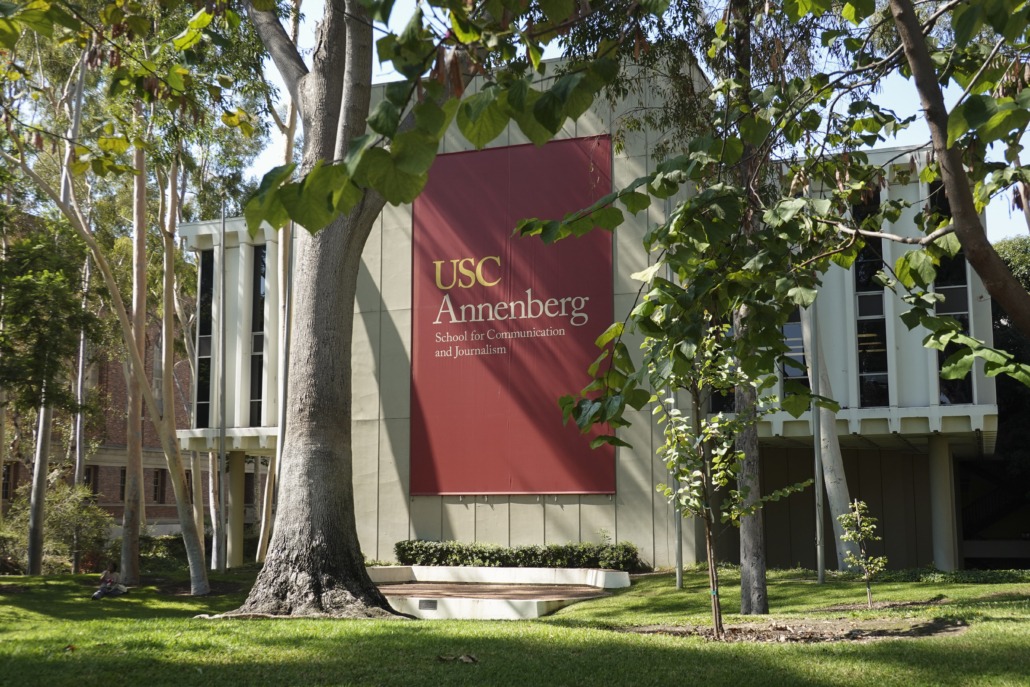

The fellows spoke as part of the Africa–U.S. forum on global health.
The USC Center for Communication Leadership and Policy hosted four African Senior Fellows on March 30 at the Annenberg School of Communications and Journalism as part of a presentation on global health, public diplomacy and international collaboration. The panel focused on how the four researchers are addressing health communication problems in Africa, ranging from misinformation on vaccines to informing people on how the climate impacts their health.
The fellows work throughout the school year and receive student research assistance as well as collaboration opportunities with USC faculty.
Dr. Yewande Alimi, with the Africa Center for Disease Control and Prevention, said her job was to protect the health of one billion African people. Her project focuses on explaining the impact climate change can have on health, and creating individualized messages for various platforms and groups of people.
“[We] unpack what messaging is relevant for different stakeholders in society,” Alimi said. “The messages that are relevant to the policymakers may not necessarily be applicable to journalists … It’s quite important that messaging is contextual, culturally sensitive, but can drive action to every citizen.”
Alimi said ensuring the language she used was relevant to all cultures, both in the myriad cultures of Africa and in the rest of the world, was one of the biggest challenges she faced.
“I’m just yapping, unless communication is context specific, which means that it suits the audience,” Alimi said. “We all come from different cultures. It’s important that messages [are] very culturally sensitive.”
Jepchirchir Kiplagat, a public health expert specializing in health systems research and epidemiology, works with elderly people diagnosed with HIV. Kiplagat said there is a problem of ageism in diagnosing HIV: Healthcare providers do not think to test elderly people for the virus as they believe HIV is “for the young.”
“[Doctors] would [test for] hypertension, diabetes, all these diseases,” Kiplagat said. “Without diagnosis, you [are dragged] along the spectrum of HIV disease, right from stage one through to stage three and four … It becomes difficult to bounce back. Even with the medication, the likelihood or the risk of other opportunistic infections can affect the quality of life for these individuals.
Mia Malan, editor-in-chief of the Bhekisisa Centre for Health Journalism in South Africa, said her project focuses mainly on the impact of climate health and the under-discussed consequences of climate change.
“In the media, you would read about how malaria, parasitic diseases or maybe dengue fever have shifted because of the climate,” Malan said, “But you wouldn’t often read about the impact on HIV … or what happens to your mental health if you have lots of floods and droughts, and my project wants to put those things on the agenda of a health department to create policies.”
Ben Phiri, the Malawian Minister of Local Government and Rural Development, said his project aimed to help Malawi provide adequate healthcare to its citizens with the limited resources it has access to. To do this, Phiri said he holds to the three E’s: being economic, efficient and effective.
“Everybody agrees that, for example, HIV and AIDS are rampant,” Phiri said. “But then they have problems [accessing] condoms, for example, purely because of stigma.”
He said people aren’t buying resources such as condoms because of religious beliefs, causing them to expire and go to waste when those resources and the money to buy them could have been allocated elsewhere.
“I was asked by UNICEF to do a short clip with polio,” Phiri said, “Because there is misinformation out there … [there are] certain religions as well as cultures that do not allow vaccines. So we had to go down and try to push every parent to consider the consequences of not vaccinating their kids.”
Kiplagat said one of her biggest obstacles when communicating about healthcare is the distortion of messaging that can occur as it is passed from person to person.
“A message can be communicated by an individual in a very clear manner,” Kiplagat said. “But as it sort of rolls down to further channels, that message gets coined differently, and that misinformation continues to penetrate and penetrate down to really the key users.”
Malan said part of the goal of the fellowship is to ensure equitable dialogue between Africa and the U.S. when it comes to topics of aid and education.
“The idea is to empower Africa,” Malan said. “We always talk about the U.S. helping Africa or Africa learning from the U.S. [We should] turn that around to say, ‘What can the U.S. learn from Africa?’”