Students welcome Arab American Heritage Month
A student assembly claimed USC silenced students after a poem recitation was cut.
By ZACHARY WHALEN

A student assembly claimed USC silenced students after a poem recitation was cut.
Attendees cheered and clapped on beat as four dancers clad in gold and teal took to Hahn Plaza Wednesday afternoon to dance dabkeh, a traditional dance hailing from Lebanon, Syria, Palestine and Jordan. Dancers kicked, stomped and twirled ropes to a drumbeat during one of the main events of USC’s Arab American Heritage Month celebration.
Allison Harnett, an assistant professor of political science, international relations, and Middle East studies as well as the event’s faculty speaker, introduced the Famous Stage dance group, describing dabkeh as a “vibrant” tradition that celebrates the Arab cultural tradition of caring for one’s neighbors.
“Dabkeh is a powerful expression of community, joy, cultural resilience and attachment to land, passed down from generation to generation and danced at weddings and public celebrations,” Harnett said. “Dabkeh is also a very social tradition, so please don’t be surprised if Famous Stage invites you to join in, and when asked, I hope you do so.”
Outside of the dance performances, one of the dancers also played several pieces with traditional Arabic instruments, including the oud, a type of lute.
Provost Andrew Guzman opened the event with a speech, reminding the audience of the theme: “Rooted in our stories, planting our own future.” Guzman said the word “story” was pluralized in the event title to recognize the diverse set of cultures, histories and languages found in the Arab world.
Guzman also said he wanted to recognize the members of the Middle Eastern North African Student Assembly, who have helped define Arab American Heritage Month celebrations at USC.
“This month here at USC exists because students built it,” Guzman said. “[MENASA students] brought celebrations into our public spaces, hosted dialogue in difficult moments and created belonging for our students, our staff and our faculty. Our students are not and have never been passive participants. They are creators, innovators and institution builders.”
In an Instagram post following the event, MENASA claimed that a member of their organization had been asked to recite a poem at the opening ceremony, but due to “internal miscommunications among administrators,” the recitation was removed 24-hours prior to the event. The post claimed that USC had “excluded” the voices of Arab American students and had acted with a lack of transparency.
“The absence of student voices and recognition by the University not only diminished the impact of the event, but also contributed to a broader sense of erasure during a month meant to center Arab American identity,” the post read. “We therefore call on the University … [to ensure] that student communities are treated as essential partners in cultural programming rather than as afterthoughts.”
The University received similar criticism from the Native American Student Assembly in November, where members claimed that USC told them Native American students were not permitted to speak at the University’s Native American Heritage Month event. In response, NASA held an independent event in Exposition Park to commemorate the month.
In a statement to the Daily Trojan, the University wrote that the event contained multiple performances recommended by community members.
“We are pleased that many people attended and enjoyed this year’s Arab American Heritage Month celebration,” the statement read.
In her speech, Harnett recounted her research on authoritarianism in Arab countries, and said the conflict in Arab students’ home countries, as well as the dehumanization and political abandonment Arab people faced, led to a grief that was unique to the Arab diaspora. Harnett said she encourages Arab students to fully feel their grief and trauma, but also to embrace joy where they can find it.
“I close with what I personally hope for the Arab American community at USC,” Harnett said. “That you experience power, solidarity and representation in a unified community at a time when the Arab world is being subjected to harm, both foreign and domestic, that the wider campus community and administration is unified in support of you and your voices and your rights to truth, dignity and life.”
Narjes Albakshy, a master’s student studying communication management who attended the event, said she enjoyed Harnett’s discussion of her research and the sense of community the event brought.
“It’s nice to see Arab people come and get together and have a taste of home, whether it’s enjoying the nice music and the performances, or the delicious food,” Albaskshy said.
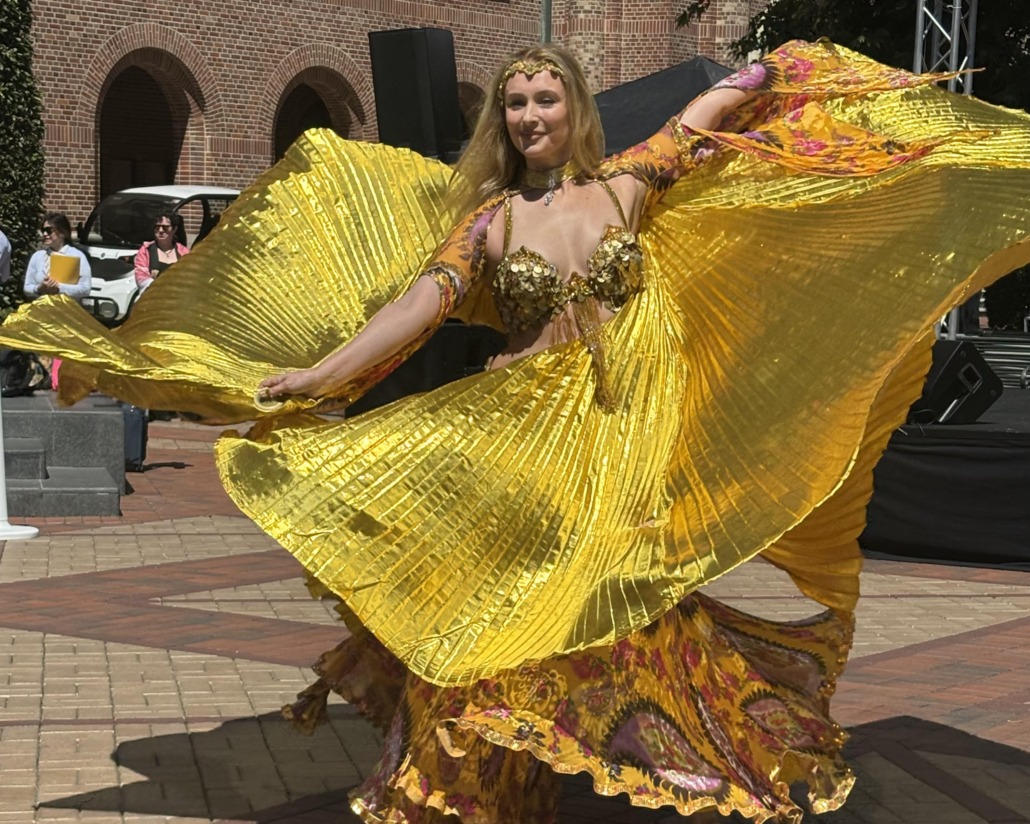
The two women performers took to the stage again to perform solo sets, now wearing dresses with flowing sleeves. During the first solo performance, two audience members joined the performer in the middle of the semicircle of onlookers and danced alongside her. The performer took the attendees’ hands and had them bow alongside her at the end.
Kate Korey, a master’s student studying construction management, said the dancers were a highlight of the event for her, as well as the food served at the tabling booths. She said she appreciated the University holding an event to acknowledge Arab American Heritage Month.
“[The event] means a lot to me because, at my [undergraduate institution], our Arab Heritage Month wasn’t really as promoted, I’d say, and not as extravagant,” Korey said. “To come to a bigger school that has these resources to do that, and I see them actually being inclusive and welcoming and promoting these cultures, is really nice.”