FEMININOMENON
We need more women behind the camera
Women cinematographers bear the brunt of gender inequity in Hollywood.

By FIONA FEINGOLD

Women cinematographers bear the brunt of gender inequity in Hollywood.
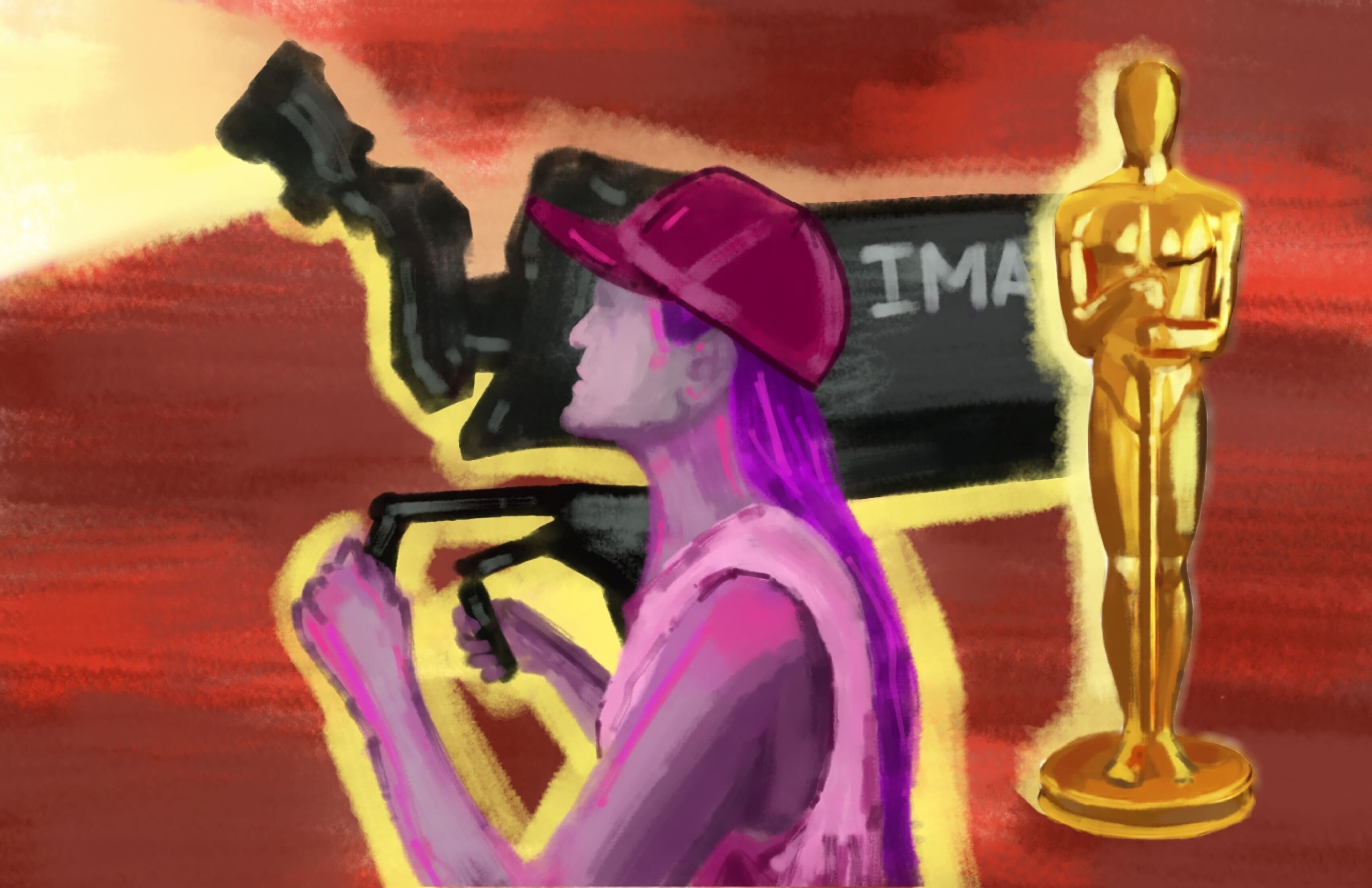
Autumn Durald Arkapaw became the first woman to win for Best Cinematography at the 98th Academy Awards, only two weeks ago. Actress Demi Moore announced Durald Arkapaw’s win to an ever-celebratory crowd, struggling to project her name over the uproar of applause. In her speech, Durald Arkapaw paid tribute to industry pioneers who preceded her, citing Ellen Kuras and Rachel Morrison as inspiration.
She took her moment to honor a collective, recognizing that her accolade was about so much more than her artistry — it was a reckoning. Now it’s time for the industry to catch up.
“I really want all the women in the room to stand up, ’cause I feel like I don’t get here without you guys,” Durald Arkapaw said while accepting the award. The Dolby Theatre erupted into whoops and hollers.
Durald Arkapaw made history well before her acceptance speech as the first woman of color to be nominated in the category. Before her monumental win, a mere three women had ever been nominated for cinematography at the Oscars: Rachel Morrison for “Mudbound” (2017), Ari Wegner for “The Power of the Dog” (2021) and Mandy Walker for “Elvis” (2022) — all within the last decade.
Durald Arkapaw’s win is especially historic, considering the long history of underrepresentation of women in cinematography. According to a 2023 San Diego State report, women made up only 7% of cinematographers in 2023, only a 3% increase from 1996. This echoes similar trends for other behind-the-scenes roles in film and television, with women representing 26% of producers, 21% of screenwriters and 17% of editors, as revealed by the same report.
Given this context, it seems fitting that Durald Arkapaw won for her work on “Sinners” (2025), a film praised for challenging the medium’s technical and narrative barriers.
The movie became the highest-grossing original film of the past 15 years, earning nearly $370 million at the global box office. Durald Arkapaw’s cinematography plays no small part in its success, as viewers are viscerally swept into the world of Jim Crow-era Mississippi.
“Sinners” garnered attention for its bold reliance on film stock, rather than using the digital cameras commonly found on most modern sets. The movie was shot entirely on analog film. Durald Arkapaw collaborated with director Ryan Coogler, a USC alum, to convey the story’s depth on celluloid, seeking inspiration in photography from the time period.
She is the first woman to shoot a movie in large-format IMAX, reinventing a long-used technique for a new kind of viewing experience. The rich, sweeping visuals of “Sinners” were made for the big screen, as anyone who was lucky enough to see the movie in IMAX will attest. Her distinct creative perspective is exactly why more women cinematographers are needed behind the camera.
In an interview with The New York Times, Durald Arkapaw spoke to the cultural implications of shooting on film, commenting on the medium’s history of solely platforming white creatives.
“We don’t see movies made like this, by people that look like us, with this format,” Durald Arkapaw told The Times.
In an era of dwindling movie theater attendance, hiring and honoring women cinematographers is necessary not only for artistic ingenuity but also for the entertainment industry’s very survival. Studios may proclaim that franchises and cinematic universes are the only modern source of theatrical profits, but the box-office success of “Sinners” vehemently refutes that hypothesis. Audiences will flock to movie theaters if they have a good reason to attend.
Amid an oversaturated media landscape, viewers are drawn to stories that cut through the noise, and cinematographers are essential to that breakout success, bringing their own unique creative voice to each project. Hiring more women as directors of photography is not only good storytelling; it’s smart business.
Every cinematographer brings their unique style to the silver screen, inspired by their own array of lived experiences. Cinematographers from underrepresented backgrounds, including women cinematographers, are more likely to shoot projects in ways that viewers haven’t seen before.
It’s not like there is a shortage of talented women cinematographers. The filmography of Morrison alone, who led Coogler’s “Fruitvale Station” (2013) and “Black Panther” (2018), is nothing short of impressive. Kuras entranced audiences with her ephemeral work on “Eternal Sunshine of the Spotless Mind” (2004), and Walker used the camera to spotlight injustice in both “Shattered Glass” (2003) and “Hidden Figures” (2016).
Cinematography remains disproportionately dominated by men. If this doesn’t change, who knows what stories we’ll never see?
Hollywood may be making strides to combat inequality, but there is still work to be done to restore gender parity behind the camera.
Fiona Feingold is a junior writing about women in the entertainment industry in her column, “Femininomenon,” which runs every other Friday.