Student group launches inclusive gym hours at Lyon Center
The program aims to make workout spaces more comfortable for women and non-binary students.
By APRIL MAO
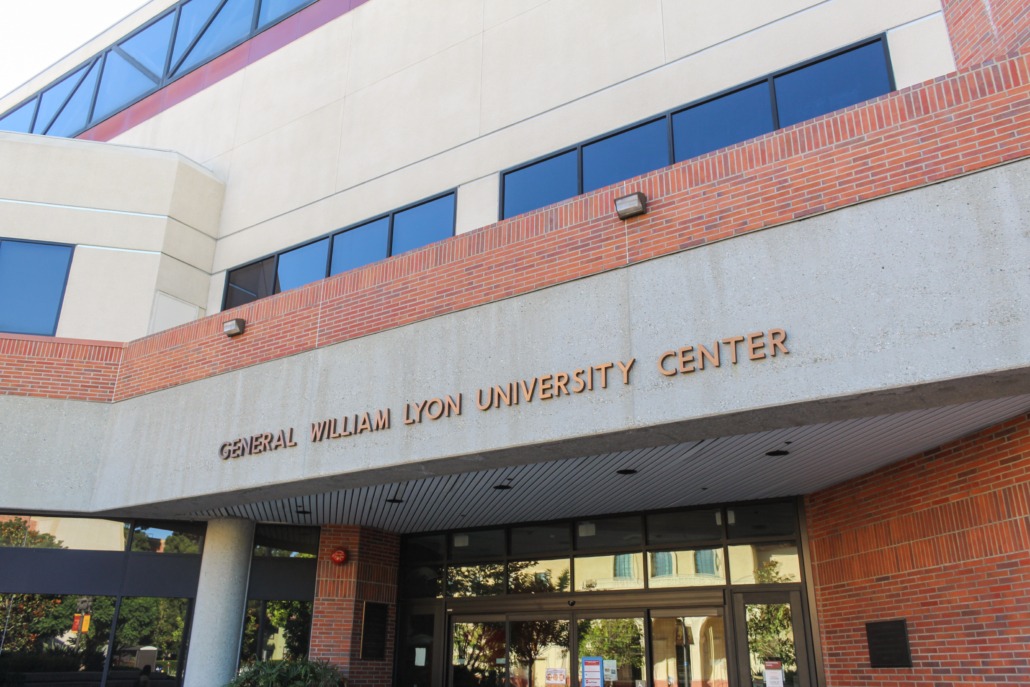

The program aims to make workout spaces more comfortable for women and non-binary students.
On Mondays and Wednesdays from 10 to 11 a.m., the Robinson Room at the Lyon Center may look a little different this month. Instead of being just another corner of the gym, a new inclusive workout space is being tested as a place where women and non-binary students can exercise with a sense of ease.
The initiative is organized by the Student Assembly for Gender Empowerment in partnership with the Lyon Center. The first trial run will last from April 6 to May 15.
For Jana Alnajjar, a sophomore majoring in philosophy, politics and law and SAGE’s advocacy liaison, the idea came from hearing women and non-binary students experience a common sense of discomfort in the gym.
“I’ve heard from multiple women and non-binary students’ perspectives who want to be involved within different workout spaces, but don’t really feel comfortable being at the gym.” Alnajjar said, “Whether that means they’re getting approached regularly or people look them up and down. Over time, that discomfort leads them to stop trying to go to the gym altogether.”
Alnajjar said the planning process began last fall, and it took months of meetings and revisions before they could actually launch the program. She first contacted the Lyon Center and began discussing the possibility of a designated space. She said the process involved “a lot of back and forth” because the room is meant to support women and non-binary student groups, but must also remain open to all under University policy.
“Because of University constraints [and] current federal constraints on DEI … there was a lot of back and forth on whether this would even be a viable option,” Alnajjar said. “How can we do it and advertise it in a way that students know it’s a space for them, but is still open to all?”
The result was a smaller-scale trial run in the Robinson Room, which Alnajjar said is more of a stretching or yoga room than a full gym floor. She originally hoped for a larger space with more equipment, but said the first phase is mainly about proving student demand.
Alnajjar said she hopes to see around 20 to 40 students use the room every day and eventually build the case for a bigger space and more convenient hours.
“My short-term goal is just to get this room utilized and show the administration and show the faculty of the Lyon Center and USC as a whole how much this is needed,” Alnajjar said.
For some students, this initiative addresses a discomfort that is hard to quantify but easy to identify with. Mengze Wu, a senior majoring in neuroscience, said men-dominated environments can make it difficult to feel at ease.
“My past experiences with being in enclosed spaces where it’s very men-dominated has never been super pleasant,” Wu said. “There tends to be this problem that I face where I don’t get to take up a lot of space unless I really declare myself. And even with that, I face a lot of hindrance in being able to feel completely comfortable.”
Wu said that even while using treadmills, she finds herself looking for other women nearby. Hannah Lee, a senior majoring in biomedical engineering, said that discomfort can also be enough to stop someone from going to the gym.
“I started going to the gym more this year, so that was like, ‘Mengze, you have to go with me,’” Lee said. “I didn’t really want to go alone, because it’d be nice to have another person with me to make me feel more comfortable.”
Still, both Lee and Wu emphasized that the initiative is not a complete fix. Wu called the designated room a “temporary solution,” saying the larger issue is the atmosphere that makes some students hesitant to use shared gym spaces in the first place.
“The fact that we even think, ‘Oh, this is kind of a good idea,’ like a space separately for women, just shows systemically how there’s a greater issue,” Lee said. “There shouldn’t need to even be a place for women specifically. It should be gender inclusive to everyone.”
Alnajjar said she’s aware of the tension, but sees the project as proof that student advocacy can still move an idea forward, even if only in a limited form at first.
“I thought this was something that would never be a possibility,” Alnajjar said. “[It] shows that advocacy really does go a long way. There are a lot of issues that are ongoing on campus, but there’s also a lot of people [who] are trying to actually make change within that.”