JAM JOURNAL
What Qawwali taught me about love
From New Delhi winters to New York summers, it is Sufi music that brings me home.

By ANAHITA SAXENA

From New Delhi winters to New York summers, it is Sufi music that brings me home.
Growing up, my favorite memories took place in car rides, on the couches of family friends’ houses, and in homes and hotels in India, because in those moments my loved ones and I gathered together to sing, or drum along with our hands to Sufi music.
Sufism is a form of Islamic belief rooted in the mystical and personal encountering of God. It asks followers to perceive God as their lover, friend or family member. Sufi music, or Qawwali, originated in the 12th century, when the Sufi saint Hazratja Khawaja Moin-Ud-Din Chishtie brought Islam to India, and found that the mostly Hindu nation practiced worship through bhajans, or hymns. So he turned the poems into songs.
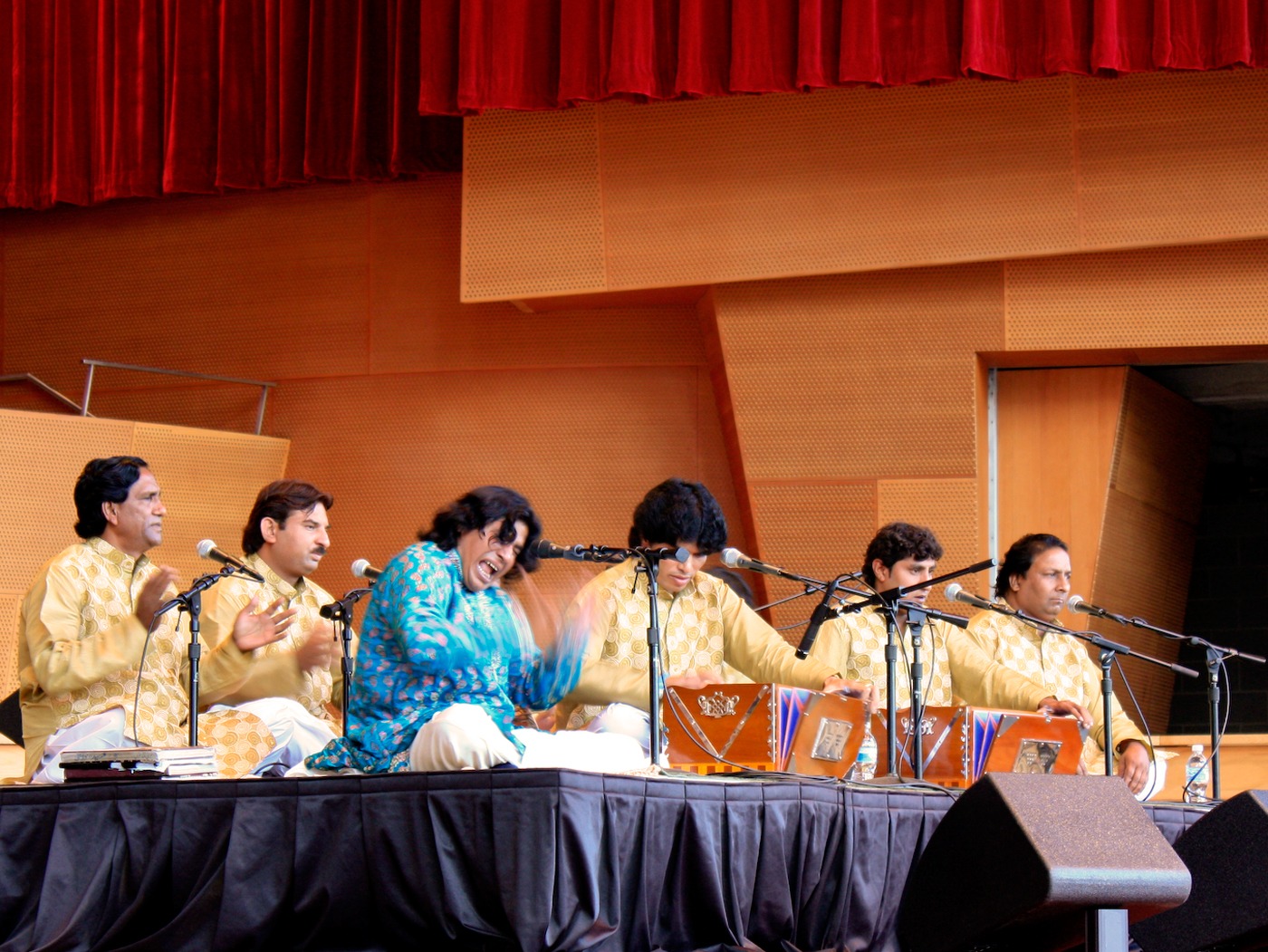
Qawwali is often performed by one lead singer, two back-up singers, percussion — with one’s hands or the dholak and tabla, which are traditional Indian drums — and the harmonium, a free-reed keyboard. And yet, the sound of the music feels as fulsome as an entire orchestra.
Whenever I listen to Qawwali, I am transported back to my grandparents’ home in India. Though it is now empty, I recall a tube-light-lit home with cracking walls and ceilings, beds and couches and rugs faded and softened with age.
Everyone on my dad’s side of the family sings — a byproduct of my grandmother, who holds a master’s degree in music — and together we cuddle under blankets during the New Delhi winter. We fill the room with songs like “Saiyyan,” collectively clapping the rhythm with our hands and thinking of our own great loves.
This summer, my grandmother stayed in our apartment in New York City, with freshly painted walls and brighter rugs. One afternoon, I offered to paint her nails, and as I carefully worked to give her the most professional mani-pedi apartment 5A could offer, I played “Saiyyan.”
A retired music teacher with weak lungs, she hummed along as best she could as I sang along, trying my hardest to not let my American accent butcher the lyrics. I followed her eyes to the framed photo of my grandfather she’s kept with her since he passed away last March.
Throughout the summer, and since I’ve come back to USC, I’ve listened to this song, allowing it to take me back to those New Delhi winters in that fading house.
I’ve heard “Saiyyan” sung more often in my cousins’ voices than the singer’s, Kailash Kher. In the song he declares, “I will become a garland of love and fall on your body / I will sit on this boat of love / And swim across the world / Swim for your love.”
Sufi poetry is painfully intimate, with verses like “Hers is the beauty of the first light of dawn,” from “Afreen Afreen.” While Allah is considered to be beyond gender, Sufi mystics often imagine God as the divine feminine.
Iconic female Sufi poet Rabia al-Adawiyya centered her spirituality around her sheer love of God, which catalyzed the movement of writing to God as if they are one’s lover.
At my cousin’s wedding, we walked her down the aisle to “Chaap Tilak,” a poem written by the 13th-century Sufi singer and poet Amir Khusro, and under a canopy of flowers. One verse, “I give my whole life to you … / You’ve made me your bride, by just a glance,” shows how, at a Hindu wedding, it was Sufi poetry that embodied the most romantic moment in one’s life.
While I grew up on Sufi music and know every beat and lyric to an endless number of songs, I still end up having to search up the English translation, as the Urdu is often too complex for me. I’ve been told many times that the translations do not compare to the words read in the original Urdu, but I cannot imagine beauty surpassing what I read.
My love for Sufi music and poetry led me to read Rumi’s “The Book of Love” over winter break. More than a book of love, it is also a book of religion, intoxication, death, sex, discipline and much more. In the book, Rumi writes, “If I love myself I love you. If I love you I love myself.”
This is what Qawwali teaches us. That love for God, oneself, one’s passions and others is rooted in the destruction of boundaries. It is the utmost intimacy that allows us to love, to tell our deepest secrets, to open our hearts fully and to allow ourselves to love freely and thoroughly.
“Jam Journal” is a rotating column featuring a new Daily Trojan editor in each installment commenting on the music most important to them. Anahita Saxena is an Opinion editor at the Daily Trojan.