An unofficial response to the Sacky Trojan
From one writer to another: Keep up the funny work, but give the domain back, please.
By NINA KREMER
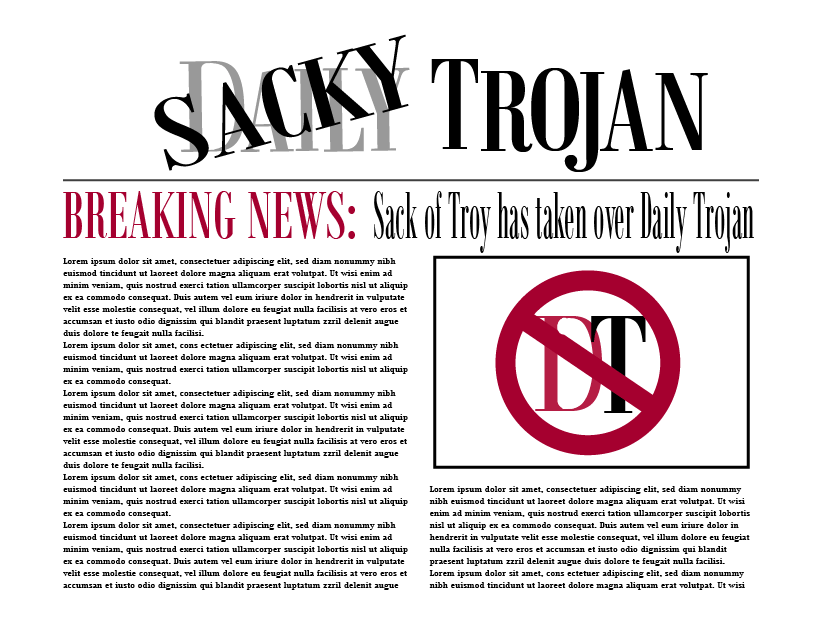

From one writer to another: Keep up the funny work, but give the domain back, please.
From the minds that brought you the fake “Save the Squirrels” campaign comes a new, and arguably improved April Fool’s day prank on the Daily Trojan.
On April 1, USC satire newspaper, the Sack of Troy, unveiled its latest elaborate hoax, obtaining the domain “dailytrojan.org” and creating a fake homepage mimicking the exact design of our very own “dailytrojan.com.”
The hilarious stunt from the Sacky Trojan features headlines such as “Tomo Chien Seen Writing About Other Universities, Tells USC Not to Worry” and “USC Announces New Separate But Equal Gubernatorial Debates.” While I applaud the timeliness of their stories, who’s going to tell them that no Daily Trojan headline would ever be in title case? That’s not AP style, Sacky Trojan. For shame, for shame. Do your research!
But, believe it or not, our editorial standards are not the only obvious difference between the two websites. Though they too may have published engaging columns from none other than “Double Agent” Pablo Rodriguez, the similarities between our two publications stops there. While our objective is to provide accurate, rigorous reporting to inform our community, the Sack of Troy has an opposing yet no less noble pursuit — to make students laugh.
Satire newspapers have a long and storied history, particularly at the university level. The Harvard Lampoon, for example, boasts an egregious amount of famous alumni, including famous yellow journalist William Randolph Hearst and some of the creators of “Saturday Night Live.” We have many famous alumni from USC too — for the record, Ivy League.
Even though the Daily Trojan and the Sack of Troy have had a similar rivalry to the Harvard Lampoon and the Harvard Crimson, at USC, with our student population being nearly double that of the relatively unknown Cambridge university, I believe this school might just be big enough for the both of us. Since the Sack’s inception in 2012, it’s the Daily Trojan that has chronicled the Sack of Troy’s history, as seen in linkage to multiple articles on its own website — you’re welcome.
On a national level, perhaps an even more notable satire publication is The Onion, which claims to be “America’s finest news source.” It’s likely if you’re one of the many Gen Z individuals who get their news from social media that you have come across and maybe even, god forbid, reposted a story from The Onion.
Though as a journalism student I am obligated to chastise you for not seeking out more reputable news sources like your very own independent campus publication — another shameless plug — it’s understandable that someone could get confused when so many of The New York Times’ headlines these days seem like they too could be satire.
Though some may cry “fake news,” the world really just is that crazy. To be incredibly humble and compare the Daily Trojan to The New York Times, we are both doing our best to make sense of the goings on for our readers and report them in factual, unbiased terms.
Satire serves an entirely different purpose — to point out the world’s hypocrisies and problems and to make light of challenging situations. While this is a fine line to walk between being silly and insensitive, it can still be incredibly impactful.
In all honesty, it can be hard to laugh in times like these, for good reason. It’s important to acknowledge that laughter is undoubtedly a privilege.
When it can be fatiguing to take in all of the information coming at us, whether it’s the news, or simply the constant phantom pinging sound of iPhone notification alerts ringing in our ears, satire helps alleviate some of that stress.
It helps validate these feelings and provoke thought and important conversations about things going on from our campus to the world stage. While news organizations stay away from commenting on current events without clearly denoting the “opinion” label, satire publications can critique institutions in a funny way that helps expose these issues.
At the same time, jokes can be taken too seriously, too far, or be misconstrued as fact — see, the Sacky Trojan’s no-so-true “Fact” section on their website, perhaps a comment on the very downside of its own existence.
I’m not sure the joke was that thought out or whether it was seemingly a similar attack on the Daily Trojan as the Sack of Troy’s own tagline reads, “USC’s second best parody newspaper.” Don’t think I missed the implication that the Daily Trojan is USC’s first best.
Still, despite this, I will give it a hesitant, slow clap.
Nina Kremer is a sophomore writing about comedy in her column, “Comic Relief,” which runs every other Wednesday. She is also an Arts & Entertainment editor at the Daily Trojan.