Thornton alum scores films, wins awards
Anastasia Listopadova finds success through feature and short film score composition.
By SOPHIA KANG
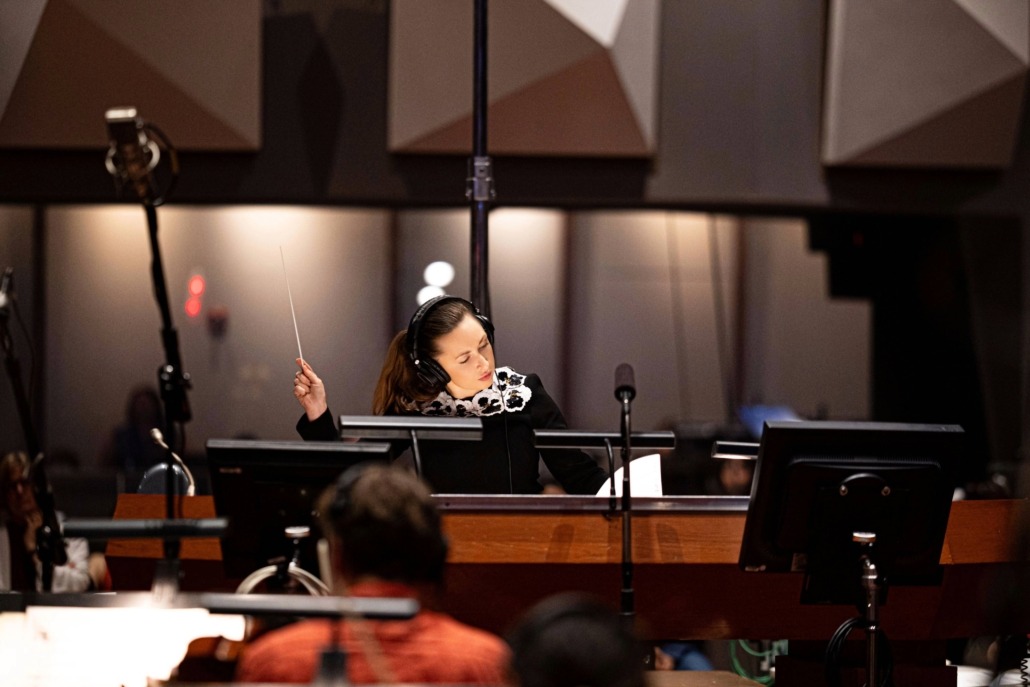

Anastasia Listopadova finds success through feature and short film score composition.
While growing up in Russia, Anastasia Listopadova had no way to pursue her passion for music. But she hasn’t let a lack of formal training stop her. Instead, she improvised.
After taking classes through Berklee Online and believing her music was not sophisticated enough for academic environments, the musician looked into the contemporary.
“[Contemporary music is] not about how music sounds,” Listopadova said. “It’s about what concept you translate through music … like in paintings and sculpture. And I always wanted people to feel something and to like it … And then I realized maybe film music is where I can fit.”
The composer then earned her master’s degree in the Thornton School of Music’s screen scoring program in 2025. Shortly after graduating, she received international acclaim for her work on various short films.
Her debut film “The Path to Enigma” (2025) earned her awards for Best Composer at the American Golden Picture International Film Festival and Best Original Score at the Five Continents International Film Festival and Amsterdam New Cinema Film Festival.
She has also earned acclaim for her work on other short films like “Perpetual Perfection” (2025) and “Don’t Call Me Anymore” (2025).
After completing her bachelor’s degree through Berklee, Listopadova said she still faced imposter syndrome and was worried she had missed her chance to break into the industry. But when she heard about the screen scoring program at Thornton, she was determined to give it her best shot.
“If they take me, it means that’s for me,” she said of her mentality when applying. “If they don’t, it means ‘Yeah, I’m not prepared’ … whatever, because you can grow. And they took me.”
Through the master’s program, she was able to gain what she called “real, industry-oriented” experience. Listopadova said students in the program learn various technical skills from translating computer programming into recording for orchestra to conducting.
Listopadova said one of the most difficult parts of film scoring is fulfilling the director’s vision because they often have a specific reference they expect the composer to follow. Despite this lack of freedom, she has still managed to build her own creative process, which she said begins with a harmony.
“Through the harmony, it’s very easy to build the mood,” Listopadova said. “It always comes from the picture, and it always comes from the director.”
Composer and adjunct instructor Garry Schyman, who was also one of Listopadova’s instructors at Thornton, said that Listopadova has a unique voice when composing.
“I would give her special appreciation for the uniqueness and how interesting her music was,” Schyman said. “That’s what really stands out.”
In 2025, Listopadova worked on “The Path to Enigma.” After speaking with director Max Gladkov, the composer had only two weeks to deliver the score, which she said she had no difficulty accomplishing.
“Maybe [because] we talked so much and I really entered the story world, it was quite easy,” she said. “I didn’t have a lot of time to rethink and to overthink again, and it was very important to catch the mood because there is some kind of ambivalence in the story.”
Recording engineer and mixer Thor Fienberg met Listopadova while she was working on her score for “Perpetual Perfection.” Fienberg said he was immediately struck by her ability to immediately convey the emotions happening on the screen in her sound.
“Even though she’s young and just starting her career, she already has her voice,” he said. “I’ve worked on a few things with her and I could kind of pinpoint, ‘Oh, this is Anastasia in here.’”
For students interested in screen scoring, Listopadova said that they should be open to any opportunities given to them but not to be disappointed if luck doesn’t come their way immediately.
“Listen to everybody, but [don’t] take really anybody’s advice, because it can be very limiting,” she said. “Just try everything and try not to overthink.”
Despite achieving success after only recently graduating, Listopadova doesn’t yet consider this to be a career.
“It’s maybe a great start,” she said. “It’s interesting to also get this experience. … I have several features in development, waiting for them to be ready and still open for everything.”