FemMtec turns up the volume for women producers
The club aims to make a male-dominated industry accessible.
By LIA ARNOLD
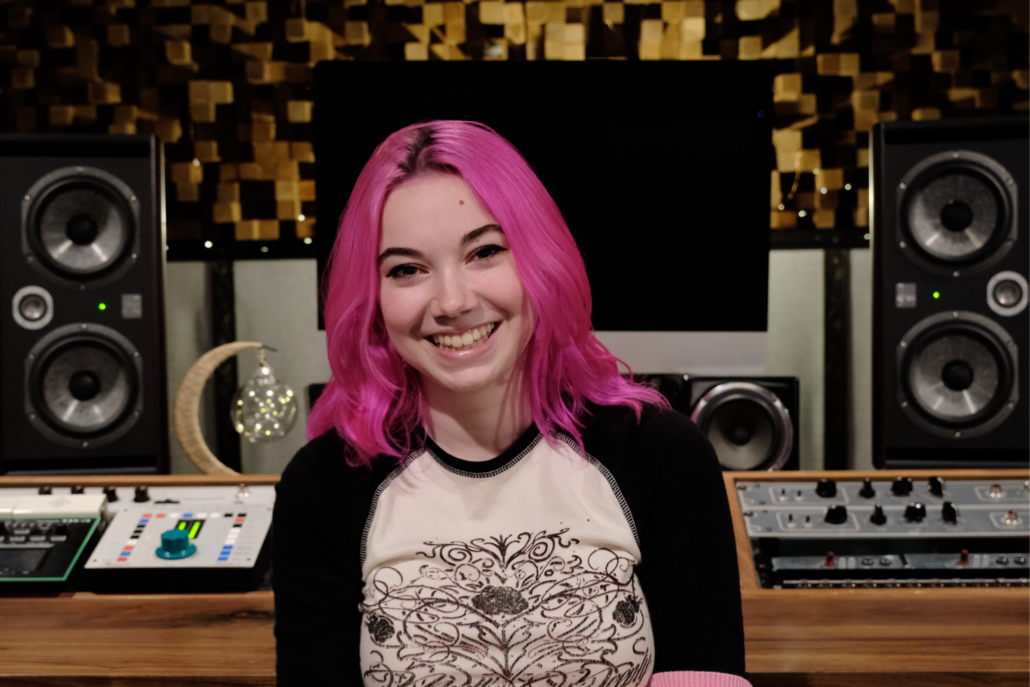

The club aims to make a male-dominated industry accessible.
Ally Waddell, a sophomore majoring in music production, is the only woman in her major cohort of 11. Only 5.9% of producing credits in music were held by women in the past 13 years, according to a report by the USC Annenberg Inclusion Initiative.
Coming from Interlochen Arts Academy, a premier arts boarding school in Michigan, where all students in her major were diverse in age and gender, Waddell missed the open nature of her high school that USC lacked. And so, during her freshman year, Waddell founded FemMtec.
“I felt like I was really out of place with my whole cohort, so I wanted to bring that environment back,” Waddell said.
FemMtec was created to make a space for women in music production to meet, collaborate and be heard. The club is made up of roughly 40 members, encompassing students with majors ranging from music industry, popular music, songwriting and even game design.
“People assume that I don’t produce and I’m only a writer or vocalist or artist. It feels like, no matter how many times I tell people, ‘I’m a producer, I work in studios, I work on [digital audio workstations],’ it just goes over their head,” Jazzy Joseph, a member of the club and a junior majoring in music production. “People are not used to female producers, and they don’t take it seriously until they see me producing.”
Joseph said there’s pressure for women producers who are often in a room full of men to know everything, while FemMtec is a welcoming, judgment-free environment.
“We want to make [FemMtec] a place where you can ask any question and figure anything out at your own pace,” Joseph said. “I’ve had to get better at not underselling my ideas and kind of having to oversell them to be heard.”
Jaida Golston-Rowlett, a board member and a senior majoring in music industry and music production, said that as a woman in the industry, she felt less confident in her abilities to pursue music production because of the environment.
“My bigger issues were being in male spaces and having a lot of men be kind of standoffish or not take you seriously, or people just disregard you in general,” Golston-Rowlett said. “It makes you feel disqualified and unqualified.”
Through weekly meetings held on the ground level of the Dr. Joseph Medicine Crow Center for International and Public Affairs, members break down production concepts and share works in progress to receive feedback. Sessions are flexible and sometimes change direction mid-meeting — shaped by attendees’ interests and experience levels.
“We are able to learn from one another. Someone may know more about a certain area of DAW and another person may know more about different concepts of how to work the DAW,” Golston-Rowlett said.
FemMtec’s Instagram group chat offers a space where women in music production can share information about internships and opportunities within the music industry.
The organization also takes members on off-campus tours: their tour of The Village recording studios in Los Angeles exposed members to the famed recording complex housed in a vintage Masonic temple.
FemMtec also recently hosted Willow Edge, a former USC student who is pursuing a music production career, working at Bakery Mastering recording studios in Culver City. During Edge’s visit, FemMtec organized a resume workshop, where Edge guided members on how to effectively present their experience and technical skills for industry roles.
Looking toward the future of FemMtec, the e-board is hoping to collaborate with We Are Moving The Needle, a nonprofit organization focused on increasing the representation of women and non-binary people in the recording industry. By establishing a USC chapter for the nonprofit, FemMtec would be able to expand its outreach and gain further institutional support.
“Just by word of mouth so far has been pretty powerful. I can only imagine how much it’s going to grow when we get [the certification] under our belts,” Golston-Rowlett said.
Golston-Rowlett said FemMtec has created a place where women interested in music production feel less alone and more accepted.
“To be in a space where we all have common stories, and we’re being honest with one another, made me so much less alone,” Golston-Rowlett said.