Politics begin in your wardrobe
Fashion operates as a language that speaks when people don’t want to.
By EFRAIN LANDIN
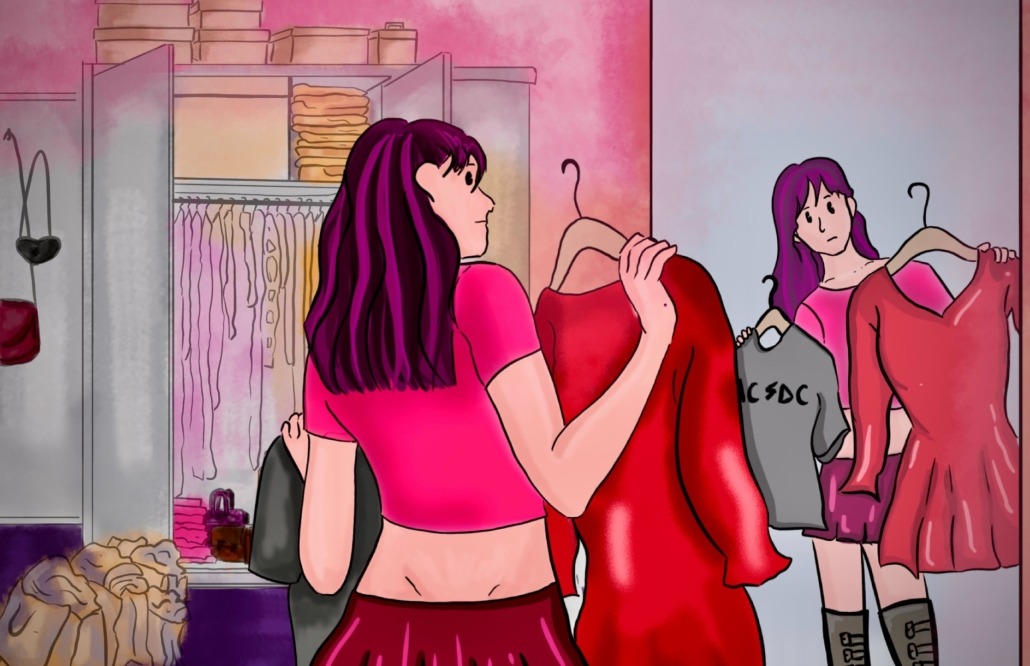

Fashion operates as a language that speaks when people don’t want to.
If you stand on the corner of Trousdale and Childs Way, you’ll spot multiple Longchamp bags, Dr. Martens, baggy jeans, flowy white maxi skirts and many, many sweatpants.
It would be far from the truth to assume that these clothing items exist inconsequentially. If you listen closely, every item reveals the same thing: Fashion is the language spoken when one does not desire to say something directly.
Recently, this language translates into beige, navy blue and other neutral colors, simple silhouettes like knitted sweaters, loafers, lounge wear and simple hair and makeup in an attempt to suggest one is “chic” or exudes “quiet luxury”. Other times, the language of fashion fixates on wearing white cotton, linen and lace clothing, cowboy boots, religious symbolism and living in the middle of nowhere: the southern gothic aesthetic.
Though these aesthetics are quite different from one another, they both thrive off the current state of our society. “Quiet luxury” found its way back into the mainstream because of Carolyn Bessette Kennedy, a fashion publicist and wife of John F. Kennedy Jr. Her position in society made her style alluring and raised a question about taste; when a wealthy and prominent figure in society chooses not to flaunt their wealth, maybe you too could climb the ranks of society by doing the same.
The quiet luxury aesthetic’s survival is dependent on the phenomenon sometimes referred to as the “grammar of appearance,” where one’s clothes and style can signal social status. Playing into this aesthetic is an attempt to assimilate oneself into the upper class at a time when the wealthiest 1% holds the same amount of wealth as the bottom 90% of Americans combined; an attempt to avoid the same ostracization as the lower class.
The Southern Gothic aesthetic comes from the literary genre of the same name, which explores how the idyllic version of the antebellum South hides the reality of slavery, white supremacy and classism. When people face the reality of the racism and lack of affordability that this country is built upon, it is no surprise that many people want to go back to times of inequality when things were “simpler.”
Both of these styles unconsciously perpetuate conservative values. However, understanding the context of both of the aesthetics is not to say that anyone and everyone who participates in the styles are a raging racist or classist, but rather to note that one should approach aesthetics with an understanding of where they come from and why they’re here.
These aesthetics promote the desire to be a part of a seemingly untouchable group of people, which has shown no interest in allocating any of their resources to help the working class, therefore perpetuating conservative values of individualism. By idealizing solitude and “simpler times,” one creates a “them versus me” mentality through which conservatism rises, because it promotes self-centeredness and discourages collective success.
To better understand why fashion operates as a parallel to society, one must confront the uncomfortable past and travel back to the early twentieth century.
Between World War I and World War II, fascist ideology permeated the air in Italy like rotting flesh, becoming tangible through Italian fashion. Fascist ideology thrives off an authoritarian power where individualism and ideological opposition is obviated. Because Italy was left in economic ruin post-WWI and was seeking structure, uniforms came crashing in.
Black tailored button-ups became infamous for their uniform-like appearance. Other men’s fashion quickly followed suit, making uniforms and suits synonymous with fascism because of their hyper-masculine silhouettes and dark colors that promoted conformity.
Conversely, women’s fashion at the time was drifting towards androgynous and masculine silhouettes that reflected the newfound freedom of women. To combat this movement, Mussolini focused on promoting femininity and motherhood through “glamorous” or traditional clothing like long dresses and puffy sleeves.
In addition to loving conformity, fascism loves aesthetics. Militaristic and nationalistic aesthetics became prominent in Italy because they made people feel that war, violence and pain were exhilarating, beautiful and inspirational. Now, aesthetics like Boho chic, which glamorize poverty, create a sense of prosperity and freedom during America’s tenuous economic state.
It is very easy to watch the news and share the pervasive belief that there is no more hope in the world. To say that there is nothing one can do is false — fashion is the medium everyone utilizes on a daily basis, and it is one course of action.
Showing diversity through a mix of fabrics, bright colors and traditional attire all oppose authoritarianism by going against uniformity. By rejecting conformity, fashion becomes human.
To downplay fashion as the language of society is to negate its ability to make change when we need it the most. However, to be fluent or aware of the language is not sufficient. Whether that be by embracing unconventional styles, experimenting with new pieces and reclaiming old aesthetics, one will find that by participating, fashion as a tool of advocacy can be successful.