Sheng Wang’s ‘Purple’ is not very colorful
Commentary on everyday occurrences can’t keep an audience engaged for an hour.
By NINA KREMER
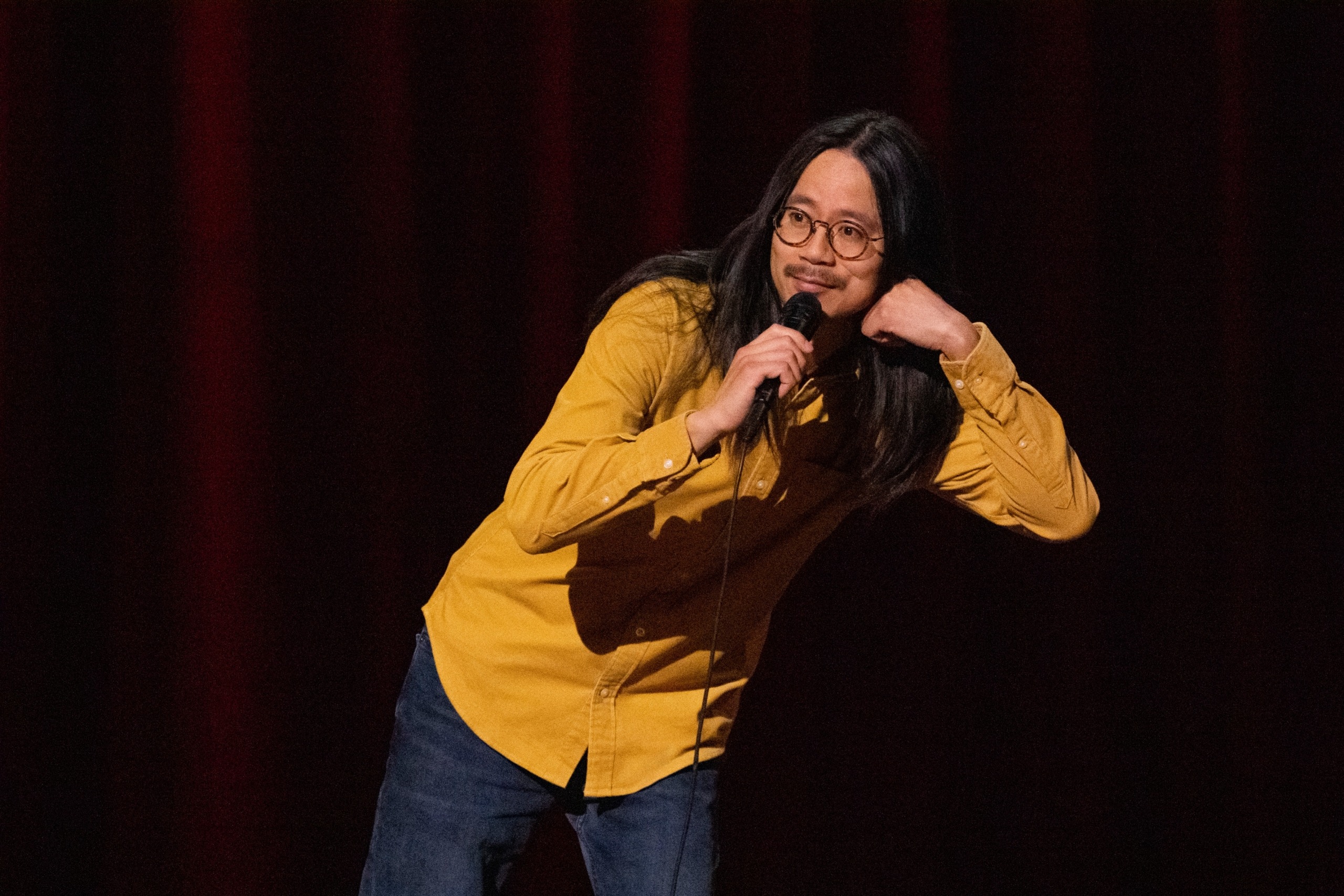

Commentary on everyday occurrences can’t keep an audience engaged for an hour.
Berries contain lots of antioxidants. That’s the first of many obvious facts of life that Sheng Wang feels the need to point out in his new comedy special “Purple,” which was released on Tuesday on Netflix.
Much of the comedy special centers around the theme of adulthood, which, for a guy who publicly admitted to being in his 40s, feels quite tired.
Wang discusses the highs and lows of aging: trying and failing to do the monkey bars, attending his friends’ bachelor parties and making smoothies. There’s an overarching emphasis on health consciousness that also perfectly encapsulates the vibe of the show; it’s for an older crowd.
The first four minutes are on the obvious health benefits of berries; Wang tells a particularly dull story about his friend’s kid eating all of his berries when they visited his house. The child picked up a fistful, to which Wang overreacted, “That’s not how you eat berries, that’s how you display a sacrificial human heart!”
While one could argue that Wang did put the berries out on the table and should accept this fate, his deadpan facial expressions, animated voice and incredibly earnest delivery create a subtle charm that instantly gets the audience on his side. The sincerity he brings to the stage betrays someone much more intelligent than his simple style of comedy lets on. It’s endearing, but at times — such as with the berry bit — borderline boring.
“Technically, I’m a full-blown adult, but I feel like I got a little ways to go to become a real grown-up,” Wang says. His version of being a real adult? Being able to move normally around one’s house in the dark after watching a scary movie and getting into the shower before turning on the water.
Wang’s depictions of everyday activities are objectively funny, and he has a real talent for making the audience think deeply about the implications of things as simple and second nature as brushing their teeth. However, the vast majority of the comedy special is spent dissecting experiences so common, they feel played out. While Wang is certainly a gifted storyteller, he adds little unique commentary of his own to the conversation.
For a tight 10 at an open mic, sure, Wang would kill. But the hourlong special became repetitive with the same intonation and style of setup for nearly every bit. He seems to hop from one entirely random topic to the next with little callback jokes or interaction with the audience.
Wang’s style of comedy is at its best when he uses humorously elegant phrasing, like his explanation of sleeping on a hotel memory foam mattress: “There was a unique emptiness created by a body that was not present but clearly defined by the boundaries of their absence. And I’m all up in the contours of a larger man.”
But unfortunately, Wang oscillates between such a sophisticated explanation and simply adding the suffix “ass” to various words, such as his description of shallots as the onion’s “fine-ass cousin,” and leeks as a “buff-ass green onion.” It seems the onion might be challenging berries to become his next strange fixation.
This style could be funny in moderation or with more thematic direction. The art of the comedy special lies in not just having enough material to fill an hour, but carving out a story, taking the audience on a ride and surprising them with a takeaway.
In the latter portion of the special, a narrative seems to suddenly develop, and Wang actually begins to share stories from his personal life rather than pulling from ubiquitous experiences, such as his joke about jury duty, and reaches for slightly less low-hanging fruit. A promising story about a backpacking trip ends with an image of himself and his buddy checking themselves for ticks in a tent.
The punchline, however, is simply that it was a bachelor trip with just the two of them, which led Wang to posit the thoughtful question, “Would more boys make the party less gay?”
The joke that is the namesake of the special also has an equally underwhelming payoff, yet it provides the perfect picture of the special. When discussing which color he would choose in a multi-pack of toothbrushes, Wang says he always opts for purple.
“The purple one is powerful. I only choose the purple one when I want to change the narrative,” he says.
Wang’s bits are too straightforward. Yes, comedy relies on relatability, but a comedian has to have a bit of a wow-factor, a way of making the audience look at their own experiences in a new, funny way. Unfortunately, as likable as Wang is, he doesn’t accomplish that, and his comedy feels strangely impersonal because of how deeply common all of the experiences he touches on are.