LOVE, ACTUALLY
In defense of the makeover
When done right, these movie montages are more about confidence than vanity.

By SOPHIA KANG
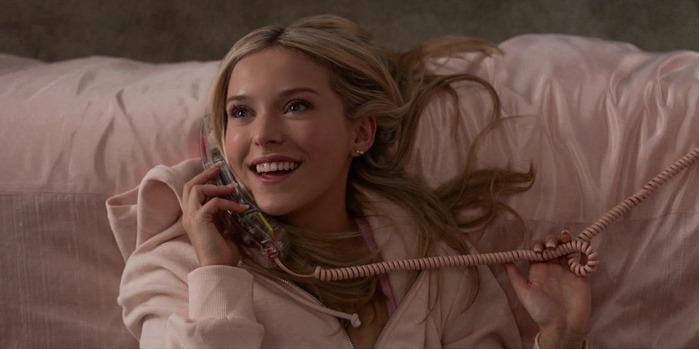

When done right, these movie montages are more about confidence than vanity.
Last Thursday, I went to see USC’s production of “Legally Blonde.” Unsurprisingly, it was a delight, and I kicked my feet and cackled my way through the show. And as I watched Elle Woods (Lydia Berckley) refuse to trade her signature pinks for the dark navy and blues deemed more acceptable by her classmates, I got to thinking about classic makeover scenes in romance media.
Unlike other outdated films like “Grease” (1978), I consider “Legally Blonde” (2001) to be an evergreen film. While Sandy Olsson (Olivia Newton-John) changes her entire personality and trades poodle skirts for a sexy latex suit for a man who, let’s face it, sucks, Elle Woods (Reese Witherspoon) is not your typical romcom female lead.
She’s already gorgeous, and she knows it; she has the confidence to lead her sorority house and get into Harvard Law School without a lick of previous interest in either the school or the field; and she is unapologetically her true pink self in the midst of a drab Ivy League environment.
While it may seem unexpected that Elle Woods, a complete stereotype of femininity, is such an empowering figure, she maintains her confidence and authenticity throughout the film. In the past, makeover scenes in romantic comedies have been used to promote gender stereotypes and make women the punchline, rather than encourage authenticity. But this does not mean that the genre is completely devoid of encouraging montages.
In fact, viewing the makeover trope through a feminine lens, rather than male-centric, allows the viewers to see that these cosmetic changes are not always a result of a female character suppressing her true self, but rather coming into it.
Elle’s “makeover montage” is less external than it is internal. She never actually changes her look but only her attitude. Putting aside her initial intention of winning back her ex-boyfriend, Warner (Matthew Davis), Elle hits the books and is determined to prove everyone wrong. Her change is truly for herself as she reaches the full potential she knows she is capable of.
Another character transformation spurred by a makeover occurs in “My Big Fat Greek Wedding” (2002). Toula Portokalos (Nia Vardalos) is the complete opposite of Elle Woods: She’s awkward and unconfident in herself and her aspirations. But similar to Elle, her first step toward confidence is through education. After enrolling in a few college classes, Toula starts to grow into her authentic self.
She dresses in brighter colors and starts wearing makeup, no longer afraid to stand out, and comes out of her shell to make more female friends. While it may seem that her makeover is physical, its purpose is not to appeal to outside observers; instead, her outward appearance begins to match the inner sense of self that she develops.
When she is eventually noticed by her love interest, Ian Miller (John Corbett), it’s not because of her “new-and-improved” looks but rather, her confidence and clear happiness because of it.
A similar example can be seen in “The Princess Diaries” (2001) — though the film commits a truly heinous crime by straightening Mia Thermopolis’ (Anne Hathaway) curls — as her makeover also gives her the confidence boost she needs. And even after looking the part, her transformation is really only a stepping stone to becoming the leader she always had the potential to be. She doesn’t just magically grow confident because of a flat iron.
Even with her new look, Mia is still as awkward as ever, feeling unsure about herself and what she can offer as a princess. It is only after several mishaps caused by her unwillingness to appreciate herself, inside and out — including a bad first kiss, a snubbed date and a momentary panic-induced escape plan — that she embraces her newfound confidence.
These makeover scenes might include outward changes, but ultimately, at their core, these transformations are about becoming your authentic self and achieving the goals that were previously believed to be impossible. Whether you’re naturally confident like Elle Woods or need a bit of a push like Mia Thermopolis, a makeover should be dedicated to you for your happiness alone.
This summer, “Elle,” a prequel to “Legally Blonde,” is gracing our screens. I can only hope that the show will portray such a timeless character with the same authenticity and personal fearlessness as the original movie. Although I am skeptical and eagerly anticipating a makeover montage up to par with its predecessor, I am excited for the next generation of young girls to see that it’s not the makeover that makes the girl, but the girl that makes the makeover.
Sophia Kang is a sophomore writing about romance media in her column, “Love, Actually,” which runs every other Tuesday.