Grocery stores are LA’s newest status symbol
Rethink where you shop, for it is that deep.
By ANVITHA KOMARRAJU
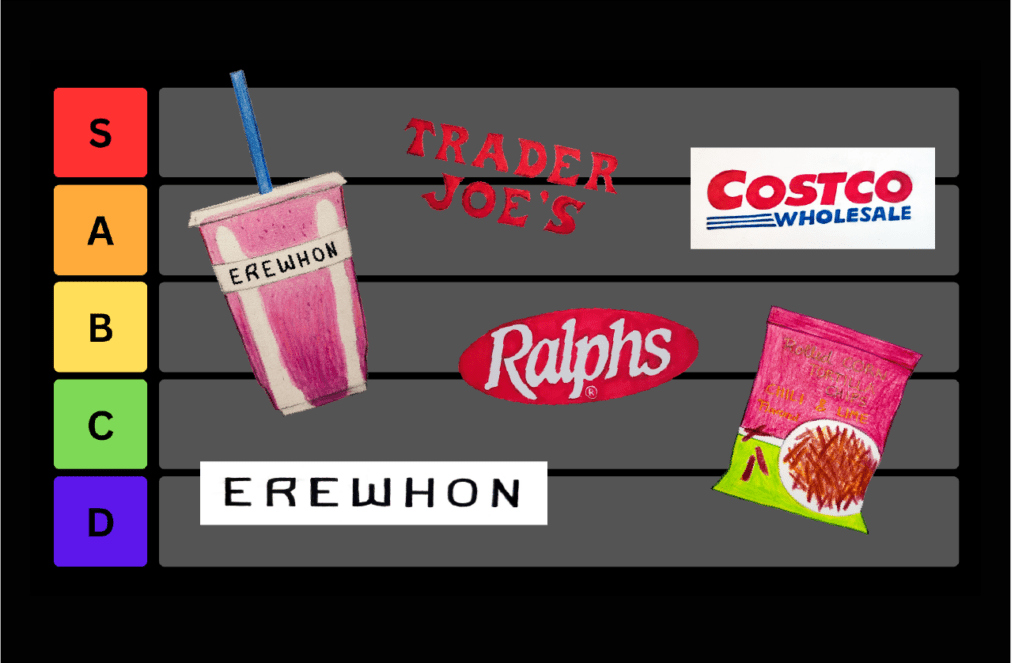

Rethink where you shop, for it is that deep.
Los Angeles is often called superficial. It might be due to the idyllic lifestyle of influencers in Beverly Hills, or the cliffside mansions of the Pacific Palisades. Yet, the most interesting show of wealth isn’t confined to the most affluent zipcodes; rather, it appears in the grocery stores found on every corner of L.A.
For most people, grocery shopping is a mundane necessity squeezed into the margins of the day. But for Angelenos, the choice of a store is a symbol, signaling exactly where you sit in the city’s social hierarchy.
In a city that seems as though it is defined by performance, groceries have become the newest stage. Especially at a university like USC, where every other person you meet seems to be building a digital platform, grocery shopping has officially transitioned from a domestic duty to another curated, Instagrammable moment.
This performative consumption is best shown at the undisputed epicenter of L.A.’s wellness culture: Erewhon.
As Vogue noted last year, Erewhon has “become a luxury brand in its own right.” Shopping there transcends the regular grocery store experience: as customers walk in, they are immediately hit with walls of meticulously placed bottles and produce, including but not limited to $44 sea moss gel.
When you spend $21 on the Strawberry Glaze Skin Smoothie, you aren’t buying a drink, but buying into a trend. The store is built for taking selfies and creating aesthetic Instagram stories about the shopping experience. With gray cement floors, mood lighting and even a stylish bathroom, Erewhon is designed to be an immersive experience.
You don’t just buy food at Erewhon — you buy the appearance of someone who can afford to drop $75 on a hot bar lunch while sporting an ALO sweat set. The problem isn’t just that we are spending too much money, it’s that we’ve lost the ability to exist without a camera lens.
Even supposedly affordable stores aren’t free from this trend of appearances. Take Trader Joe’s, a store started just a few miles away in Pasadena, which has accumulated a cult-like fan base across the country with its low prices and seasonal goods. With its location at USC Village, visiting is not an infrequent occurrence for many USC students.
Don’t let the low prices fool you, though. Trader Joe’s customers are just as consumerism-driven as the rest. Just a few weeks ago, lines stretched across USC Village in the early hours of the morning for the brand’s newest tote bag drop.
These bags are nothing special – except they somehow seem to be going on sale for $15,000 on eBay. By keeping these items limited, Trader Joe’s has turned a $3 tote bag into a scavenger hunt, and those who win, win the company-made game of artificial scarcity as well.
We have clearly reached an apex in our consumerism, when a bag that is supposed to be reliable, useful and budget friendly becomes a badge of a lifestyle worth camping out for.
This display of sheer consumer desperation shows how budget-friendly grocery stores have turned into another show of economic station. Even affordability turns into a status symbol when branded correctly.
The soul of grocery stores is slowly being stripped away, with the Amazonification of Whole Foods, a once charming home for organic food made to please any crunchy parent, has transformed into another efficient, corporate machine.
After buying Whole Foods for $13.7 billion dollars in 2017, Amazon heavily integrated its Prime membership into the shopping experience, creating a loyalty program that incentivizes grocery shoppers to use Prime.
Amazon’s huge scale allows it to pressure suppliers for lower prices, beating out smaller, independent retailers who cannot compete with the exclusive discounts shoppers with Prime receive.
This shift toward corporate sterility has taken human interaction out of grocery stores. We’ve become so used to the convenience of the self-service kiosk and scanning a QR code to pay that we’ve forgotten how to be a part of a community.
Though these issues of tote bag hoarding and automated check-outs aren’t exclusive to L.A., this city has a way of turning a mundane activity into a spectacle.
The ultimate status symbol in L.A. shouldn’t be a $20 smoothie or a tote bag, but a genuine connection to the community. Next weekend, take a trip to the Crenshaw Farmers’ Market or a local neighborhood yard sale. Talk to the person who actually grew your food and the community members that sustain it.
Stop shopping for appearances and start shopping for the neighborhood you actually live in. In a city that can feel performative and manufactured, it’s up to you to be authentic. An heirloom tomato from a local fruit stand might not get as many likes as the Malibu Mango smoothie, but it tastes a lot more like the real L.A.