President Kim makes speech on his inspirations
In the “What Matters to Me & Why” series, President Beong-Soo Kim talks about his values and beliefs.
By ADAM YOUNG
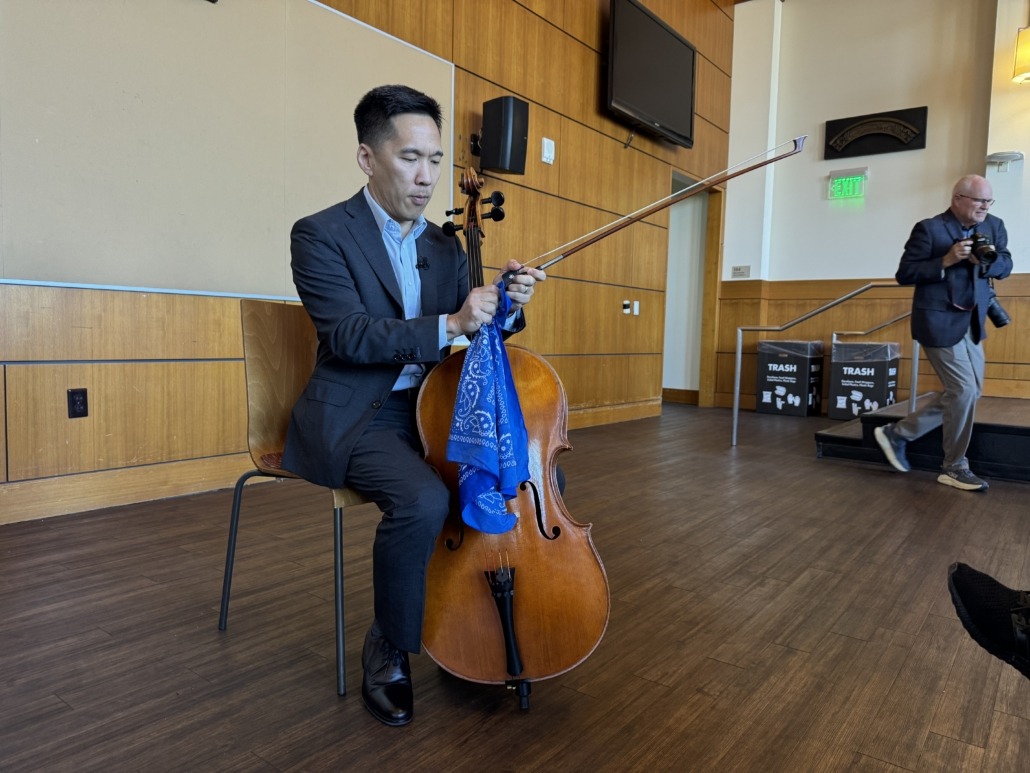

In the “What Matters to Me & Why” series, President Beong-Soo Kim talks about his values and beliefs.
When President Beong-Soo Kim was driving his mother home from the hospital for the last time, she told him to turn the car around when they were over halfway home. Rather than thinking about the disease that would soon kill her, Kim’s mother’s priority was thanking the nurses who helped her at the hospital.
So, Kim and his mother turned around and bought See’s Candies. At her funeral a few weeks later, Kim said the church was completely packed because of her kindness.
“I don’t know if this is a healthy way of looking at it, but when I’m hanging it up at USC, I want the delta between what I’ve given to the University and to the world to be as large as possible, between what I’ve given and what I received,” Kim said Wednesday. “That’s my goal.”
Kim’s speech was a part of the Office of Religious and Spiritual Life’s “What Matters to Me & Why” series, which looks at the values and beliefs of USC faculty and staff. He spoke about three people whom he admired because he said the thought of speaking about himself for 30 minutes was an “unpleasant thought.”
One of the three people that Kim talked about was his mother. Kim said he greatly admired his mother’s love for learning, which was reflected in her custom license plate: “LV2LRN,” which meant “love to learn.” Kim said he was fortunate to grow up with someone who loved education so much.
Min Ahn, the pastor for the White Harvest Evangelical Church, said he came to the event to congratulate Kim for becoming president. Ahn said that Kim’s description of his mom reminded him, in some aspects, of his own mother, who he described as “giving and selfless.”
Another person Kim talked about was Sir Isaiah Berlin, a political philosopher, who Kim said shaped how he thought about politics and universities. Kim said he was always looking for the “right answer” as a kid, but Berlin’s writings made him realize that there is often no single answer.
Kim also said he liked Berlin’s idea of positive liberty, or when people engage with one another on politics, and believes that this idea reflects what USC and other universities aspire to be.
“When you first talk about the importance of open dialogue, really it’s coming from these ideas and these beliefs and these books that I’ve been reading and learning from for many decades,” Kim said.
After his speech, Kim opened the forum to take questions from the audience. One attendee asked Kim how he approaches making decisions, especially in a role where difficult decisions are made every day.
Kim said he tries to not think about what feels good right now, but what is going to be right years later. He also said he is not perfect, especially when making quick decisions, but has to move on and learn from them.
“What I’ve experienced in the USC community is that if you just stand up in front of people and explain how you made the decision, whether or not people agree with the decision, I think they’re willing to really give you a lot of grace if you just give them the opportunity to express themselves and have a conversation with you,” Kim said.
As a cellist, Kim said he also admires Pablo Casals, who was considered the greatest cellist in the world throughout the early 20th century. But, what comes to mind when Kim thinks about Casals is his discipline and hard work.
Kim said the “maniacal focus” necessary to play the cello well is a mindset he applies to every role he takes on. But, because of this focus on excellence, Kim said he always feels like he is falling short, especially in his new position as president.
“I would say that, yes, excellence is the goal for all of us, but I don’t think that sometimes people fully appreciate how hard it is to achieve, and the sacrifice and the cost of really working towards excellence, and this feeling that [you’ll] never, ever [arrive],” Kim said. “It’s this idea that, ‘Well, that didn’t work out, but I’m going to get up and do better next time.’”
Another reason Kim said he admired Casals is because he viewed himself as a human before a cellist, standing up for causes he believed in by refusing to play in fascist regimes. Kim said Casals was invited to the United Nations to perform and receive an award in 1971, and told the intergovernmental organization: “Birds sing when they are in the sky, they sing: ‘Peace, Peace, Peace,’” before performing a Catalan folk song called “Song of the Birds.”
With that, Kim sat with his cello in front of the crowd, wiped his bow’s strings with a blue handkerchief and played the folk song to the attendees.