Audiobook, podcast stage joins LA Times Festival of Books
A new stage will feature seven panels discussing the formats and their genres.
By NICHOLAS CORRAL & NATHAN ELIAS
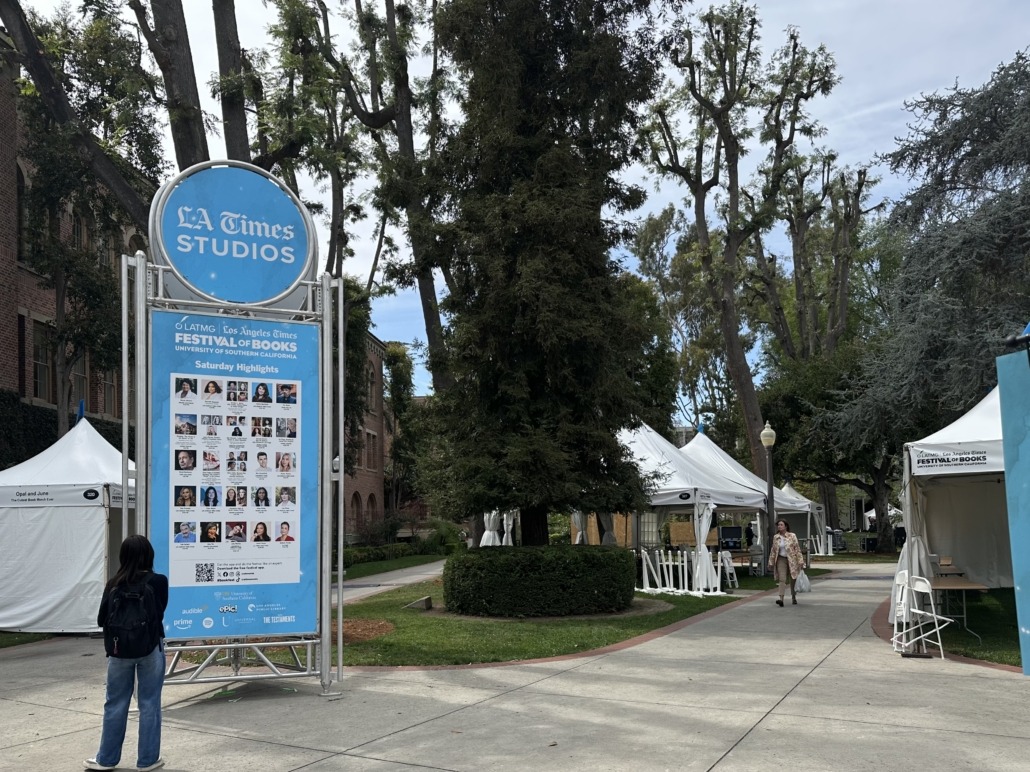

A new stage will feature seven panels discussing the formats and their genres.
Audiobook narrators spend most of their working time alone in a soundproof booth. Unlike in theater, film or television, narrators don’t work across from each other. That means each one has to develop their own processes and techniques, said January LaVoy, who has worked on over 600 audiobooks.
“The thing about audiobook narration is, ask 20 narrators how they do something, their methods, their opinions, their loves and hates and focuses, and you’ll get 20 different answers,” LaVoy said. “And so I always think it’s great when there’s three or four or five of us together.”
This year, there will be a dedicated audiobook and podcast stage at the 31st annual Los Angeles Times Festival of Books. The stage will feature seven panels over the weekend, touching on romance, true crime and the art of telling a story across different formats, among other topics.
The festival has awarded an audiobook production prize since 2023, but this is the first year it has had a dedicated space for audio content.
In the past, if book festivals included audiobooks at all, it would be during panels with names such as “Audiobooks, are they really reading?” said Andi Arndt, an award-winning audiobook narrator. But that was roughly 15 years ago.
At the festival this weekend, Arndt will join a panel about narrating romance audiobooks.
“We like to get out and see the people,” said LaVoy, who previously made appearances at comic cons and sci-fi conventions as much as literary conventions. She will make her L.A. Times Festival of Books debut in a panel about how narrators tell stories.
“You get sci-fi folks and fantasy folks and romance folks, and it’s kind of endless, and it’s really fun,” LaVoy said. “Again, because we work alone in this soundproof room: Please invite us to your con.”
Americans spent 773 million hours a week listening to podcasts in 2025, according to Edison Research. Meanwhile, the Audio Publishers Association reported audiobooks generated $2.22 billion in revenue in 2024.
“Audiobooks are growing faster than any other part of the publishing industry,” Arndt said. “It’s time for something like this.”
Bruno Cavelier, manager of event sales and sponsorships for L.A. Times Studios, said that, with an increase in audiobook listenership, the festival wanted to respond to the moment.
“We’re really flexible to what the culture is at any given moment. And we want the theme and the spirit of the festival to always remain the same, but to be bringing something new every single year,” Cavelier said. “To that end, the rise of audiobooks has been the perfect thing for us to highlight.”
Planning for the stage began in 2024, Cavelier said, when Spotify — which will be presenting the stage — approached the Times about some kind of involvement in the festival. He said podcasts, featured on the same stage, fit with the festival’s goal because while they “aren’t necessarily literary, they are informative.”
Traci Thomas, host of the literature-focused podcast, “The Stacks,” has seen the evolution of reading culture firsthand. In addition to her podcast, which she started in 2018, she engages with readers online through Substack and in person through live events. Thomas, who will host a panel at the festival, said she hopes to use her time with the panelists to talk about their love of books and what it means to be a reader today.
“We’re in a weird place with books where people act like they’re this separate thing,” Thomas said. “I’m always just trying to remind people that books exist, they’re fun and they’re fun to talk about.”
For LaVoy, audiobooks are an important accessibility tool for books, and can benefit people with disabilities, incarcerated people and people with low literacy. They also allow people to reconnect with reading even when busy, she said.
“I know a lot of people in the last, you know, 20, 30 years — again, digitally, since all of this started — have lost the habit of reading, and so I think everyone should care about audiobooks, because it is an opportunity for people to return to the oldest form of communication, which is storytelling,” LaVoy said.
Cavelier said the festival wants to expand into live podcast recordings if the stage goes well.
“Our goal is absolutely to have the stage be a mainstay,” Cavelier said. “We’ve seen that rise of audiobooks over the last year and a half [and] I think that theme and sort of that growth and popularity is only going to get bigger.”