Founding documents arrive at USC Fisher Museum
The exhibit is temporarily showcasing nine documents including the Constitution.
By NICHOLAS CORRAL
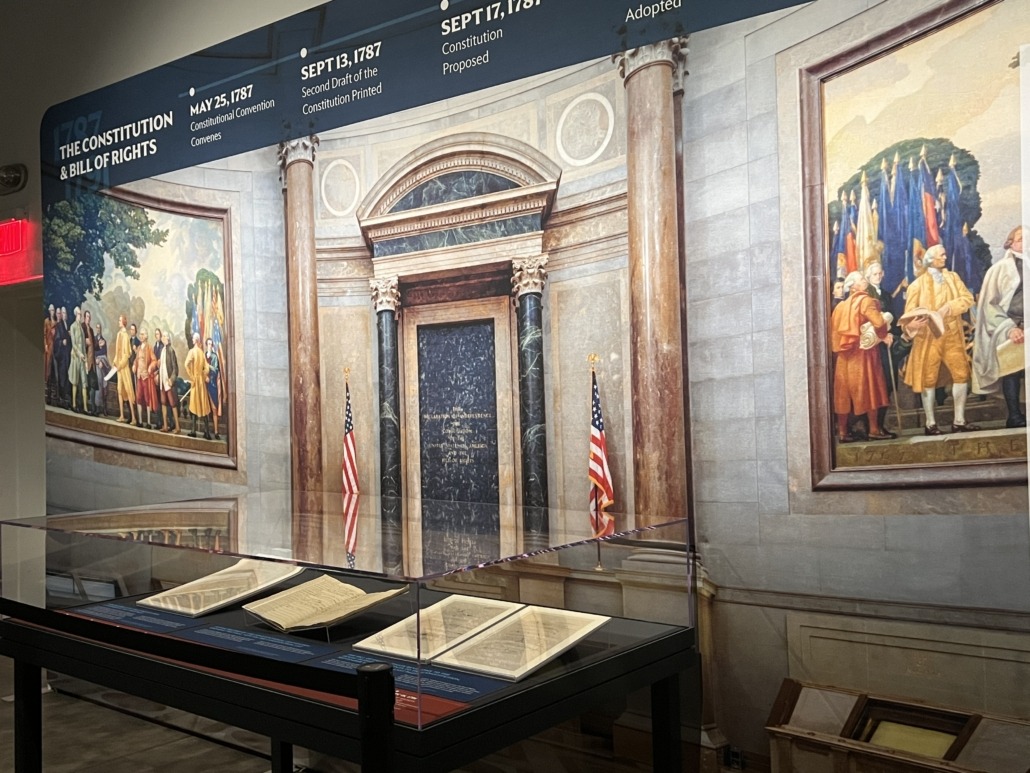

The exhibit is temporarily showcasing nine documents including the Constitution.
One year ago, Jessie Kratz, historian for the National Archives, wasn’t sure whether the Archives would be able to put together a traveling exhibit before the United States 250th anniversary.
She said the Archives usually spends at least two years on a major exhibit, but for the tour, it had approximately half the time to find venues, cull down thousands of documents to just nine and find a way to transport the documents.
“We were just saying, ‘What? How can we? Are we crazy? Can we do this?’” Kratz said of that planning period. “It involved everyone: the curators, the registrars, our lawyers, our conservators, the venues’ lawyers, and then the staff and countless calls.”
Now, nine documents from the founding of the United States are traveling across the U.S. on an eight-city tour and will be showcased at the USC Fisher Museum for two weeks, beginning Friday. The documents include the Oaths of Allegiance — signed at Valley Forge during the Revolutionary War — the Treaty of Paris and a rare copy of a draft of the Constitution, among others.
Kratz, is also the lead curator for the exhibit, called the Freedom Plane in recognition of the Bicentennial Freedom Train and because it travels by way of a decorated Boeing 737. She said she wished they could show more pages of the documents they chose on the tour, but due to space constraints, they could only choose a few pages from each document.
Patrick Madden, CEO of the National Archives Foundation, said the tour allows the documents to reach a far wider audience.
“There’s a lot of events and programs happening in Washington. Not everybody can make it to Washington,” Madden said. “Part of the mission of the Archives is to make the records more accessible.”
Madden said the host cities were chosen based on various factors, including market size, with the aim of getting the documents in front of as many Americans as possible. The documents previously landed in Atlanta and Kansas City, and will go on to Houston, Denver, Miami, Dearborn and Seattle.
Bethany Montagano, director of USC Museums, said the University’s long history of having a reserve officer training corps program — extending back to 1914 — and the accreditation of its museums by the American Alliance of Museums were important factors in USC hosting the documents. USC is the only university among the host venues.
Montagano said that getting the documents involved 13 different University departments: That included everything from Facilities, Planning and Management to University Relations and the history department. And at USC, she said all the planning and preparation took place over six months.
The documents landed in Los Angeles on Monday at Van Nuys Airport, traveling by private plane. ROTC students and Department of Public Safety officers took them off the plane, and the documents were then escorted by police to USC.
After arriving at USC, the documents had to be given a day to acclimate to the museum space, then had to be inspected carefully for damage before finally being installed in the Fisher Museum, Kratz said.
Inside the Fisher Museum, the documents require 24-hour security both inside and outside the building, as well as round-the-clock camera surveillance, according to Montagano.
The documents also have strict requirements on how much light they are allowed to receive: only eight hours a day. Montagano said that when the documents are unveiled each morning, USC has to immediately notify the National Archives to start the countdown clock.
“I’m so proud of my colleagues at USC who were able to step up and show up, and [make] sure that the temperature and humidity was perfect, making sure that the lighting was perfect,” Montagano said. “This has been a great project to show how USC can work across the University.”
After the tour ends, Madden said the documents will be stored in complete darkness for between five and 10 years to preserve them after being exposed to light.
Lauren Cella, a social studies teacher and social media influencer, was at the exhibit to talk about it on her social media. She said she would love to be able to bring her students because going to Washington, D.C., was far beyond her school’s budget.
“We’re seeing this resurgence of physical media with [Generation] Z and [Generation] Alpha,” Cella said. “They don’t want to be tied to their devices all day. So seeing the actual 250th anniversary documents that are here, like IRL, right? That makes that connection.”
Madden said the documents on display connect students with American democracy, showing both inspirations and divisiveness.
“We’re back into a place where we have very divisive times. So students should be not thinking about the 250, but what they are doing for the 250 and democracy going forward,” he said. “These documents are a way to look back at where it all started and then have them think about ‘What’s my role?’”