Knead LA combats food insecurity one loaf at a time
The student-run nonprofit has plans to expand services beyond Los Angeles County.
By KATE HENRY
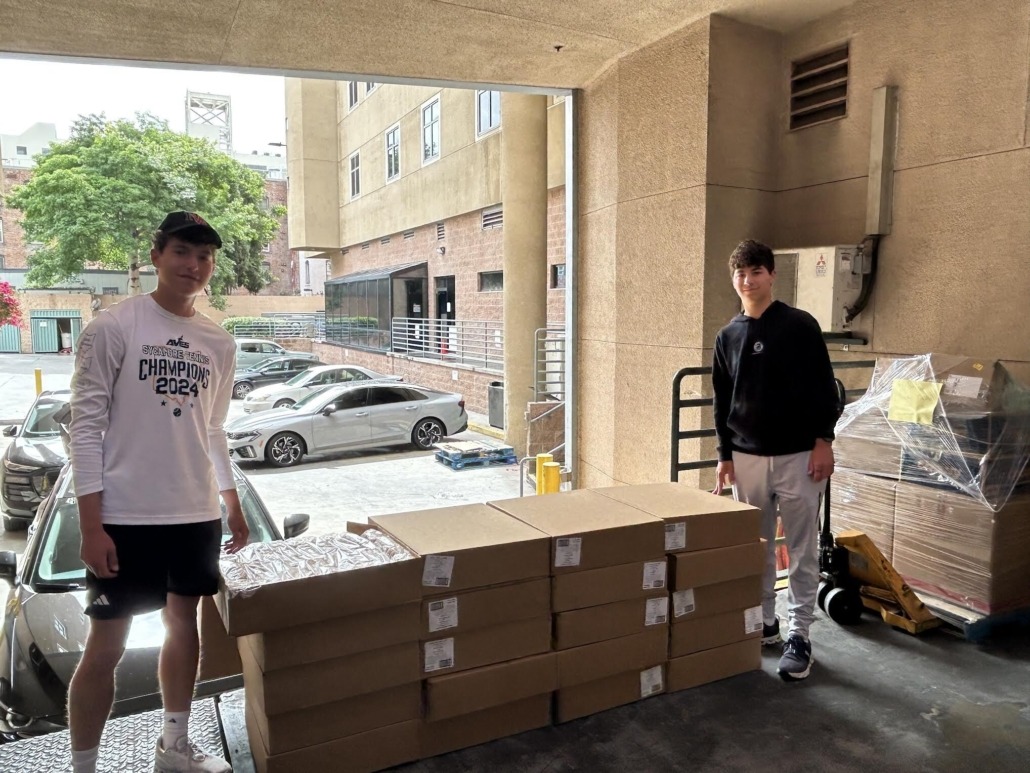

The student-run nonprofit has plans to expand services beyond Los Angeles County.
Standing outside of a Los Angeles shelter, Harvard-Westlake junior Zack Figlin saw a line of people waiting to get meals extending down the block. He knew he could do something to help.
Figlin is the chief operating officer for Knead LA, a group that helps combat food insecurity by redistributing unsold bread from bakeries around L.A. to communities in need.
“These people really need this,” Figlin said. “They need people to be compassionate for them.”
Knead LA was founded in March 2024 by Max Coleman and Nikhil Sarvaiya, then-sophomores at the Harvard-Westlake School. What started as a two-person pursuit has since expanded to include a team of around 20 student drivers, who deliver the bread from bakeries to local nonprofits and several partner organizations.
Knead LA takes baked goods that would otherwise be thrown away by bakeries, such as Puritan Bakery and Western Bagel. Since its inception, the organization has delivered around 200,000 baked goods, for a total of 36,000 pounds of bread, helping more than 15,000 people, according to its website.
Chase Klugo, Knead LA’s chief financial officer and a junior at Harvard-Westlake, said this work helps to combat the long-standing issue of food insecurity in L.A. As of 2025, the issue affects one in four L.A. County households.
“We want to become the tool that helps nonprofits essentially be as efficient as possible,” Klugo said. “Instead of focusing on the driving aspect, [they can focus on] the good of actually handing out and preparing meals for people who need them.”
Klugo said he remembers one interaction he had with a nonprofit worker during a recent bread drop-off that emphasized the need for the organization’s work.
“[The worker] practically hugged me because he knew the amount of people that this was going to help,” Klugo said.
Student volunteers across multiple L.A. high schools assist with operations. Volunteers work in conjunction with Knead LA’s nonprofit partners, including the Hollywood Food Coalition, North Hollywood Interfaith Food Pantry and St. Patrick Catholic Church.
“I describe it as a patchwork base of systems,” Figlin said. “We all work together, but we’re all managing our own bits and pieces.”
Peter Shabani, a volunteer for Knead LA and a junior at Beverly Hills High School, said he was surprised by the amount of food that would go to waste without Knead LA.
“I didn’t realize that [one bakery could be] producing so much extra bread, and it was just going to be thrown away,” Shabani said. “[It feels] really nice that we are making a difference.”
Shabani said Knead LA provides young people with the opportunity to join a group to help with the challenge of food insecurity instead of taking action alone, which can seem daunting.
Klugo said that the organization has plans to expand its services. In the next two months, Knead LA will launch a mobile app, programmed using artificial intelligence, which will make it easier for more people to assist the organization. The app will include an interactive interface for bakeries, partner nonprofits and volunteer drivers to log amounts of bread delivered or received.
“We’re going to try to get as good as we possibly can [in the L.A. area],” Klugo said, “and then start moving from city to city.”
Figlin said the motivation behind the expansion is to assist those in need.
“It’s all with the one goal in mind of being able to help more people,” Figlin said. “If these individuals are able to have all the meals that they need, then our job is complete.”
The organization has plans to begin delivering food other than baked goods. Klugo said that as Knead LA takes steps to grow, it relies on donations and volunteer drivers to stay afloat.
“[The volunteers] see the wrong that’s happening in the world, and they see that they have the potential to fix it,” Klugo said. “Instead of just sitting passively, saying, ‘I’m one person. I’m not big enough to fix this,’ they decide to do something. They decide to take action.”