‘Leave If You Can’ explores migration beyond borders
Amelia Frank-Vitale’s new book examines the young community in Honduras.
By MIRANDA HUANG & SOPHIA KANG
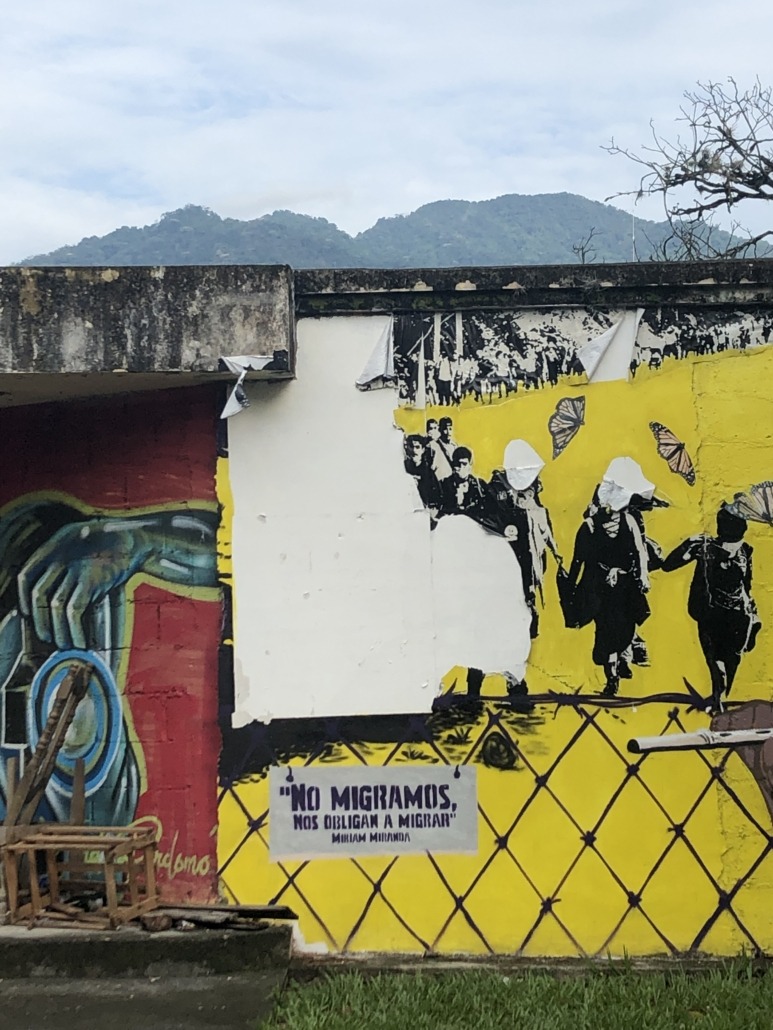

Amelia Frank-Vitale’s new book examines the young community in Honduras.
As an anthropologist and long-time advocate for migrant rights, Amelia Frank-Vitale said there is a “violence to the ordinariness” of deportation.
“[Industrialized] countries are doing a lot to push their borders further and further from … [their] actual geographical boundaries,” Frank-Vitale said. “In so doing, these countries are trapping people in cycles of immobility [and forcing] return to the places that they tried to flee.”
Frank-Vitale’s book, “Leave If You Can: Migration and Violence in Bordered Worlds,” illustrates this commonplace violence by documenting how Honduran youth navigate life after deportation in urban Honduras and cities such as San Pedro Sula. Frank-Vitale will be discussing the immigration crisis at the Los Angeles Times Festival of Books.
After immersing herself in Honduran culture and communities, Frank-Vitale said she started to feel an obligation to honor the subjects whose lives she studied. So, she decided to write a book.
“I really felt like it was my duty to them to follow through on what I had promised them and make this book happen, to share their stories that they shared with me, with the idea that the world might understand something better,” Frank-Vitale said.
Frank-Vitale said she placed an ethnographic attention on the consequences of United States politics. The time she spent in migrant communities allowed Frank-Vitale to experience similar emotional highs and lows as the residents.
“[The subjects] are dealing with a lot of fear [and] a lot of heartbreak. The ever-present possibility of violence is very much at the forefront,” Frank-Vitale said. “They are also falling in love and having babies and making jokes and trying on new clothes and cooking their favorite foods and living full lives.”
As an assistant professor of anthropology at Princeton University, Frank-Vitale has long been involved in immigrant rights work in the U.S. and Mexico. While pursuing a master’s degree, she worked in Oaxaca, Mexico, as a labor and community organizer in migrant communities. During her two-year residency in Mexico, she studied transit migration around the U.S.-Mexico border.
Soon after, Honduras became her primary focus.
“I spent a long time just learning, listening [and] being in the place where the people were … years and years before I ever thought I would be interested in or have the right to write anything,” Frank-Vitale said.
In addition to focusing on urban life, Frank-Vitale wanted the book to illustrate that the violence enacted by the “immigration regime is unavoidable right now.”
“Even when we have a government [that] is less gleeful about inflicting harm on immigrants, often what that has looked like is still doing violence to a lot of people, but just keeping it out of sight,” Frank-Vitale said. “[It’s] outsourcing that terror and outsourcing that violence so that it happens far from view before people ever have a chance to set foot on U.S. soil.”
Estefania Castañeda Perez, an assistant professor of political science and international relations at USC and a colleague of Frank-Vitale, said violence is only one part of the book’s focus.
“The problem with these stories that only depict migrants as victims is that, even though sometimes [they] are meant to humanize or shine light into the challenges that asylum seekers endure, they often end up putting migrants into a box of … vulnerable people that don’t have agency,” Perez said. “But what I appreciate about [Frank-Vitale’s] work is precisely that she has a very human, humanistic understanding of the process of migration.”
“Leave If You Can” is Frank-Vitale’s first book, building on her 2020 dissertation. She likened the project to a puzzle, as she developed a writing process while trying to tell the stories of the people she studied.
“When I would get stuck in a moment of not knowing what the next step is, or how to get out of a particular passage I was working on, I would go back to my notes,” Frank-Vitale said. “I would go back to the people.”
Kate Marshall, Frank-Vitale’s editor at the University of California Press, said that this element of humanity is what made the book so special for her.
“Amelia does a really good job of synthesizing contemporary conversations about migration and immigration, and framing what is original and unique about her work in very clear, accessible prose,” Marshall said.
Lauren Heidbrink, a professor of human development at CSU Long Beach, became colleagues with Frank-Vitale through work conferences while Heidbrink was researching Central American migration in Guatemala. Heidbrink said the book questions the standard understanding of deportation.
“Until recently, there have been ideas that when people are deported, they are left out and not able to access the state [they are being deported from]. That is the end of the story,” Heidbrink said. “But the story continues. People’s lives continue … one of the things that [Frank-Vitale’s] work intervenes in is really following people over time and seeing what happens following deportation.”
With this book, Frank-Vitale hoped to illustrate the regularity of migration and challenge the criminalizing language surrounding it. According to her, migration is an act of human instinct — to seek refuge when “things at home are untenable.” Although the book is now written and published, and Frank-Vitale is back in the U.S., she said she doesn’t believe she will ever truly leave Honduras.
“I still feel very connected to the communities I was in,” Frank-Vitale said. “I go back to Honduras from time to time, and back to Mexico from time to time. It feels like an ever-evolving and shape-shifting world. … Being engaged in [the migration] process and in that community is something that doesn’t end because I’ve finished the book.”
Frank-Vitale will be a panelist for “The Human Cost: The Immigration and Refugee Crisis in America and Beyond” at the L.A. Times Festival of Books on Saturday at 4:30 p.m. at Newman Recital Hall.