Punk icons turn up the mic on inclusivity
Punk for the People, vol. 2 taught the audience about punk’s significance today.
By FELIX HWANGBO
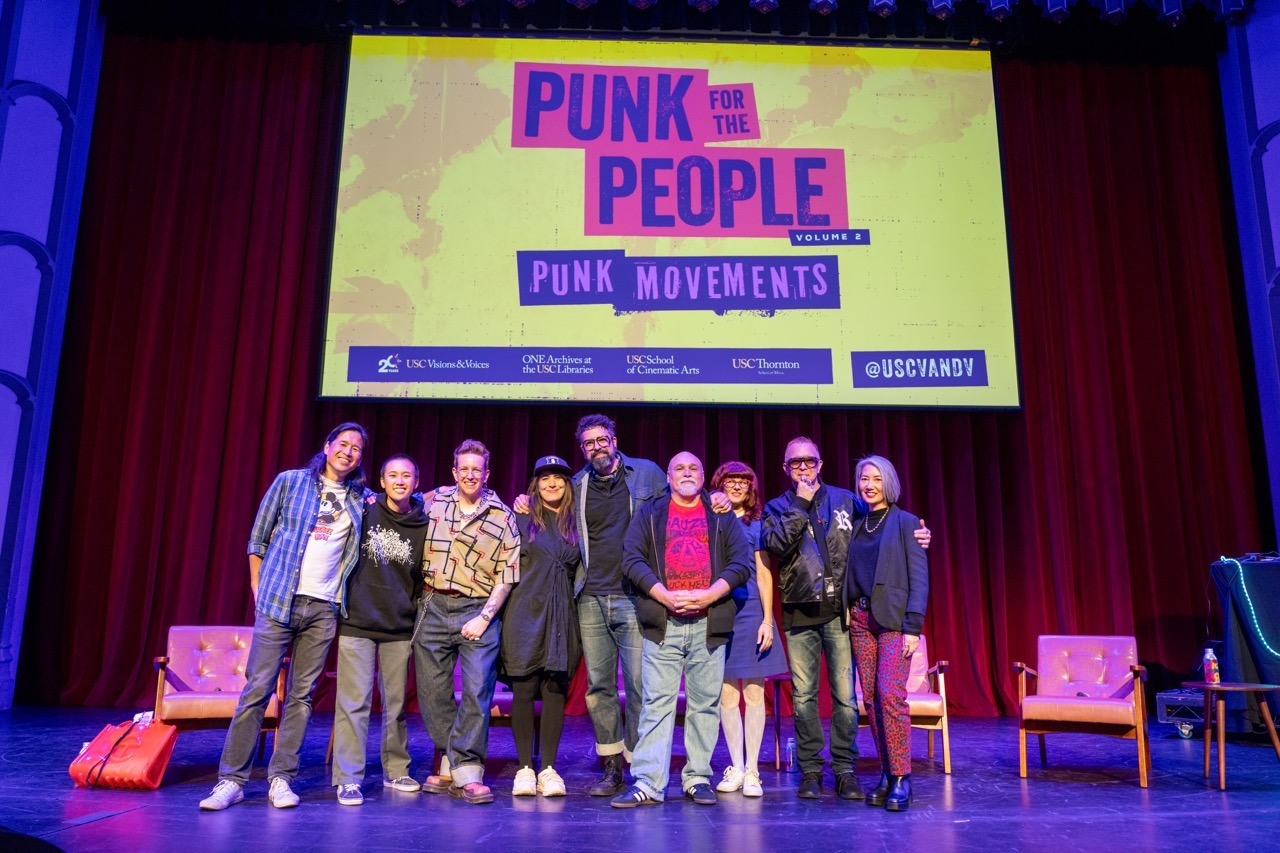

Punk for the People, vol. 2 taught the audience about punk’s significance today.
Punk music might conjure images of rebellious artists wearing ripped clothes and leather jackets with spiked, brightly colored hair, making aggressive music. In other words, chaos.
Punk for the People, vol. 2, a panel event held in Bovard Auditorium on Tuesday, looked to prove that image isn’t all punk is. They showed that punk movements carry deep messages still relevant in today’s society.
Presented by USC Visions and Voices, the panel event featured some of the most influential artists in the punk scene, including Kathleen Hanna, frontwoman of Bikini Kill and Le Tigre. She said that as a woman leading a band in the ’90s, she did not always feel welcomed.
“We want to see more girls on stage, we want to see more, we want to hear more,” Hanna said. “There were a lot of women who always made punk music, who made music in general, who were erased.”
Hanna has championed female empowerment throughout her career. It was a consistent effort for her to make women’s role more prominent in the punk world, Hanna said, something she did through the riot grrrl movement, an underground feminist punk movement focused on challenging social norms for women as well as patriarchy in the ’90s in Olympia, Washington.
Thus, Hanna decided to take on the challenge herself of marking the presence of women in the world of punk.
“I started doing zines, and I put out shows, and I did a lot of behind the scenes stuff because in the ’90s, it was still really weird to be a woman in a band,” she said.
Martin Sorrondeguy, singer for Los Crudos and Limp Wrist as well as a filmmaker, said he encountered punk music in his childhood through his mother, who was a big fan of punk music. He said despite being initially startled by the aesthetics of the punk movement in his childhood, he felt a strong appeal to the genre.
“It was The Cramps, and I remember being in the safety of my home and feeling scared watching. I was still in grammar school, and I was like, ‘What am I watching?’” Sorrondeguy said. “I was like, ‘I don’t know what this is,’ but it was one of those moments that I felt started pushing me into this.”
Sorrondeguy said when he first started his career with his band and gained recognition for his music, he received a mixed reception, including positive feedback and support, but also criticism that his music was often loud and chaotic. Still, he said when people started learning the lyrics to his songs, he felt like he was making a connection to his community.
“Other young Latino kids [were] identifying with what we were doing and what we were saying,” Sorrondeguy said. “This kid comes to me and goes, ‘My grandfather loves your lyrics but hates your music,’” Sorrondeguy said. “I’m okay with that. Like, get down with the lyrics.”
Bruce LaBruce, a queercore icon, said he found community and acceptance in the punk scene that, as a gay man, was hard to find in other places.
“In the early ’80s, we just didn’t feel represented. We didn’t feel like we had a community,” LaBruce said.
The specific punk movement that LaBruce was part of was called queercore. The culture of queercore is marked by its exploration of sexual and gender identity as well as LGBTQIA+ rights through its lyrics, inclusivity and aesthetics.
James Spooner, a graphic novelist, tattoo artist and co-founder of the Afropunk Festival, said he was inspired by Afropunk growing up, and spoke about idolizing Maurice Mitchell from the band Cipher, who spoke up against social issues such as racism. Afropunk is a movement that advocates for diversity and inclusivity.
“It instantly hit, because he’s very political, singing about the middle passage and slavery as the only Black person in the room,” Spooner said. “A couple years later when [the band] The Zone came out, I started screaming when the African community started to play, it was like a beautiful moment.”
The panel shared experiences that are each unique and different, but united by one desire to increase diversity and awareness in not only the punk community but in society.
“We had lost a lot of people to AIDS and drugs and suicide, and so we were having our own depressions in our apartments and not talking about it,” Hanna said. “We did not know how to fucking communicate … so I just started doing electronic music.”