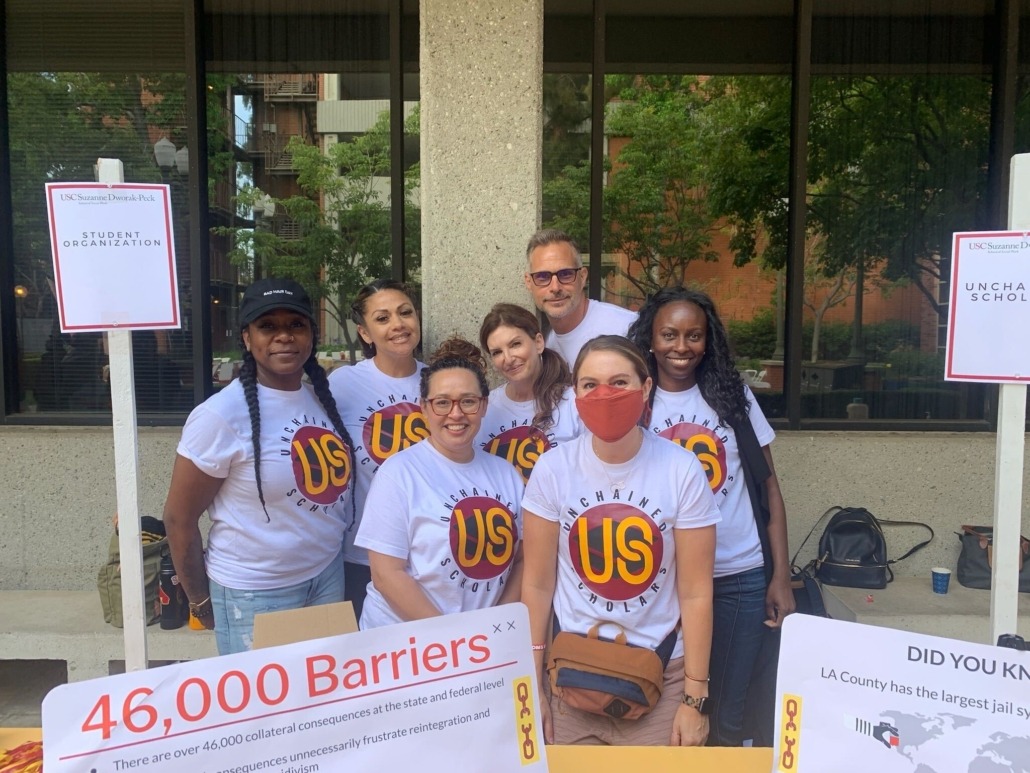
James DeBacco spent 30 years of his life in prison. After his release, he lived on Skid Row for six months before finding stable housing. Now, the formerly incarcerated student works as a Veterans Services Officer for Los Angeles County while pursuing his doctorate in social work at USC.
Susan Hess, a professor of social work, helped found the Unchained Scholars program in 2018 to help students like DeBacco and serves as the group’s faculty advisor. DeBacco, now the president of the Unchained Scholars program, said the goal of the support group is to empower students to not view their past as a barrier to future success.
“Just because somebody has experience being justice-involved … doesn’t mean that those people are rotten,” DeBacco said. “It doesn’t mean that those people can’t perform well in higher education.”
Daily headlines, sent straight to your inbox.
Subscribe to our newsletter to keep up with the latest at and around USC.
The group meets once or twice a month over Zoom to help each other navigate challenges in the educational process — like the difficulty of applying for a social work license with a criminal record — and provide a sense of community for formerly incarcerated students.
Support was ‘life-changing’ for DeBacco
DeBacco credited the Unchained Scholars program with helping him get to where he is today.
DeBacco said that while in prison, he promised himself he would pursue two goals upon his release: to live his life the right way and to honor the people he harmed prior to his arrest.
To achieve these goals, DeBacco enrolled in school. He began at Los Angeles City College and earned a bachelor’s degree in rehabilitative science at CSU Los Angeles in 2022.
After graduating, DeBacco said he was unsure if he would fit in at a school like USC, but the way Hess, and Unchained Scholars embraced him has been “life-changing” even before starting at USC.
“Coming out of prison and not knowing anything about what it takes to reintegrate back into society, and not really knowing how [Hess] would look at someone like me, and to be embraced, without question, not only by her but by the rest of the students at the time [drove me to attend USC],” DeBacco said.
After earning a master’s degree in social work from USC in 2024, DeBacco is now in his second year of USC’s Doctor of Social Work program.
Community helped Nguyen stay in school
As a formerly incarcerated student, Wynn Nguyen didn’t feel like she belonged when she began studying at USC.
“A lot of times coming onto campuses, especially like USC, it’s intimidating,” said Nguyen, a graduate student in the Rossier School of Education. “We get lost, and we feel like we don’t belong here.”
Nguyen said she has struggled with addiction throughout her life, and has been incarcerated three times as a result. After trying to attend college but failing out because she did not connect with the campus community, she said the Unchained Scholars program and a similar program called Project Rebound at CSU Long Beach helped her escape this cycle.
“[Project Rebound] is where I found connection, support [and] community; and I realized that I wasn’t alone in this,” Nguyen said. “It was just talking about things, helping each other and supporting.”
One of Nguyen’s professors at Long Beach connected her with Hess, who helped introduce her to the Unchained Scholars program at USC. Nguyen said the program showed her that earning a doctorate degree is possible for formerly incarcerated students, giving her a sense of belonging and empowerment.
“There are so many people that are formerly incarcerated, but a lot of us won’t identify as it, because a lot of times we’re judged,” Nguyen said. “[Unchained Scholars] is for me, it’s really reinforcing that we do belong here, that there’s more of us, and that wanting to provide that community for others, because I know how much it’s helped me.”
‘Trauma doesn’t die’
Hess said the program began as her meeting informally with students who had misdemeanors or felonies on their record. In the meetings, Hess said she coached the students on how to describe their past experiences as a strength.
These one-on-one meetings revealed that formerly incarcerated students had inadequate resources and support, Hess said, motivating her to propose a meeting between all interested students to connect with one another.
Following that first meeting, the Unchained Scholars program has grown into an established support group with around 20 to 30 members, according to DeBacco.
Since the group formed in 2018, two former members have died. Hess said that the program and its efforts have continued in memory of these two students and the ongoing struggles formerly incarcerated people face.
“Carceral trauma doesn’t die when you get out of prison,” Hess said. “It’s still with you, so that’s why the support group piece continued.”