NO STRAIGHT ANSWERS
Love isn’t failing — we are, in the ways we hesitate to begin
Modern love has become a system of rules, risk and restraint — but the most radical act is choosing sincerity anyway.

By ANDREW CARDENAS
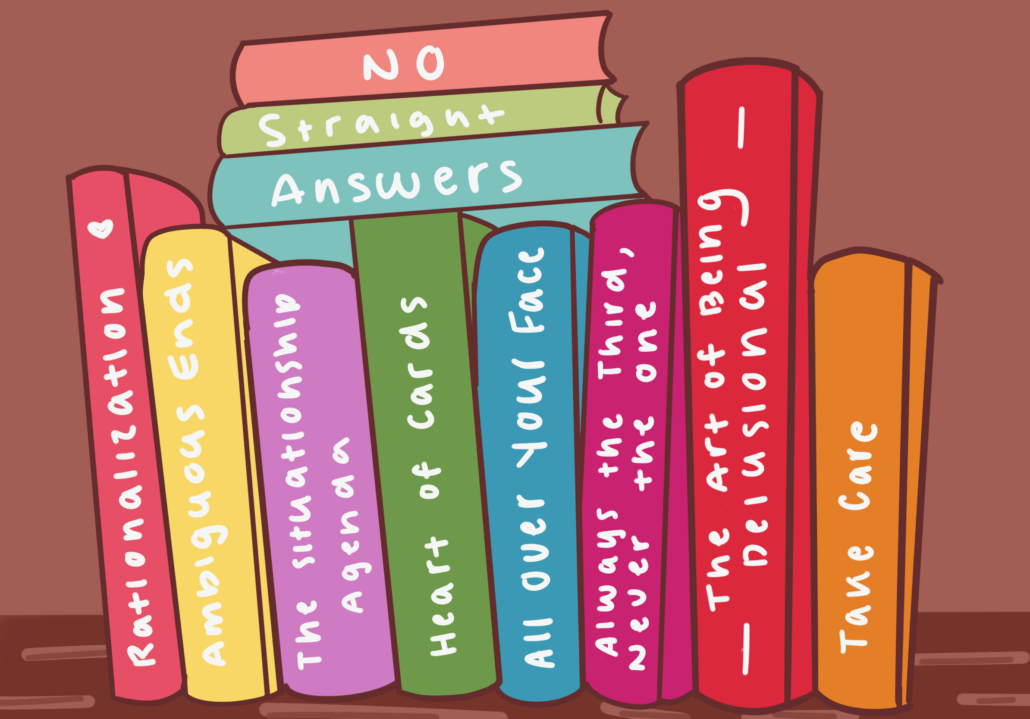

Modern love has become a system of rules, risk and restraint — but the most radical act is choosing sincerity anyway.
It was a Friday night when he told me he was graduating a year early. Standing there confused, there was only one thing I could think to do: go to a party.
In the back of an Uber, on the way to the Arts District, I realized I cared for him more than I’d like to admit, and I had, once again, arrived too late to my own feelings.
Philosopher Amia Srinivasan writes in “The Right to Sex” that desire is never wholly private; it is shaped by the world around us — through what is visible, what is valued, what is normalized and what is made imaginable. That is true for everyone. Our world has normalized the quiet calculus of self-preservation — the instinct to measure, assess and contain our feelings before they ever have the chance to speak.
While dancing to DJ Shih in a crowded loft, I watched people laugh, chat and lean into one another with ease. We are not afraid of love ending; we are afraid of love that doesn’t justify itself. We have turned affection into a legislative body, complete with committees, quorums and veto power. We want guarantees before we give anything away, as if love must be evenly split, carefully portioned and accounted for in advance.
That night, I saw how thoroughly I had been governing my own heart: forming committees on timing, risk and distance, drafting policies on who texts first and who has more to lose. I filibustered my own impulses, delayed every confession and amended my feelings until they were unrecognizable. I had become a one-person government standing tall — politically erect, if you will — and the only bill never passed was the simplest one: honesty.
My whole life, I thought I knew exactly what I wanted: to be the father of the bride, to live a Disney ending — marriage, a big house, animals by the dozen. I knew it all, or thought I did, and everything else became a “mistake” or “almost.”
What if that story is simply wrong? What if a love that lasts one month, one week, even one night of real honesty is not a failed love but a completed one? What if two people can move through each other’s lives unevenly — one leaving, one staying, one ready, one not — and still walk away having given and received something real?
Srinivasan, citing writer Audre Lorde, reminds us that we are taught to distrust our own desires — to treat them as dangerous, excessive or premature.
“We have been raised to fear the yes within ourselves, our deepest cravings,” Lorde wrote in “Uses of the Erotic” in 1978.
But suppressing what we feel does not make it disappear; it only gives it more power.
When I left him for a party, I chose governance over surrender. And in doing so, I chose the belief that love without a future is not worth having.
No matter how much I danced it out, I still couldn’t suppress my feelings for him. Against the grain of every self-protective instinct I own, I called him knowing there were no words left,, because we had said them all. I knew it was over. There was no relief in it — only the quiet weight of having meant something to someone, briefly and fully.
Srinivasan wrote, “There would be heartbreak even in the post-capitalist utopia.” In that sense, heartbreak is not evidence that your campaign failed — it’s simply the cost of having been sincere.
The goal is not to avoid heartbreak, but to be broken by something real. It is the most autonomous thing we can do: choosing connection knowing full well it might hurt, and to choose it anyway. Even when the timing is uneven. Even when one of you is already halfway out the door. Even when the ending is built into the beginning.
We want a world where love is freer, where sincerity is not punished, where our willingness to admit our desires isn’t tabled until the next encounter. Yet we hesitate at the smallest admission. We cannot wait for that world to arrive before we live as if it already exists. The transformation begins in the message we hesitate to send, in the conversation we avoid and in the admission we delay.
The tragedy of modern love isn’t that it ends. Everything ends. It’s that we talk ourselves out of the beginning.
“I am asking what might happen if we were to look at bodies, our own and others’’ and allow ourselves to feel admiration, appreciation, want, where politics tells us we should not,” Srinivasan wrote. “There is a kind of discipline here, in that it requires us to quiet the voices that have spoken to us since birth.”
Those voices tell us to wait, to calculate, to protect, to postpone. But love has never listened — and neither should we. The real political act isn’t to adjourn; it’s to begin. So stop abstaining from your heart — find the courage to start.
Andrew Cardenas is a junior writing about love in all its forms in his column, “No Straight Answers,” which runs every other Wednesday. He is also the DEIA director and Talkin’ Troy editor at the Daily Trojan.